World History
Maat
Maat, one of the most captivating figures in Egyptian mythology, transcends the mere role of a deity. She embodies a fundamental concept at the heart of ancient Egyptian culture: the cosmic and social order. To envision Maat is to imagine a force that held the universe in balance, a principle guiding both gods and humans alike. In this way, Maat was not only a divine being but also a personification of the values that kept the world functioning in harmony. Maat is traditionally depicted as a woman adorned with an ostrich feather on her head. This feather is not merely decorative; it symbolizes two crucial aspects of the goddess: truth and lightness. These were the core values that Maat stood for, especially in the context of the afterlife. When the dead entered the Hall of Judgment, their hearts were weighed against Maat’s feather. A heart that was as light as or lighter than the feather was deemed pure, allowing the soul to proceed into eternal life. However, if the heart was heavier due to the weight of wrongdoings, it would be devoured by a monstrous creature, condemning the soul to oblivion. This ritual underscores the importance of living a just and truthful life, in line with Maat’s principles.
By A Históriaabout a year ago in History
The Arch of Titus: A Monument of Triumph and Legacy in Ancient Rome
In the heart of ancient Rome, near the towering Colosseum, stands an enduring symbol of Roman power and architectural brilliance: the Arch of Titus. Constructed in 81 AD after the death of Emperor Titus, this monument commemorates one of Rome's most significant military victories—the conquest of Jerusalem in 70 AD. Built by the Roman Senate and Emperor Domitian, Titus' younger brother, the arch celebrates the achievements of the late emperor and immortalizes his legacy within the history of the Roman Empire.
By Deji Akomolafeabout a year ago in History
The Sioux
We are shaped by the experiences of those who preceded us. Our ancestors endured, labored, faced challenges, and encountered both deep joy and sorrow. Their moments of insight and creativity have left us a valuable legacy. Reflecting on the history of North America reveals the remarkable and diverse cultures that have thrived on this continent for thousands of years. Among these extraordinary societies are the Sioux, a Native American nation that has historically coexisted with nature. In this article, we will delve into the history, culture, and enduring legacy of the Sioux people, one of the most prominent indigenous civilizations in North America. The Sioux are a Native American nation whose ancestral lands span the modern-day states of Colorado, North and South Dakota, Wyoming, Montana, and Nebraska. Their story began approximately 13,000 years ago, during the tail end of the last Ice Age, when much of North America was still covered in vast sheets of ice. These early ancestors migrated from Asia across the Bering Land Bridge, known as Beringia, and eventually settled in the northern regions of what is now the United States.
By A Históriaabout a year ago in History
The Roman Lighthouse of Dover: A Beacon of History
Nestled on the southeastern coast of England, the Roman Lighthouse of Dover, also known as the Pharos of Dover, stands as a testament to the ingenuity and architectural prowess of the Romans. Dating back to 46–50 AD, during the reign of Emperor Claudius, this ancient structure is not only the oldest surviving lighthouse in England but also one of the oldest in the world. Despite the passage of nearly two millennia, the lighthouse remains a significant landmark, illuminating the maritime history of England and the Roman Empire.
By Deji Akomolafeabout a year ago in History
Sutton Hoo: The Enigmatic Anglo-Saxon Burial Ground
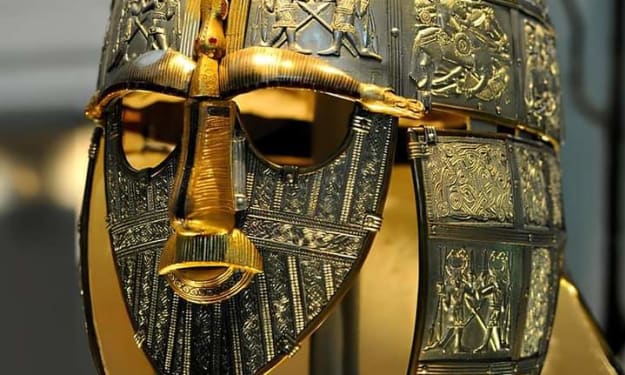
In the summer of 1939, as the shadow of war loomed over Europe, a discovery was made in the quiet Suffolk countryside that would forever alter our understanding of England’s early medieval past. The Sutton Hoo burial site, located near Woodbridge, Suffolk, revealed a treasure trove of Anglo-Saxon artifacts that astounded archaeologists and historians alike. This 7th-century ship burial was not only a testament to the craftsmanship and wealth of the time but also an intriguing mystery, with the absence of human remains leaving scholars to speculate on the identity of the individual buried there.
By Deji Akomolafeabout a year ago in History
Raahe Wanha Herra: The Old Gentleman of Raahe – The World's Oldest Surviving Diving Suit
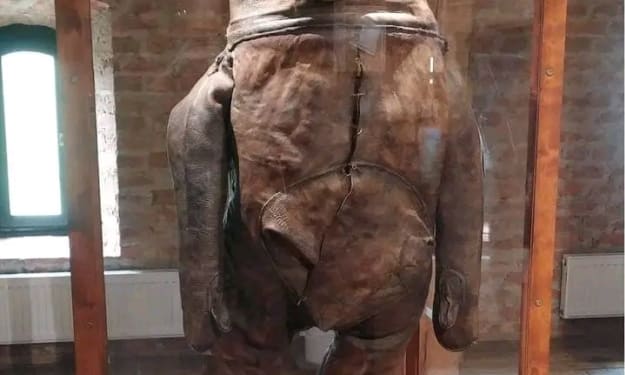
In the small town of Raahe, Finland, an extraordinary relic from the 18th century is carefully preserved in the Raahe Museum—a relic that holds the distinction of being the world’s oldest surviving diving suit. Known affectionately as the “Raahe Wanha Herra” or “The Old Gentleman of Raahe,” this unique piece of maritime history offers a fascinating glimpse into the early innovations of deep-sea exploration. Constructed from calfskin and waterproofed with a mixture of pork fat, tar, and pitch, the suit is a testament to the ingenuity of its time, when venturing beneath the waves was both dangerous and mysterious.
By Deji Akomolafeabout a year ago in History
Atlit Yam: A 9,000-Year-Old Window into the Neolithic Past
Submerged beneath the waters off the coast of Atlit, Israel, lies one of the most remarkable archaeological discoveries of our time: Atlit Yam, a 9,000-year-old Neolithic village. This ancient settlement, now resting 8 to 12 meters underwater, provides a detailed glimpse into the lives of people during the final Pre-Pottery Neolithic period, which dates back to between 6900 and 6300 BC. Atlit Yam, which spans around 10 acres, is not only an impressive testament to human ingenuity and survival but also a treasure trove of information about early agriculture, freshwater management, and social structures.
By Deji Akomolafeabout a year ago in History
Why Did This WWII Tank Float in the Air?
They say necessity is the mother of all invention, and no time in human history proves this maxim more than during periods of war. Beyond the heavy artillery, the advanced weaponry, and the outnumbering of troops, there’s something equally powerful that has decided the outcome of many conflicts: out-thinking the enemy. History is riddled with examples where deception, strategy, and psychological warfare have shifted the tide of battle just as much as bullets and bombs.
By Marveline Merababout a year ago in History
The Ancient Origins of Impalement: The Assyrians and the Birth of a Brutal Punishment
When one hears the word “impalement,” many might immediately think of Vlad the Impaler, the 15th-century ruler of Wallachia who used this brutal technique to terrorize his enemies and defend his kingdom against the Ottoman Empire. However, the history of impalement stretches back much further, far beyond Vlad Dracula’s reign or the Ottomans. In fact, the Assyrians, one of the most powerful and advanced civilizations of the ancient Near East, were the first to use impalement as a method of punishment and psychological warfare on a large scale. This gruesome practice, employed from around the 9th to the 7th centuries BCE, became one of the defining features of Assyrian rule, and its legacy would echo throughout history.
By Deji Akomolafeabout a year ago in History