
Why Did This WWII Tank Float in the Air?
The Invasion That Never Was: How Inflatable Tanks, Fake Armies, and Deception Turned the Tide of World War II

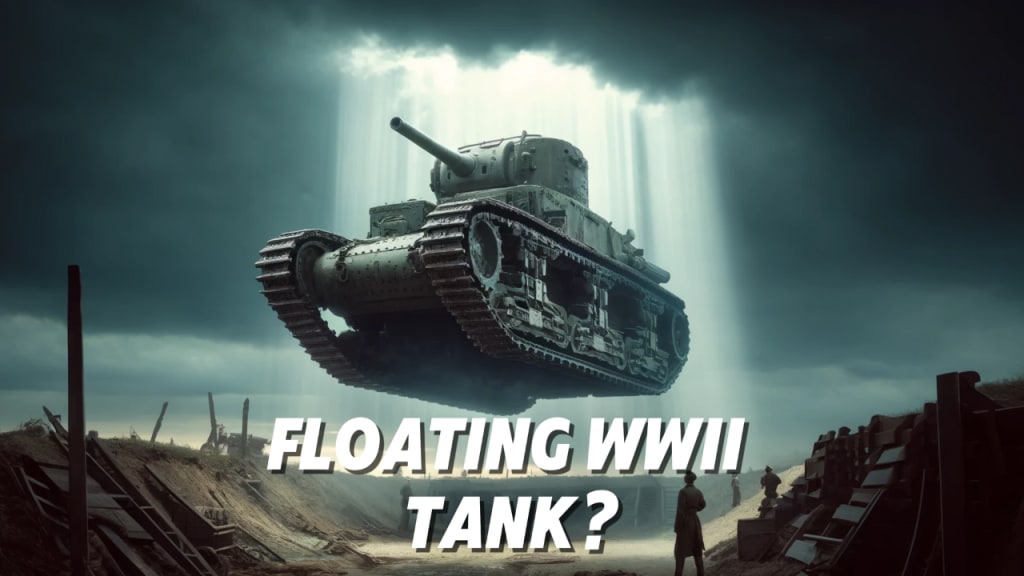
They say necessity is the mother of all invention, and no time in human history proves this maxim more than during periods of war. Beyond the heavy artillery, the advanced weaponry, and the outnumbering of troops, there’s something equally powerful that has decided the outcome of many conflicts: out-thinking the enemy. History is riddled with examples where deception, strategy, and psychological warfare have shifted the tide of battle just as much as bullets and bombs.
The Second World War was no different. While it gave the world radar, night vision goggles, jet engines, and the devastating nuclear bomb, the war also birthed one of the most brilliant—and improbable—deceptions ever executed: convincing the German high command that an entire army, armed to the teeth and poised to invade France, existed when, in reality, it was nothing more than a figment of Allied imagination.
A Picture of War and the Trickery of Tanks
Take a look at an ordinary WWII photograph: an M4 Sherman tank, a three-ton support lorry, and other tools of war stationed strategically, ready to take on the enemy. Imagine the view from above—German reconnaissance planes would see this image and report back that the Allies had amassed an impressive force. The Nazis would likely think twice before storming what seemed like an impenetrable defense of military vehicles and tanks.
But the reality? These "imposing war machines" were nothing more than giant balloons—inflated with nothing but rubber and air. Far from actual tanks and lorries, these were the products of Operation Fortitude South, part of an elaborate scheme to trick the Germans into believing that an Allied force was far larger and better-equipped than it really was.
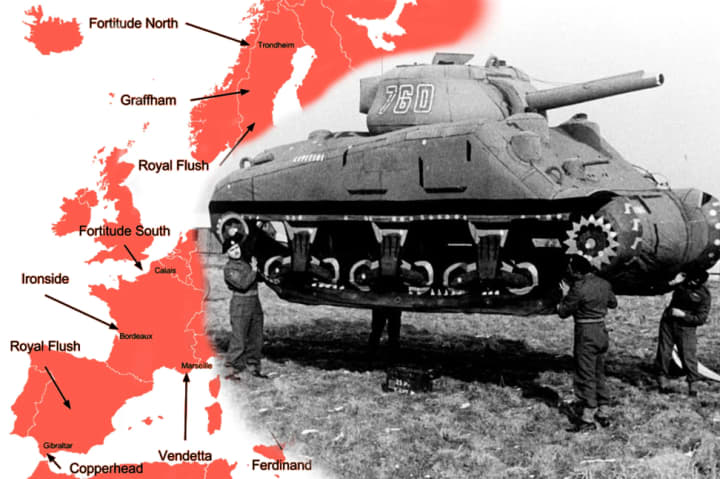
This deception, and others like it, have gone down in history as some of the most ingenious military tactics ever used.
Military Deception: Outthinking the Enemy
Camouflage and deception had long played a role in military tactics, but World War II took the art of out-thinking the enemy to unprecedented heights. These weren’t just random acts of trickery but coordinated efforts involving entire armies of artists, engineers, and strategists. While the Germans were known for their military prowess, the Allies mastered the art of psychological warfare.
During World War I, military deception was already in play, and both sides used inventive tactics to gain an upper hand. For instance, one famous trick involved a camouflage tree. This wasn't just any tree—after carefully selecting a real tree in no man's land (the territory between enemy lines), artists and engineers created a perfect replica of the tree using metal, canvas, and paint. Under the cover of darkness, soldiers would replace the real tree with the fake one, which was hollow inside, allowing soldiers to hide in plain sight and spy on enemy movements. Ingenious, right?
And while such tricks were effective, the vast expanse of the ocean presented a unique challenge. How could one conceal a massive warship from enemy forces in the open sea? The answer came in the form of dazzle camouflage—a stroke of brilliance by British artist Norman Wilkinson.
Dazzle Camouflage: Optical Illusions on the High Seas
Imagine painting a ship in a way that made it look like a walking optical illusion. That's precisely what dazzle camouflage achieved. Instead of blending into the environment, it used bold patterns and geometric shapes to make it incredibly difficult for enemy ships and submarines to determine a vessel’s speed and direction—crucial elements for launching an effective attack. Thousands of ships were “bedazzled” in this way during the First World War, and the practice was even revived during the Second World War.
But as the war progressed, deception techniques became even more sophisticated.
The Plot Thickens: Operation Fortitude and the Art of Deception
By 1944, the Allies were preparing for one of the most defining moments of the war: the invasion of German-occupied France. It was no secret that this invasion was coming—Hitler and his generals knew the Allies would attack soon. What remained unclear was where the invasion would take place.
Several locations were in consideration: Brittany, the Cotentin Peninsula, Normandy, and Pas-de-Calais. While Pas-de-Calais made the most strategic sense—being closest to the south coast of England and thus offering a shorter route for an invasion—it was also the most heavily fortified. Normandy, though further away, was less defended and offered an ideal entry point for a deeper push into France.
Why Did This WWII Tank Float in the Air? You'll definitely enjoy this!
However, storming Normandy head-on would be disastrous, with the entrenched Germans ready to fend off any assault. The solution? Convince Hitler that the Allied invasion would occur at Pas-de-Calais while secretly preparing to storm the beaches of Normandy.
Inflatable Tanks, Fake Landing Craft, and Radio Signals
This is where the brilliance of Operation Fortitude South came into play. The goal was to mislead the German forces into thinking that Pas-de-Calais was the intended invasion point. And to do this, the Allies needed more than just leaked intelligence—they needed to create an entirely fake army.
The result? Thousands of inflatable tanks, fake landing craft, and wooden aircraft were constructed and positioned across southeastern England, visible to German reconnaissance planes. These fake war machines were convincing enough from the air to fool the Germans into believing a massive invasion force was being gathered near Dover, ready to storm Pas-de-Calais.
To further support this illusion, hundreds of thousands of coded radio messages were sent, mimicking the type of communications that would be expected from an army gearing up for battle. Double agents—whom the Germans believed were loyal to them—were activated to feed false information, further solidifying the ruse.
Patton and the Fake Army That Fooled Hitler
But the Allies didn’t stop there. In a move that could only be described as genius, General George Patton—one of the most feared and respected Allied commanders—was put in charge of this fictitious army, dubbed the First United States Army Group (FUSAG). Hitler had immense respect for Patton, considering him the most likely leader of an invasion of France, and so having Patton “command” this imaginary army added significant weight to the deception.
Though it may seem wasteful to use a military mastermind like Patton on an army that didn’t even exist, it actually worked perfectly. At the time, Patton had been temporarily sidelined due to an incident where he slapped two battle-shocked soldiers. By putting him in charge of FUSAG, the Allies used his fearsome reputation to reinforce the idea that an invasion at Pas-de-Calais was imminent.
To top it off, the Allies even staged a German POW’s “escape” from captivity, allowing him to be led through what he believed was southeastern England swarming with Allied troops, tanks, and supplies. In reality, he had been shown the fake army—and once he returned to Germany, his firsthand account convinced the Nazis that the invasion at Pas-de-Calais was indeed forthcoming.
The D-Day Deception: How It Worked
Operation Fortitude South was nothing short of a masterstroke. When the Allies launched their real invasion of Normandy on June 6, 1944—now famously known as D-Day—the Germans were caught completely off guard. Despite heavy casualties, the invasion succeeded in giving the Allies a foothold in mainland Europe.
What’s more, the deception was so convincing that even after the Normandy landings, Hitler and his commanders continued to believe that a second, larger invasion would come at Pas-de-Calais. They maintained heavy defenses there for months, allowing the Allies precious time to establish themselves in France and push the Germans back.
In the end, Operation Fortitude saved countless lives, prevented further bloodshed, and ensured the success of one of the most important operations in World War II.
Conclusion: The Legacy of Military Deception
Military deception has always been an essential component of warfare, but few operations have been as bold, creative, and successful as Operation Fortitude. From inflatable tanks and fake landing craft to carefully orchestrated radio communications and false intelligence, the Allies demonstrated that out-thinking the enemy could be just as powerful as out-gunning them.
The success of D-Day and the subsequent Allied victories in Europe owe much to the psychological warfare waged through these deception techniques. By the time Hitler realized he had been fooled, it was too late—the Allies had already secured a critical foothold in Europe, and the tide of the war had shifted in their favor.
As we look back on this extraordinary chapter in history, we are reminded that sometimes, the most powerful weapons are those that exist only in the mind.
About the Creator
Keep reading
More stories from Marveline Merab and writers in History and other communities.
Why Was There a War Over Dinosaur Bones? The Bone Wars
When you hear the phrase “thunder lizards,” what comes to mind? Probably some massive, lumbering reptile that shakes the earth with every step. And you'd be right—well, mostly. The Brontosaurus, or "thunder lizard" in Greek, was one of the largest creatures to ever roam the Earth, measuring around 23 meters long with a neck to match and a tail that seemed to go on forever.
By Marveline Merababout a year ago in History
Alexander the Great: Conqueror of Empires
Alexander was born in 356 BCE in the ancient kingdom of Macedon, a rugged land of warriors and kings. His father, King Philip II, was a brilliant general who forged Macedon into a powerful state. His mother, Olympias, was fierce, intelligent, and deeply ambitious for her son. From the beginning, Alexander’s life was wrapped in stories of destiny. Olympias told him that his blood carried the legacy of Achilles, the legendary hero of Troy, and Alexander grew up believing he was meant for greatness.
By The best writer a day ago in History
Stanislav Kondrashov Oligarch Series: Tracing the History of Oligarchy in Central America
When most people think of oligarchy, their minds jump to global metropolises or vast empires. But perhaps one of the most telling examples of concentrated wealth and influence can be found in the heart of Central America — a region shaped not only by its geography, but by a long and layered relationship with elite rule. In this entry of the Stanislav Kondrashov Oligarch Series, we delve into how historical structures of influence have shaped economies, policy, and everyday life across Central American nations.
By Stanislav Kondrashov7 days ago in History


Comments
There are no comments for this story
Be the first to respond and start the conversation.