
Achilles and Patroclus: A Tale of Love, War, and Destiny
A Legendary Friendship Forged in Love and Tragedy

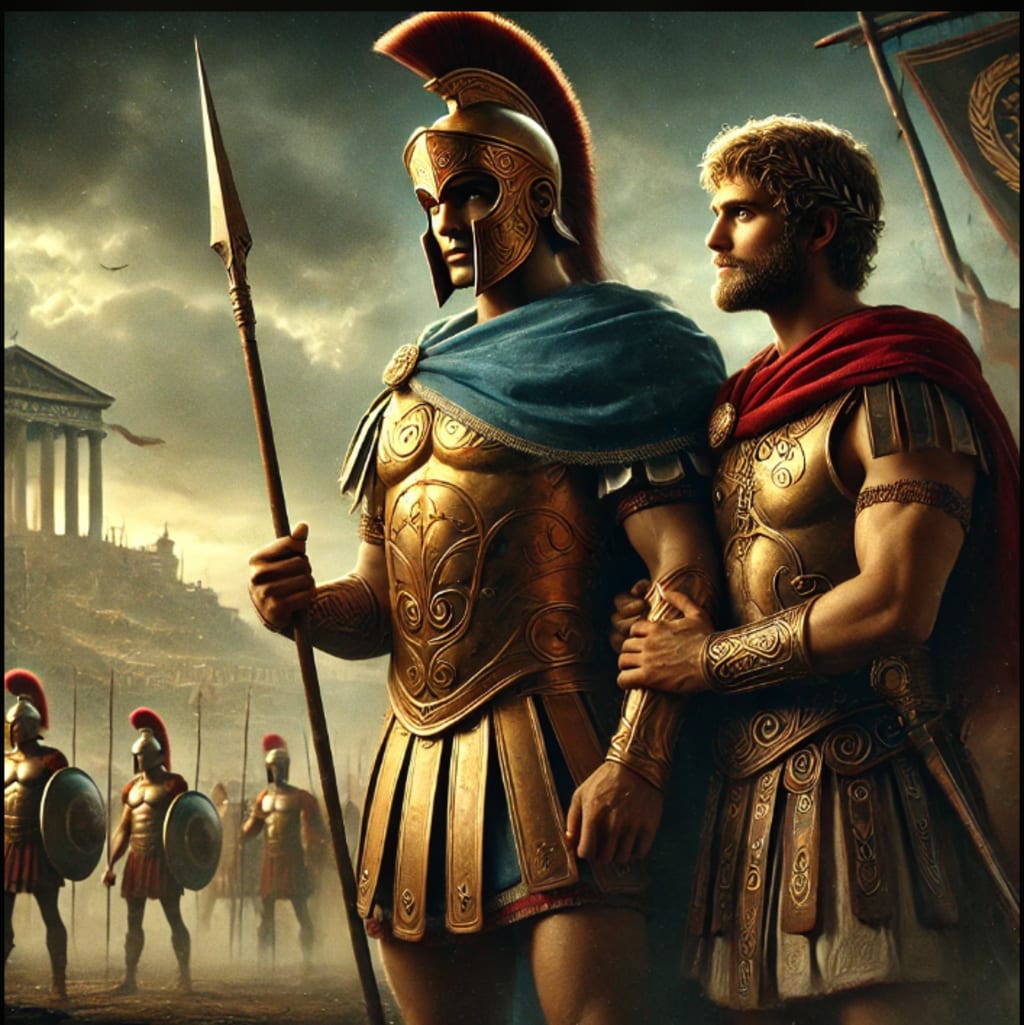
Achilles, the legendary Greek hero, was a demigod destined for greatness from the moment he was born to Thetis, a sea nymph, and King Peleus. Like the renowned Heracles before him, Achilles was entrusted to the wise centaur Chiron, who taught him hunting, music, and medicine. However, one of the most significant figures in Achilles' life was his closest companion, Patroclus. Unlike Achilles, Patroclus was mortal, born with no divine parentage or lofty prophecies. Despite their differences in origin, their bond transcended the limits of mortality, and they loved one another unconditionally.
Their legendary story unfolds during the Trojan War, a conflict sparked when Helen, the wife of Menelaus, a Greek king, vanished to Troy with Paris, a Trojan prince. This act ignited the flame of war, and soon Greece assembled a mighty army to retrieve Helen. Among them was Achilles, whose destiny was intricately tied to the outcome of the war. He prepared for battle with his horses, born of the west wind, and a spear forged from the peak of a mountain. But Achilles was never alone in this venture—Patroclus stood by his side.
As they sailed with over a thousand ships to Troy, the Greeks found themselves up against the formidable Trojan forces led by Prince Hector, son of King Priam. However, even Hector’s strength was no match for Achilles, whose unparalleled skill turned the tide in favor of the Greeks. Many believed Achilles was invincible, with myths swirling that his mother had dipped him in the River Styx or bathed him in the immortal nectar of ambrosia. Yet, despite his prowess, the war stretched on for nine long years, and internal conflicts threatened the Greek camp.
Tensions boiled over when Achilles captured a woman named Briseis, only for King Agamemnon, the leader of the Greek army, to seize her out of envy. This act enraged Achilles, who withdrew from the fight, leaving the Greeks vulnerable. As the Trojans advanced, Patroclus witnessed the devastation and pleaded with Achilles to let him borrow his armor. Patroclus believed the mere sight of Achilles on the battlefield would send the Trojans running. Reluctantly, Achilles agreed but warned Patroclus not to approach the gates of Troy, where the god Apollo stood guard.
Clad in Achilles’ armor, Patroclus led the Greek forces and, for a brief moment, felt invincible. He pushed the Trojans back, but as he neared the gates of Troy, Apollo intervened, striking him down and leaving him vulnerable. Hector seized the opportunity and killed Patroclus, taking Achilles’ armor as a prize. Devastated by the loss of his beloved companion, Achilles was consumed with guilt and grief. He vowed not to bury Patroclus until he avenged him.
Achilles threw himself back into the battlefield with a fury that left a trail of destruction. He soon faced Hector, now wearing the armor that had once belonged to Achilles. The two warriors clashed, but Achilles, knowing the armor’s weak spots, delivered a deadly blow. Yet, even in his victory, Achilles found no solace. His grief for Patroclus was insurmountable, and he desecrated Hector’s body, dragging it behind his chariot—a heinous act that defied all sacred customs of war.
That night, the ghost of Patroclus appeared to Achilles, warning him of his own impending death and asking that their bones be laid to rest together. Achilles agreed, but when he tried to embrace Patroclus, the apparition vanished. Meanwhile, Priam, the Trojan king and Hector’s father, was equally tormented by grief. Desperate for closure, he approached Achilles, humbly begging for his son’s body. Priam’s plea touched Achilles, and the two shared a moment of deep sorrow, weeping together for their lost loved ones.
Achilles returned Hector’s body to Priam and prayed to Patroclus for forgiveness. With little left to lose, Achilles continued to fight, defeating many of the greatest warriors of the age. However, as Patroclus had foretold, Achilles' own death loomed near. Paris, with an arrow guided by Apollo, struck Achilles in his vulnerable heel, ending his life.
In the aftermath of the war, Achilles and Patroclus were laid to rest together, their remains mingled for eternity. The Greeks went on to win the war, but both sides suffered the loss of their greatest heroes. Their lives, marked by love, vengeance, and tragedy, became immortalized in legend, forever intertwined in the annals of history. The story of Achilles and Patroclus reminds us of the devastating costs of war and the enduring power of love, even amidst the heartbreak of conflict.
About the Creator
THiNK
Think - Your go-to destination for exploring captivating mysteries, insightful psychology, intriguing facts, and the latest news. Our mission is to spark curiosity and inspire learning. Join us as we uncover the unknown!
The First Rainbow Baby
Pitter-patter, pitter-patter. The rain fell in rhythmic splatters, slowly slowing, but still constant. Mira rolled onto her side pulling the blanket tight against her ears, but still she could hear chitter-chatter and scurrying feet of the creatures that refused to sleep in the lower decks.
By A. J. Schoenfeld3 days ago in Fiction



Comments (3)
well written
Your writing is always engaging.
Loved your take on this topic.