
The Last Day of the Dinosaurs
Last Stand Before Extinction..

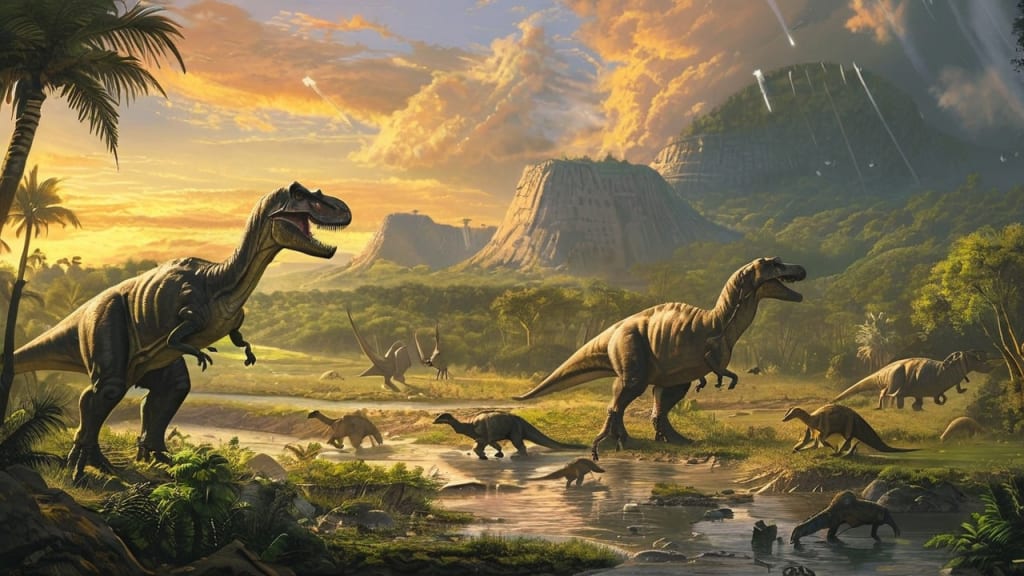
In a time long before humans roamed the Earth, 66 million years ago, the age of the dinosaurs was at its zenith. For an astonishing 160 million years, these magnificent creatures dominated the planet, evolving into a diverse array of forms that filled every ecological niche imaginable. From the towering giants that grazed on treetops to the swift predators that ruled the ground, dinosaurs thrived in environments that stretched across continents.
### The World of Dinosaurs
The Earth during the late Cretaceous period looked significantly different from today. The continents, having drifted apart from the supercontinent Pangaea, were beginning to take on their modern shapes. North and South America were fully separated, while Africa, Australia, and Greenland were recognizable but still evolving. The climate, though generally warmer than today, was marked by fluctuations, with icy poles and seasons that brought harsher winters in some regions.
The Cretaceous period was notable for its lush vegetation, which included the emergence of flowering plants. These angiosperms spread rapidly, creating new habitats and food sources that spurred the evolution of both plant and animal life. Conifers and ginkgo trees thrived alongside the newly developed herbs, while a vibrant array of insects, including butterflies and bees, began to pollinate these flowering plants. This new food web supported various herbivorous dinosaurs, which in turn allowed carnivorous species to flourish.
Among these creatures was the **Alamosaurus**, an enormous herbivore that weighed up to 38 tons and stood nearly 29 meters tall. Its sheer size required it to consume vast amounts of vegetation daily, leading a nomadic lifestyle as it searched for fresh greens. In stark contrast, the smallest dinosaur of the time, the **Ogdenavis**, measured no larger than a modern hummingbird, showcasing the incredible diversity within dinosaur species.
### A Fateful Morning
As the sun rose on that fateful day, herds of Alamosauruses grazed peacefully in the rich flora of the Yucatán Peninsula. Nearby, a **Tarbosaurus**, one of the largest predatory dinosaurs of the late Cretaceous, prowled the floodplains of what is now Mongolia, its keen senses alert for prey. Meanwhile, a **Pachycephalosaurus** ambled through North America, its thick, bony dome providing both defense and a means to assert dominance in conflicts with rivals. A mother **Ankylosaurus** carefully guided her four hatchlings through the dense underbrush, oblivious to the impending cataclysm that would change the world forever.
However, the skies were about to betray them. An enormous asteroid, ten kilometers wide and traveling at a staggering speed of 20 kilometers per second, was hurtling toward Earth. This was no ordinary celestial body; it carried within it the potential to bring about mass extinction, obliterating 75% of life on the planet.
### The Collision
As the asteroid penetrated the atmosphere, it created a brilliant flash of light that filled the sky. The immense heat generated by its entry ignited fires across the landscape, turning lush forests into flames in mere moments. The dinosaurs, engrossed in their daily routines, had no idea that their world was about to collapse.
In a cataclysmic instant, the asteroid struck the Gulf of Mexico with a force estimated to be equivalent to 10 billion Hiroshima bombs. The impact unleashed shockwaves that rippled through the Earth, toppling trees and sending the largest dinosaurs soaring into the air. The resulting chaos was unimaginable—forests were reduced to ash, and the shockwave generated tsunamis that surged inland, flooding vast areas of land.
The Pachycephalosaurus, who had been so close to safety, was caught in one of these colossal waves, dragged into the ocean's depths. Meanwhile, the Tarbosaurus, searching for prey in Mongolia, found a temporary refuge in an underground cave just as the world erupted around it.
### The Aftermath
In the aftermath of the impact, a thick cloud of ash and dust enveloped the planet, blocking sunlight for months and plunging the Earth into a prolonged darkness. The vibrant ecosystems that had thrived for millions of years now lay in ruins. The temperatures plummeted, creating what scientists refer to as "impact winter," a catastrophic event that led to the extinction of numerous species.
With food sources vanishing and a new, inhospitable climate taking hold, the once-mighty dinosaurs faced starvation and extinction. For millions of years, they had reigned supreme, but now they were helpless against the forces of nature that they had never encountered.
### Survival and Evolution
Amidst the devastation, a small number of creatures managed to survive. Mammals, which had evolved to be small and adaptable, took refuge underground or in trees. They were poised to inherit the Earth, as their ancestors had developed traits that allowed them to withstand extreme conditions. These small mammals could reproduce quickly and required far less food than the dinosaurs, making them more resilient in the face of the changing environment.
As decades turned into centuries, the dust clouds began to dissipate, and sunlight finally reached the surface again. Nature began to heal; ferns and horsetails sprouted, followed by the return of flowering plants and grasses. With the dinosaurs largely gone, the survivors of this cataclysm began to fill the void left by their extinction.
### A New Era
The end of the dinosaur era marked the beginning of the Cenozoic era, an age dominated by mammals. Over millions of years, these mammals evolved into a wide variety of forms, eventually giving rise to the primates. Among them, Homo sapiens would emerge as the most intelligent species on the planet.
As life slowly returned to the ravaged world, the memory of the dinosaurs faded into history. They had ruled the Earth for millions of years, but their time had come to an end, leaving behind a legacy that shaped the planet in ways we are still discovering today.
Now, as humans walk the Earth, we find ourselves contemplating our place in the grand tapestry of life. Will we, too, stand the test of time? Will we rule the planet for millions of years like the ancient reptiles once did? Only time will tell if we can learn from the past and adapt to the future, ensuring our own survival in a world that is constantly changing.
About the Creator
THiNK
Think - Your go-to destination for exploring captivating mysteries, insightful psychology, intriguing facts, and the latest news. Our mission is to spark curiosity and inspire learning. Join us as we uncover the unknown!
A Workshop from the Age of Alexander Discovered in Peshawar
Archaeologists in northwestern Pakistan have uncovered what appears to be an ancient workshop dating back to the era of Alexander the Great, offering new insights into the region’s historical importance during one of the most transformative periods in ancient history. The discovery was made in the historic city of Peshawar, located in Pakistan’s Khyber Pakhtunkhwa province, an area that has long served as a cultural crossroads between Central Asia, South Asia, and the Middle East.
By Irshad Abbasi 7 days ago in History


Comments (1)
great piece