
Maat
The Egyptian Goddess of Truth, Justice, and Harmony

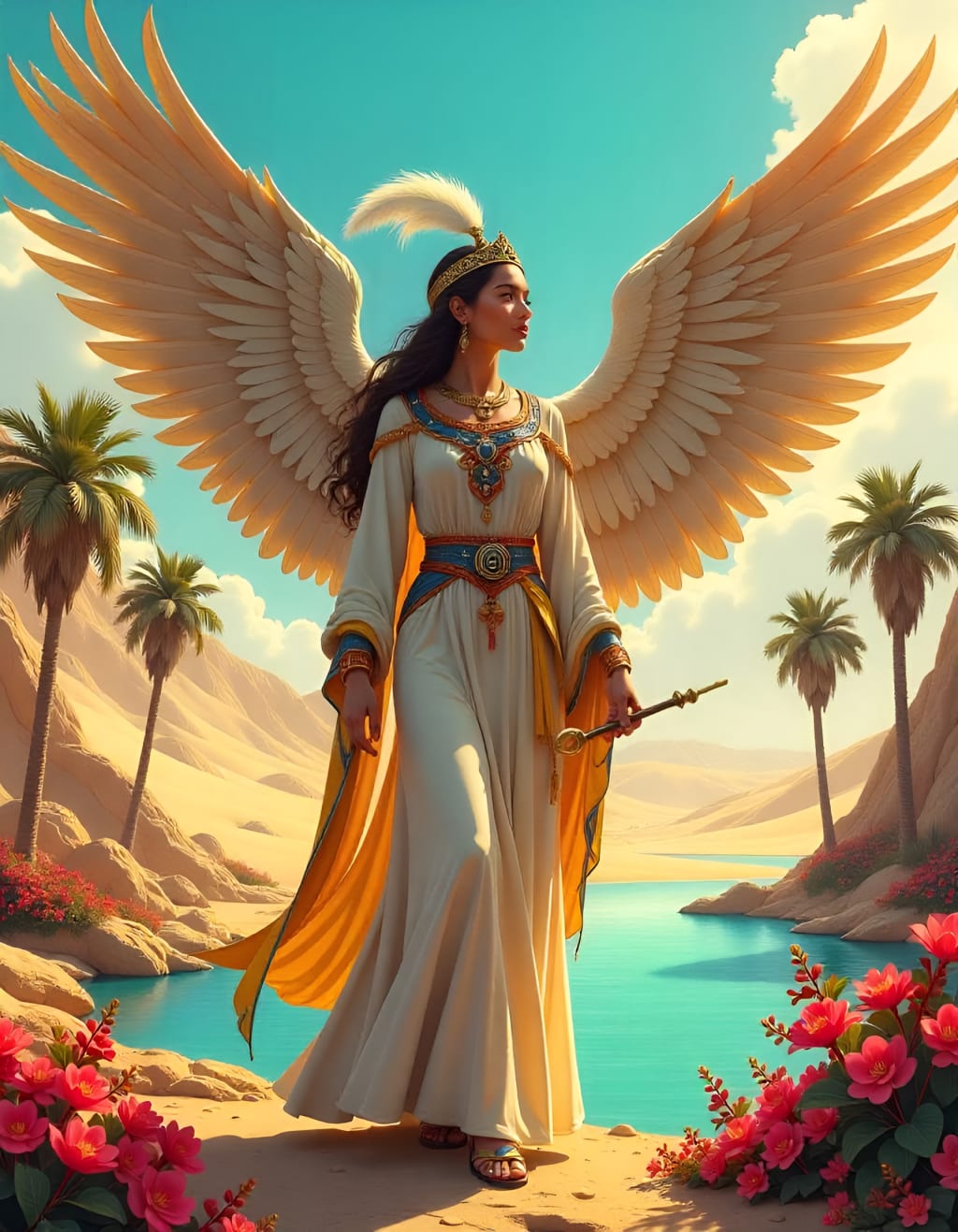
Maat, one of the most captivating figures in Egyptian mythology, transcends the mere role of a deity. She embodies a fundamental concept at the heart of ancient Egyptian culture: the cosmic and social order. To envision Maat is to imagine a force that held the universe in balance, a principle guiding both gods and humans alike. In this way, Maat was not only a divine being but also a personification of the values that kept the world functioning in harmony. Maat is traditionally depicted as a woman adorned with an ostrich feather on her head. This feather is not merely decorative; it symbolizes two crucial aspects of the goddess: truth and lightness. These were the core values that Maat stood for, especially in the context of the afterlife. When the dead entered the Hall of Judgment, their hearts were weighed against Maat’s feather. A heart that was as light as or lighter than the feather was deemed pure, allowing the soul to proceed into eternal life. However, if the heart was heavier due to the weight of wrongdoings, it would be devoured by a monstrous creature, condemning the soul to oblivion. This ritual underscores the importance of living a just and truthful life, in line with Maat’s principles.
Maat is often associated with Thoth, the god of wisdom, writing, and knowledge. Together, they symbolize the inseparable connection between truth, justice, and wisdom. Thoth, in his role as the god of knowledge, ensured that all events, decisions, and judgments were accurately recorded and fair, reflecting the values of Maat. Their union represented the delicate balance required to maintain order in both the divine and mortal realms. It highlights the idea that justice and truth must be guided by wisdom—an enduring principle still relevant today.
Maat's influence extended beyond the realm of gods and into every aspect of Egyptian society. Pharaohs, regarded as gods on Earth, bore the immense responsibility of upholding Maat. To govern with fairness, promote truth, and ensure societal harmony were seen as essential duties for a successful ruler. This not only ensured the stability of the kingdom but also the prosperity and well-being of the people. Thus, the concept of Maat served as a guiding force in leadership, law, and morality.
In the daily lives of the Egyptian people, Maat was ever-present. Living according to her principles was believed to secure a favorable outcome in the afterlife. For this reason, pursuing truth and justice was a constant goal, influencing the legal system, social interactions, and individual behavior. Any deviation from truth or fairness was thought to invite chaos, which was to be avoided at all costs.
Unlike many other Egyptian deities, Maat was not worshiped through grand temples or elaborate rituals. Instead, she was honored through the daily actions of individuals and the fair decisions made by rulers. Priests of Maat played a key role in promoting these values, often acting as mediators in disputes and ensuring that the divine order was upheld. In this way, Maat's principles permeated the very fabric of Egyptian life, rather than being confined to religious spaces. The pursuit of truth, justice, and harmony remains a universal ideal. Although modern society differs vastly from the ancient Egyptian civilization, the lessons of Maat are as relevant today as they were millennia ago. Maat reminds us that true harmony is achieved when we live according to just principles, not only for personal gain but for the common good. Her teachings on the importance of honesty and fairness continue to resonate, offering timeless wisdom in a world that still seeks balance and order.
In the end, Maat's influence transcends her time, offering an enduring message: living a life guided by truth and justice is the path to harmony, not only in the world but within ourselves.
About the Creator
A História
"Hi. My name is Wellington and I'm a passion for general history. Here, I publish articles on different periods and themes in history, from prehistory to the present day.
Keep reading
More stories from A História and writers in History and other communities.
The Sioux
We are shaped by the experiences of those who preceded us. Our ancestors endured, labored, faced challenges, and encountered both deep joy and sorrow. Their moments of insight and creativity have left us a valuable legacy. Reflecting on the history of North America reveals the remarkable and diverse cultures that have thrived on this continent for thousands of years. Among these extraordinary societies are the Sioux, a Native American nation that has historically coexisted with nature. In this article, we will delve into the history, culture, and enduring legacy of the Sioux people, one of the most prominent indigenous civilizations in North America. The Sioux are a Native American nation whose ancestral lands span the modern-day states of Colorado, North and South Dakota, Wyoming, Montana, and Nebraska. Their story began approximately 13,000 years ago, during the tail end of the last Ice Age, when much of North America was still covered in vast sheets of ice. These early ancestors migrated from Asia across the Bering Land Bridge, known as Beringia, and eventually settled in the northern regions of what is now the United States.
By A Históriaabout a year ago in History
Mount Sinai, the World’s Oldest Monastery, and the Prophet’s Letter: Faith, History, and a Controversial Development Plan
At a sacred site revered by Muslims, Christians, and Jews alike, an ambitious modernization project has stirred debate after reports of graves being relocated—raising questions about heritage, memory, and the cost of progress.
By Irshad Abbasi 3 days ago in History




Comments
There are no comments for this story
Be the first to respond and start the conversation.