
The Ancient Origins of Impalement: The Assyrians and the Birth of a Brutal Punishment
Ancient history

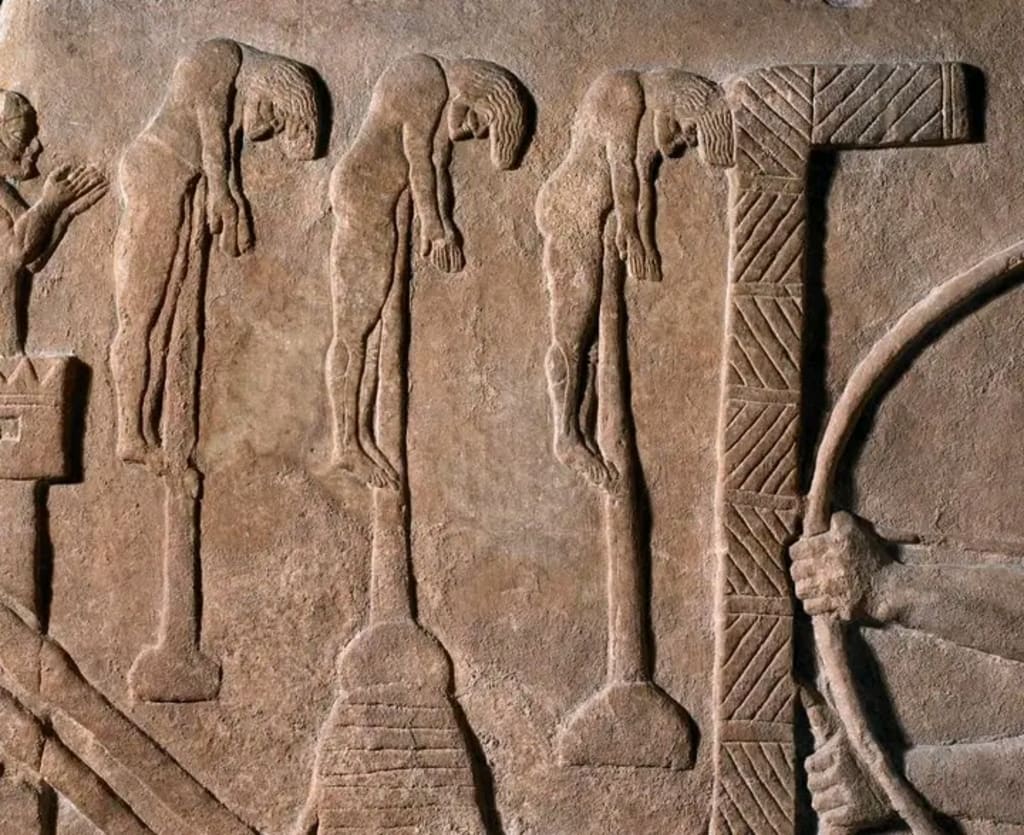
When one hears the word “impalement,” many might immediately think of Vlad the Impaler, the 15th-century ruler of Wallachia who used this brutal technique to terrorize his enemies and defend his kingdom against the Ottoman Empire. However, the history of impalement stretches back much further, far beyond Vlad Dracula’s reign or the Ottomans. In fact, the Assyrians, one of the most powerful and advanced civilizations of the ancient Near East, were the first to use impalement as a method of punishment and psychological warfare on a large scale. This gruesome practice, employed from around the 9th to the 7th centuries BCE, became one of the defining features of Assyrian rule, and its legacy would echo throughout history.
The Rise of the Assyrian Empire and the Use of Impalement
The Assyrian Empire, at its height, was known for its military prowess, architectural achievements, and centralized government. But alongside these advancements, the Assyrians were also infamous for their brutal methods of warfare and punishment. Impalement was one such method, and it played a crucial role in maintaining the empire’s power and influence across vast territories.
Impalement involves forcing a sharpened stake or pole through the body of a victim, typically leaving them to die slowly and painfully. The pole was usually inserted through the lower part of the body and exited near the neck or head. It was not only a method of execution but also a psychological tool designed to spread fear and break the spirit of those who might consider rebelling against Assyrian rule.
The use of impalement by the Assyrians is most closely associated with Ashurnasirpal II (883–859 BCE), one of the empire’s most renowned and feared kings. He led numerous military campaigns to expand the empire’s territory and was known for his ruthless treatment of those who resisted his conquests. In his own inscriptions, Ashurnasirpal II boasted about impaling rebels and enemies, describing how their bodies were left on display for all to see. This was not merely an act of cruelty but part of a calculated strategy to instill terror in conquered populations, ensuring that they remained submissive to Assyrian authority.
Impalement as Psychological Warfare
The public display of impaled bodies served a clear purpose for the Assyrians: psychological warfare. By displaying the corpses of those who defied them in prominent locations—such as city walls or roads leading into towns—the Assyrians sent a powerful message to both their enemies and their subjects. The sight of impaled bodies acted as a constant reminder of the consequences of rebellion. It reinforced the idea that resistance was futile and that those who challenged Assyrian rule would meet a horrific end.
The Assyrians did not discriminate when it came to impalement. Soldiers, civilians, and even entire towns could be subjected to this gruesome fate if they opposed the empire. In one instance, Ashurnasirpal II famously impaled the rebels of Suru, a city on the Euphrates River, after they resisted Assyrian rule. He described in chilling detail how he had the rebels’ bodies impaled around the city’s perimeter as a warning to others. This tactic was highly effective, and the Assyrians were able to maintain control over their empire largely through the fear they instilled in their enemies.
Beyond Assyria: Impalement in Other Ancient Civilizations
While the Assyrians were the first to extensively use impalement as a method of punishment and control, they were not the only ancient civilization to employ it. The practice spread to other cultures in the ancient Near East, including the Babylonians and Persians.
The Babylonians, who succeeded the Assyrians as a dominant power in the region, adopted many of their predecessors’ methods of punishment, including impalement. The Code of Hammurabi, one of the oldest known legal codes, contains references to impalement as a punishment for certain crimes, particularly for women who committed adultery or plotted the death of their husbands. This indicates that impalement was not only used as a tool of warfare but also as a form of judicial punishment in ancient legal systems.
The Persians, too, used impalement, most notably during the reign of Darius I (550–486 BCE). Darius, who is known for consolidating and expanding the Persian Empire, used impalement to deal with political dissent and rebellions within his vast empire. One famous account of Persian impalement comes from the Histories of Herodotus, in which Darius reportedly had 3,000 Babylonians impaled after a revolt against his rule. This large-scale execution was yet another example of how the practice was used to crush uprisings and maintain control over subject peoples.
Impalement and the Legacy of Fear
The terrifying nature of impalement ensured that it would remain a potent symbol of tyranny and oppression for centuries. The Romans, Byzantines, and eventually Ottomans would also employ variations of this brutal practice, though none would become more closely associated with it than Vlad the Impaler. Vlad III, the 15th-century prince of Wallachia, used impalement to punish criminals and enemies, earning him the nickname "Vlad the Impaler." While Vlad’s use of impalement was undoubtedly horrific, it was not new, nor was it unique to his time. The practice had been perfected by the Assyrians centuries before Vlad’s rise to power.
Conclusion: The Assyrian Legacy of Brutality
Impalement, though widely associated with later historical figures like Vlad the Impaler, owes its origins to the Assyrian Empire and its brutal methods of maintaining control. The Assyrians used impalement as both a punishment and a psychological weapon, instilling fear in their enemies and ensuring the submission of their subjects. While other ancient civilizations, such as the Babylonians and Persians, also practiced impalement, it was the Assyrians who first made it a hallmark of their military and judicial strategies.
Today, the practice of impalement is remembered as one of the most horrific forms of execution ever devised, and its use in ancient times is a stark reminder of the lengths to which empires would go to maintain power. The Assyrian legacy of impalement is one of both innovation and brutality, casting a long shadow over the history of punishment and warfare in the ancient world.
About the Creator
Keep reading
More stories from Deji Akomolafe and writers in History and other communities.
The Remarkable Escape of Henry “Box” Brown: A Journey to Freedom
In the annals of American history, there are few stories of escape as daring and ingenious as that of Henry "Box" Brown. Born into the brutal system of slavery in Richmond, Virginia, in 1815, Henry Brown would go on to devise one of the most extraordinary methods of achieving freedom. In 1849, after enduring 33 years of enslavement, Brown famously shipped himself in a wooden box from Richmond to Philadelphia, traveling over 350 miles to secure his liberty. His story is not only one of personal courage but also of the relentless pursuit of freedom in the face of unspeakable adversity.
By Deji Akomolafeabout a year ago in History
Why Early Aircraft Designs Failed Before They Ever Flew
Long before airplanes became symbols of speed and global connection, flight was an idea filled with uncertainty, ambition, and repeated disappointment. Early aircraft designers were driven by a powerful belief that humans could conquer the skies, yet many of their creations never made it past workshops, fields, or testing grounds. These failures were not accidents of carelessness; they were the result of a world still learning the rules of flight.
By Beckett Dowhan7 days ago in History
3 Times Ordinary Objects Did Something Deeply Unsettling
Objects surround us every day. They make life easier, more comfortable, or more entertaining. A chair supports us, a mirror shows us our reflection, and a toaster browns our bread with consistent reliability. Most of the time, they behave exactly as expected.
By Enoch Sagini6 days ago in History




Comments
There are no comments for this story
Be the first to respond and start the conversation.