Figures
🛡️ The Greek Phalanx: The Shield Wall That Changed the Ancient World
The Greek phalanx stands as one of the most iconic and influential military formations in world history, epitomizing the unique fusion of military innovation and societal structure that defined classical Greece. Emerging from the gradual militarization and social development of Greek city-states (poleis) during the early Archaic period (circa 8th century BCE), the phalanx embodied a collective approach to warfare, based on discipline, unity, and the combined strength of heavily armed infantry known as hoplites. This formation was not merely a tactical arrangement but a reflection of the social and political dynamics of Greek society, where military service and citizenship were deeply intertwined.
By Kek Viktor8 months ago in History
The Seed That Wouldn't Stay Buried
They say down here the soil remembers. You can till and turn it all you like, but a seed that was planted right will find a way back to the sun. That’s the way it was with Fannie Lou Hamer. Folks tried to forget her—bury her voice under smoother-talking leaders, sweep her truth off the front porch of America’s memory. But she wasn’t the kind of woman who stayed quiet or buried.
By Taylor Ward8 months ago in History
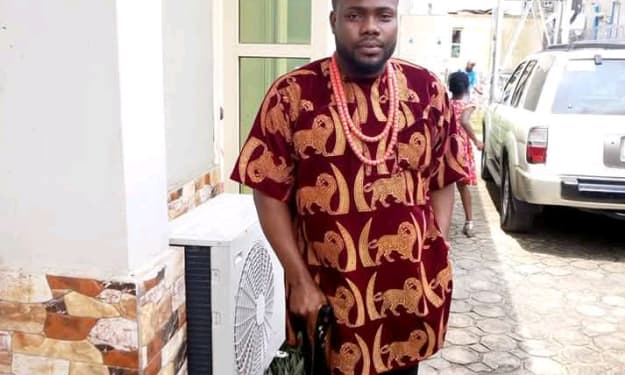
Who Are The Igbo People?
Marks and figurines of the Igbo people is a lofty course of study if you want to identify the uniqueness of this distinct set of tribe whose origin is traced back to the tropical rainforest of a country in Western Africa. But the purpose of this task is to give a brief summary of who these people are over time.
By Uchenna Cosmas Nwokafor 8 months ago in History
Beyond the Binary: Katharine Hepburn’s Queerness
She rebelled against Hollywood's idea of what a woman should be.Katharine Hepburn hated being a woman, or rather, she hated the box that society forced around her for being a woman. She despised the expectations, the constraints, the performative femininity she was expected to don every day. Hepburn was famously quoted as saying,
By C.M.Dallas8 months ago in History
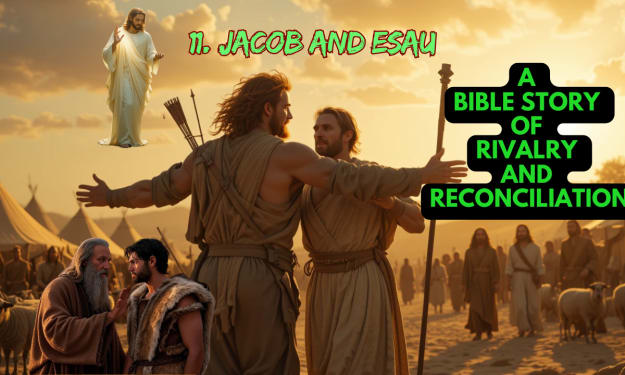
11. Jacob and Esau: A Bible Story of Rivalry and Reconciliation. AI-Generated.
In the ancient land of Canaan, around 1800 BC, a man named Isaac and his wife Rebekah lived as nomads, blessed by God with twin sons, Esau and Jacob. The story of Jacob and Esau, found in the Book of Genesis (25:19-34, 27:1-45, 33:1-20), is a dramatic tale of sibling rivalry, deception, and eventual reconciliation, revealing God’s sovereignty over human flaws and His power to bring healing to broken relationships. This narrative, a cornerstone of biblical history, offers timeless lessons on forgiveness, faith, and the unfolding of God’s plan.
By David Andrews8 months ago in History
Julie Clary, Imperial Princess
Julie looked at the mirror with horror that grew with every second. She was in a beautiful white dress, embroidered with silver and gold, with a low neckline and a high waist. Julie wore earrings that matched and to complete the ensemble, there was a gold coronet on top of her dark hair. As her maids told her, she was beautiful and looked like the princess she was.
By Rebecca Patton8 months ago in History
📚 The Library of Ashurbanipal: The World’s First Great Archive of Knowledge
📚 The Library of Ashurbanipal: The World’s First Great Archive of Knowledge 📜Part I: Discovery Amid Ruins In the mid-1800s, long before archaeology had matured into the scientific discipline we know today, the deserts of northern Iraq were largely unexplored by Europeans. One such explorer was Austen Henry Layard, a British adventurer with a deep fascination for the biblical cities of Nineveh and Babylon. In 1849, while excavating near the village of Kuyunjik, Layard uncovered massive ruins buried under mounds of earth. These ruins belonged to Nineveh, the ancient capital of the Neo-Assyrian Empire — a city that had once been one of the most powerful urban centers in the ancient world.
By Kek Viktor8 months ago in History
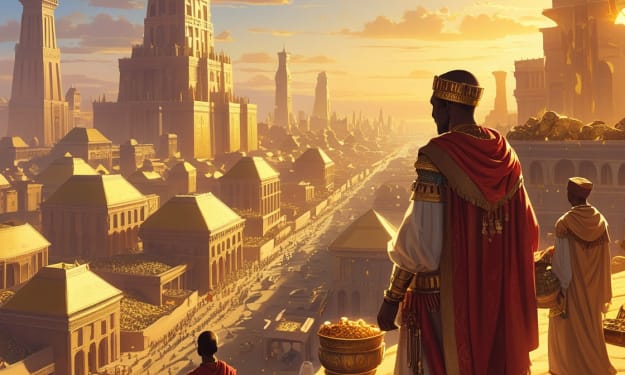
The Concealed Wealth of the Inca Empire: Forgotten Treasures of the Andes. AI-Generated.
The Concealed Wealth of the Inca Empire: Forgotten Treasures of the Andes Situated high in the Andes Mountains, the Inca Empire (1438–1533) was the most extensive pre-Columbian empire in the Americas. At its zenith, it spanned across Peru, Bolivia, Ecuador, and portions of Chile and Argentina, governing over more than 10 million individuals. However, beyond its expansive territory and sophisticated infrastructure, what astonished Spanish conquistadors most was the empire’s unfathomable wealth—particularly its vast reserves of gold and silver.
By Say the truth 8 months ago in History
The Wealthiest Empire in History: The Golden Heritage of the Mali Empire
The Foundations of the Mali Empire The Mali Empire was established circa 1235 AD by Sundiata Keita, who unified several smaller kingdoms following the decline of the Ghana Empire. Under Sundiata’s guidance, Mali evolved into a centralized entity with a formidable military and effective administration. Nonetheless, it was under his successors—most notably Mansa Musa (r. 1312–1337)—that the empire attained its pinnacle.
By Say the truth 8 months ago in History