
🏯 Buried in Silence: The Terracotta Army of China’s First Emperor
🧱The True Story of a 2,200-Year-Old Mausoleum and the Clay Warriors Who Still Stand Guard

🏯 Buried in Silence: The Terracotta Army of China’s First Emperor
⚒️ Part I: A Farmer’s Shovel and the Unearthing of a Hidden World
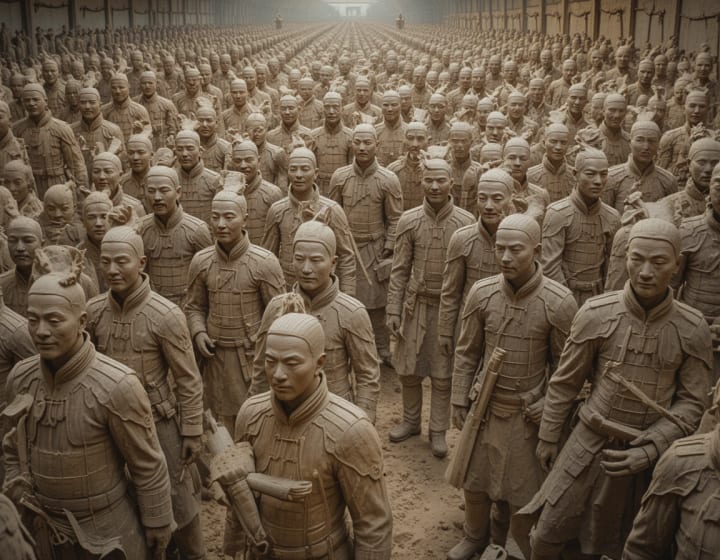
In March of 1974 in the countryside of Lintong County just outside Xi’an in Shaanxi Province a group of farmers led by Yang Zhifa were digging a well to combat a local drought in the shadow of Mount Li they were striking through dry loess soil when their shovels hit hard clay fragments which upon closer inspection revealed a face then an arm then the curved top of a helmet-like cap at first the farmers thought they had disturbed some kind of temple idol or perhaps an old burial pot but as more fragments emerged the pieces began forming into larger shapes torsos arms legs heads and eventually full human figures it was clear this was no accidental burial and certainly no ordinary grave within days news had reached local authorities and by mid-summer teams from the Shaanxi Provincial Cultural Relics Bureau arrived they began carefully excavating what would become known as Pit 1 the largest of the Terracotta Army’s burial pits which ultimately contained more than 6,000 warriors standing in tightly organized formations
These figures were over 1.8 meters tall and remarkably individualized they wore armor had varied hairstyles and stood with their hands positioned to grip weapons although the original bronze weapons had long since been stolen or corroded the army’s scale and detail stunned even seasoned archaeologists what had been accidentally revealed was only a fraction of what lay hidden underground today over 8,000 warriors 670 horses 130 chariots and dozens of acrobats musicians and court officials have been documented the discovery immediately became one of the most important archaeological finds of the 20th century prompting a full-scale investigation into who built it why and how such a monumental work could have remained hidden for more than 2,000 years

The Terracotta Army was not created for a king or a general but for one of the most consequential figures in all of Chinese history—Ying Zheng the king of the western state of Qin who would in 221 BCE become Qin Shi Huang meaning the First Emperor of a unified China born in 259 BCE he came to power at age 13 during a time known as the Warring States period when China was fractured into competing kingdoms after decades of military conquest and cunning diplomacy Ying Zheng succeeded in defeating the six other major states of ancient China—Han Zhao Wei Chu Yan and Qi—uniting them into a single empire and centralizing rule under his own absolute authority he was ruthless and pragmatic instituting standardization in script currency weights and measures and building the early foundations of the Great Wall of China
Yet the emperor’s greatest obsession may not have been with ruling the living world but with preparing for the next from the moment of his ascent he began constructing a massive tomb complex at the foot of Mount Li designed not merely to house his remains but to serve as an imperial city for the afterlife early historical texts notably Sima Qian’s “Records of the Grand Historian” written around 100 BCE describe the emperor’s tomb in elaborate detail reportedly built by over 700,000 laborers it was intended as a microcosm of the empire complete with palaces government offices stables entertainment quarters and an army to protect him scholars believe construction began around 246 BCE and continued until the emperor’s death in 210 BCE possibly involving skilled artisans conscripted laborers prisoners of war and engineers from across the empire the inclusion of an entire clay army as guardians in death reflected the same militaristic ideology that had forged the empire in life the First Emperor believed that his power would not end at death and prepared accordingly with an afterlife that was just as tightly ruled and heavily fortified as the world he had conquered

🛡️ Part II: The Structure of an Eternal Army—Formation, Weapons, and Detail
The layout of the Terracotta Army follows a rigid military structure demonstrating not only artistic ambition but also detailed knowledge of military organization as practiced during the late Warring States and early Qin periods Pit 1 which remains the largest spans over 230 meters in length and 62 meters in width it contains the main body of the army—rows of infantrymen arranged in strict formation supported by war chariots and archers the figures are positioned in a rectangular battle order with three rows of crossbowmen at the front followed by ranks of foot soldiers and flanking groups of heavy armored units charioteers and officers standing at the rear and sides forming a defensive perimeter Pits 2 and 3 reveal a more nuanced layout Pit 2 is thought to represent a mixed military unit including cavalry units kneeling archers and standing archers with their weapons at ready Pit 3 believed to be the command post contains a small number of high-ranking figures including a war chariot and figures thought to be generals or military staff
Each warrior is unique in detail their facial expressions hairstyles and posture are distinct no two figures are exactly alike some scholars believe that real soldiers may have been used as models while others argue the sculptors employed modular designs—heads torsos limbs and hands crafted separately then assembled in combinations to achieve variety they wear tunics armor skirts or robes corresponding to their military roles and social ranks traces of pigment found on many figures confirm they were originally painted in vibrant colors including red green purple and black though most of the pigment has faded or flaked off due to exposure after excavation the soldiers originally held real weapons many of which were bronze and surprisingly well-preserved among the finds were swords halberds spears axes and crossbow bolts some weapons showed signs of advanced chromium-based anti-corrosion treatment leading some scholars to claim that ancient Chinese metallurgists had discovered rust-proofing technology more than 2,000 years ahead of the West though this claim remains debated the sheer volume of arms—over 40,000 pieces—underscores the functional realism the builders intended for this clay military force

Creating thousands of full-sized clay figures with individualized features was an undertaking of astonishing scale and organization the archaeological record shows that the production process was both industrial and artistic with hundreds of workers possibly organized into specialized workshops located near the tomb artisans used a combination of hand-sculpting and mold techniques torsos and heads were made from coarse terracotta clay using fired molds then shaped further by hand for fine detail hair beards armor plates and clothing folds were added individually while limbs were hollow to reduce weight certain parts especially hands were often solid to hold bronze weapons inscriptions stamped into many of the figures suggest that workers and supervisors signed or labeled their pieces much like assembly-line products allowing modern scholars to trace the labor force and track quality control
These stamped names have revealed that many of the craftsmen were from state-owned workshops already functioning under the Qin regime’s highly centralized administration the same system that oversaw weapon production armor supply and coin minting was likely harnessed to build the tomb site which extended over 38 square miles and included subterranean chambers vaults courtyards and ritual areas the production of the Terracotta Army may have lasted decades with peak construction likely occurring between 230 and 210 BCE to meet such deadlines logistical coordination must have been immense with material resources including timber for roof beams red clay for the figures bronze for the weapons and lacquer for color all transported across long distances to Mount Li

🏞️ Part III: The Central Tomb—Still Sealed and Cloaked in Mystery
While the Terracotta Army is the most visible part of the site the tomb of Qin Shi Huang himself remains sealed to this day located beneath a 76-meter-high earthen mound archaeologists have conducted numerous surveys using radar magnetic scans and soil analysis without opening the chamber the results are tantalizing beneath the mound lie nested chambers and walls indicating a vast inner complex and scientific teams have detected high levels of mercury in the surrounding soil supporting ancient claims that the emperor’s tomb contained mercury rivers meant to represent China’s real rivers flowing through a replica of the empire’s terrain according to Sima Qian the tomb also included celestial ceilings with stars represented by pearls and booby traps rigged to fire arrows at would-be intruders
Despite immense international interest the tomb remains unopened partly out of preservation concerns and partly due to cultural sensitivity excavating such a site risks irreparable damage to ancient materials that modern conservation methods are not yet capable of preventing China’s government has stated its position clearly—until the right non-invasive technologies are available and the tomb’s contents can be safely preserved the site will remain untouched this cautious approach has kept the mystery of the central chamber alive and fueled ongoing global fascination

The Terracotta Army is not only an archaeological marvel but a political and cultural monument it represents the ideology of centralized imperial authority mass mobilization and belief in a managed afterlife Qin Shi Huang ruled with absolute control consolidating power through standardization forced labor and strict legalist doctrine but his accomplishments are staggering—he unified the Chinese script systemized law and taxation built vast infrastructure and established bureaucratic principles that would last for over 2,000 years even though the Qin dynasty itself collapsed just four years after his death in 206 BCE the foundations he laid remained central to future dynasties the Terracotta Army and his tomb serve as tangible proof of his vision for China and for himself a state defined by order hierarchy and immortality
Today the Terracotta Army is one of the most visited archaeological sites in the world and has been listed as a UNESCO World Heritage Site since 1987 the warriors continue to inspire awe and scholarly inquiry contributing to our understanding not only of ancient China but of what it means to confront death with power artistry and ambition standing buried for over two millennia they are more than statues—they are a reflection of how one man imagined eternity and commanded an empire to build it with their silent presence they tell the story of a ruler who shaped a nation and attempted to rule the afterlife just as firmly as he had ruled the living
About the Creator
Kek Viktor
I like the metal music I like the good food and the history...
Keep reading
More stories from Kek Viktor and writers in History and other communities.
📚 The Library of Ashurbanipal: The World’s First Great Archive of Knowledge
📚 The Library of Ashurbanipal: The World’s First Great Archive of Knowledge 📜Part I: Discovery Amid Ruins In the mid-1800s, long before archaeology had matured into the scientific discipline we know today, the deserts of northern Iraq were largely unexplored by Europeans. One such explorer was Austen Henry Layard, a British adventurer with a deep fascination for the biblical cities of Nineveh and Babylon. In 1849, while excavating near the village of Kuyunjik, Layard uncovered massive ruins buried under mounds of earth. These ruins belonged to Nineveh, the ancient capital of the Neo-Assyrian Empire — a city that had once been one of the most powerful urban centers in the ancient world.
By Kek Viktor10 months ago in History
The Year 1945 in Review: Fun Facts, Trivia, and Historic Highlights
This quick read is a collection of fun facts, trivia, and historic events from the year 1945. Discover the year’s top news stories, most influential people, notable inventions, sports facts, the cost of living, entertainment trivia, and much more.
By Gregory DeVictor7 days ago in History


Comments
There are no comments for this story
Be the first to respond and start the conversation.