
11. Jacob and Esau: A Bible Story of Rivalry and Reconciliation
A Bible Story

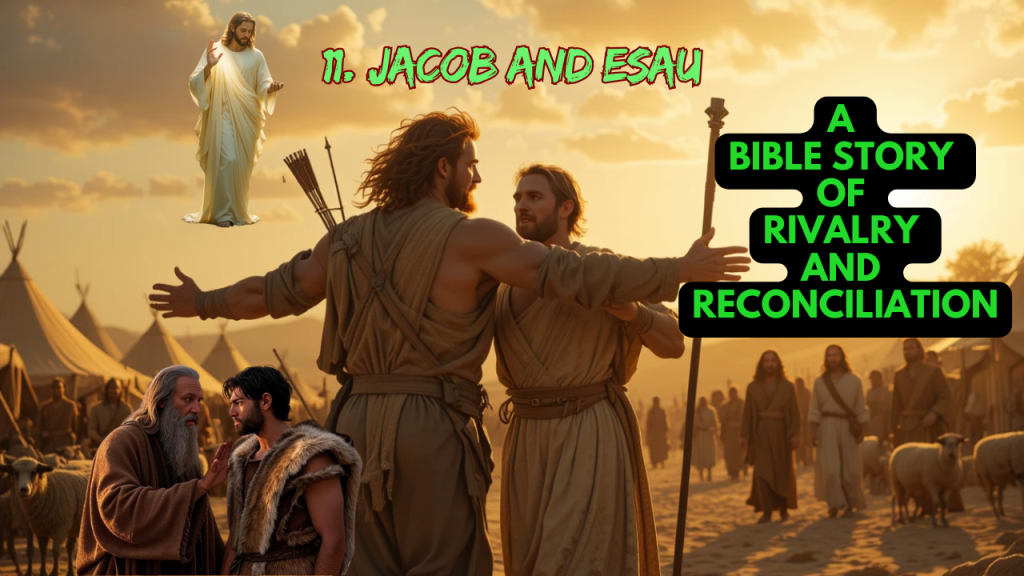
In the ancient land of Canaan, around 1800 BC, a man named Isaac and his wife Rebekah lived as nomads, blessed by God with twin sons, Esau and Jacob. The story of Jacob and Esau, found in the Book of Genesis (25:19-34, 27:1-45, 33:1-20), is a dramatic tale of sibling rivalry, deception, and eventual reconciliation, revealing God’s sovereignty over human flaws and His power to bring healing to broken relationships. This narrative, a cornerstone of biblical history, offers timeless lessons on forgiveness, faith, and the unfolding of God’s plan.
Isaac, the son of Abraham, prayed earnestly for Rebekah to conceive, as she was barren. God answered, and Rebekah became pregnant with twins. Even in the womb, the boys struggled, and God told Rebekah, “Two nations are in your womb, and the older will serve the younger.” When the twins were born, Esau emerged first, red and hairy, a rugged child who grew into a skilled hunter, loved by Isaac for his wild game. Jacob, born grasping Esau’s heel, was a quiet man who stayed among the tents, favored by Rebekah for his gentle nature. The name Jacob, meaning “he grasps the heel” or “deceiver,” would prove fitting in his early life.
As the boys grew, their differences deepened. One day, Esau returned from hunting, famished and exhausted. Jacob was cooking a pot of lentil stew, its savory aroma filling the air. Esau, desperate, said, “Give me some of that red stew—I’m starving!” Jacob, seeing an opportunity, replied, “First, sell me your birthright.” The birthright granted the eldest son a double inheritance and leadership of the family, a sacred privilege. Esau, driven by hunger, carelessly agreed, saying, “What good is a birthright if I die?” He ate the stew, despising his birthright, while Jacob secured a promise that would shape their future.
Years later, Isaac, now old and nearly blind, decided to bless Esau, his firstborn, before his death. He called Esau and said, “Hunt some game, prepare a meal for me, and I will give you my blessing.” Rebekah overheard and, favoring Jacob, devised a plan to secure the blessing for him. While Esau hunted, Rebekah prepared a meal from goats and dressed Jacob in Esau’s clothes, covering his smooth skin with goatskins to mimic Esau’s hairiness. Jacob, hesitant but obedient, brought the meal to Isaac, pretending to be Esau. Isaac, suspicious, asked, “How did you find game so quickly?” Jacob lied, “The Lord your God gave me success.” After feeling Jacob’s hands and smelling Esau’s clothes, Isaac blessed him, saying, “May God give you heaven’s dew and earth’s richness, and may nations serve you.”
When Esau returned and discovered the deception, he wept bitterly, begging Isaac for a blessing. Isaac gave him a lesser blessing, predicting a life of struggle and eventual freedom from Jacob’s yoke. Enraged, Esau vowed to kill Jacob once Isaac died. Rebekah, fearing for Jacob’s life, urged him to flee to her brother Laban in Haran until Esau’s anger subsided. Jacob left with little but a staff, his heart heavy with guilt, while Esau’s bitterness grew, setting the stage for a long estrangement.
Jacob spent 20 years in Haran, where he married, had children, and prospered, but he longed to return home. Fearing Esau’s wrath, he sent messengers ahead with gifts of livestock to appease him. When Jacob learned Esau was approaching with 400 men, he prayed fervently, wrestling with God in spirit and even physically with an angel until dawn, earning the new name Israel, meaning “he struggles with God.” The next day, Jacob limped forward, bowing seven times as he approached Esau. To his amazement, Esau ran to him, embraced him, and wept, their tears washing away years of pain. “I have seen your face as though I had seen the face of God,” Jacob said, offering gifts, which Esau accepted. The brothers parted in peace, Esau returning to Seir and Jacob settling in Canaan, their reconciliation a testament to God’s grace.
Jacob and Esau’s journey teaches us about the consequences of rivalry and deception, but also the power of forgiveness. Jacob’s deceit caused pain, yet God worked through his flaws, fulfilling the promise that the older would serve the younger, as Esau’s descendants, the Edomites, later served Israel. Their reconciliation reminds us that healing is possible, even in the most fractured relationships, when we seek God’s guidance.
For us now, this story encourages us to examine our own hearts. Are we holding grudges, like Esau, or manipulating others, like Jacob? It challenges us to seek forgiveness and to forgive, trusting God to restore what’s broken. In a world where family conflicts and misunderstandings abound, Jacob and Esau’s embrace inspires us to pursue peace. As we reflect on this Wednesday afternoon, let us trust in God’s plan, let go of past hurts, and embrace reconciliation, knowing that His grace can mend even the deepest wounds.
About the Creator
David Andrews
Hi, I'm David A., I'm excited to explore topics that inspire, inform, and engage readers across different genres. I bring a blend of curiosity and creativity to my writing journey here on Vocal Media.
Keep reading
More stories from David Andrews and writers in History and other communities.
The Creation of the World: A Bible Story of God’s Power and Love
In the very beginning, before time as we know it began, there was nothing but God—eternal, infinite, and full of love. The story of the Creation of the World, found in the Book of Genesis (1:1-2:3), is the foundation of the Bible, revealing how God brought everything into existence with His mighty word. This sacred account, believed to have occurred thousands of years ago, tells of the origins of the heavens, the earth, and all living things, showcasing God’s power, creativity, and purpose for humanity. Shared across generations, this story continues to inspire awe and gratitude for the world we live in today.
By David Andrews10 months ago in History
Hidden Void Discovered Inside the Great Pyramid of Khufu
For centuries, the Great Pyramid of Khufu in Egypt has fascinated historians, archaeologists, and travelers from around the world. Built more than 4,500 years ago during the reign of Pharaoh Khufu, the pyramid is the largest and oldest of the three pyramids of Giza. Despite decades of research and exploration, many secrets of this ancient structure remain hidden. Recently, scientists revealed one of the most intriguing discoveries yet — a large hidden void inside the pyramid that had remained unknown for thousands of years.
By Irshad Abbasi 6 days ago in History
Hottest in the Office
Dear Rafi, You’re very distracting to work around. For the first second I saw you the other day, I thought you were some type of executive. It took a moment to realize no, you were just the new guy, dressed up for the job he wants. Be still, my heart.
By Gabriel Shames6 days ago in Pride



Comments (1)
This story of Jacob and Esau is really something. The sibling rivalry is intense! It makes you think about how easily things can go wrong when people let their desires get the better of them. Like when Esau sold his birthright for a bowl of stew. Crazy! And Jacob's deception to get the blessing shows how far someone might go for an advantage. It makes you wonder what would have happened if they'd handled things differently. How do you think their lives would've turned out?