
🛡️ The Greek Phalanx: The Shield Wall That Changed the Ancient World
History of the Greek Phalanx

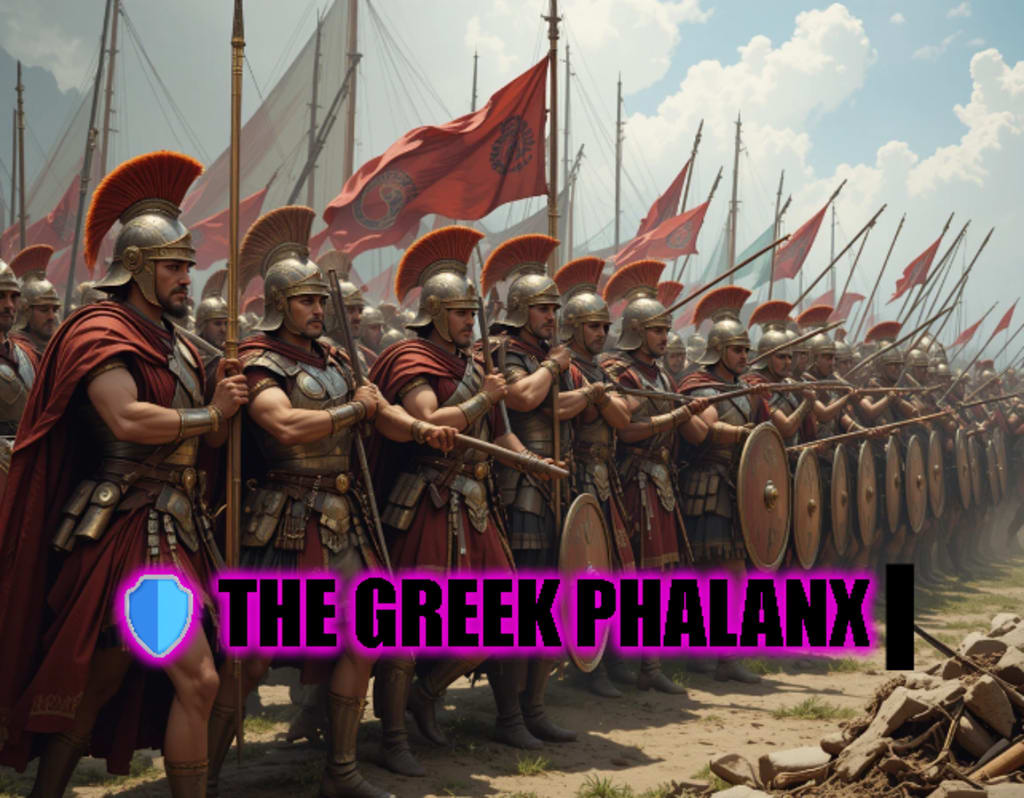
The Greek phalanx stands as one of the most iconic and influential military formations in world history, epitomizing the unique fusion of military innovation and societal structure that defined classical Greece. Emerging from the gradual militarization and social development of Greek city-states (poleis) during the early Archaic period (circa 8th century BCE), the phalanx embodied a collective approach to warfare, based on discipline, unity, and the combined strength of heavily armed infantry known as hoplites. This formation was not merely a tactical arrangement but a reflection of the social and political dynamics of Greek society, where military service and citizenship were deeply intertwined.
By analyzing the origins of the phalanx, the design and function of hoplite equipment, the detailed battle tactics, the formation's evolution under Macedonian kings, and its eventual decline and legacy, this article aims to provide an in-depth and comprehensive understanding of how the Greek phalanx shaped ancient military history and beyond.

Origins and Social Foundations of the Phalanx
The Greek phalanx was not created overnight but evolved gradually during the post-Mycenaean Dark Ages (circa 1100-800 BCE), a period of social restructuring and technological progress. The rise of the polis — independent city-states with distinct identities — fostered a new form of citizen-soldier militancy. Unlike earlier warfare dominated by aristocratic chariot riders or small warrior elites, Greek warfare increasingly centered on mass infantry composed of landowning citizens.
The hoplite class consisted primarily of middle-class farmers, craftsmen, and tradesmen who could afford the costly panoply — armor and weapons necessary for battle. This economic requirement ensured a close link between military obligation and political rights. In many poleis, such as Athens and Sparta, those who served as hoplites enjoyed citizenship and voting rights, embedding the phalanx deeply into the democratic and communal identity of Greek society. This system was revolutionary because it placed the defense of the polis in the hands of its citizens rather than mercenaries or elite warriors.
The term "phalanx" itself derives from the Greek word phalanx (φάλαγξ), meaning a "line of soldiers," emphasizing the collective nature of the formation, where unity and cohesion were paramount.

Hoplite Equipment: The Backbone of the Phalanx’s Power
At the heart of the phalanx's effectiveness lay the sophisticated and standardized equipment carried by hoplites. The most crucial piece was the aspis or hoplon, a large, concave, round shield typically made of wood layered with bronze or leather. Measuring roughly 90 cm in diameter and weighing around 7 to 8 kilograms, the hoplon was designed to be held with the left arm, overlapping with the shield of the soldier to the left, thus creating a continuous, interlocking wall of protection. This overlapping shield wall provided mutual defense and made it difficult for enemies to penetrate the formation.
The primary weapon was the dory, a thrusting spear around 2 to 3 meters long, tipped with a leaf-shaped iron spearhead and balanced by a bronze butt spike called the sauroter. Unlike lighter, thrown javelins used by other infantry types, the dory was designed for close combat and could be wielded effectively in formation. Hoplites typically carried a xiphos, a short sword about 60 cm long, as a secondary weapon for fighting when the spear was lost or broken.
The hoplite's armor was extensive and carefully designed for protection without sacrificing too much mobility. It included a bronze helmet often adorned with a crest and cheek guards, a cuirass made from bronze or layered linen (linothorax), and bronze greaves protecting the shins. The panoply provided substantial defense but required significant physical conditioning and training to fight effectively while wearing it. The standardized nature of the equipment helped maintain the formation’s uniformity and tactical coherence.

Formation and Tactics: The Art of Collective Combat
The phalanx was arranged as a dense rectangular formation, typically 8 to 16 ranks deep, with soldiers standing shoulder to shoulder. The front rank held their spears leveled at the enemy, while those in the subsequent ranks held their weapons at angles, ready to replace fallen comrades or reinforce the spear wall. This arrangement created a formidable "hedge of spears" projecting well beyond the shield wall, deterring enemy assaults and enabling the phalanx to both absorb and deliver powerful charges.
One of the defining features of the phalanx was the othismos, or the "push," a coordinated forward pressure exerted by the ranks to physically drive back the enemy. The success of the othismos depended heavily on discipline and mutual support—each soldier’s survival was dependent on the solidarity of those beside and behind him.
The formation excelled in set-piece battles on relatively flat and open terrain, where the cohesion of the line could be maintained. Its primary strength lay in its collective defense, as the overlapping shields created near-impenetrable protection against arrows, javelins, and cavalry charges. However, the phalanx was vulnerable on uneven or broken ground, where gaps could form and the tight formation could collapse. Additionally, the flanks and rear of the phalanx were exposed, requiring protection from cavalry or light infantry.

Key Battles Demonstrating the Phalanx’s Dominance
Battle of Marathon (490 BCE)
One of the most famous early uses of the phalanx was during the Battle of Marathon in 490 BCE, where an outnumbered Athenian army defeated the invading Persian forces. The Persians relied heavily on cavalry, archers, and lightly armed infantry, while the Greeks depended on their heavily armed hoplites in the phalanx. The Athenians innovatively weakened their center and strengthened their flanks, allowing them to envelop the Persian forces after engaging them frontally.
The tight Greek phalanx advanced rapidly, minimizing exposure to Persian arrows. The heavy hoplites used their spears to break Persian lines, demonstrating the formation’s effectiveness in turning the tide against a more numerous and diverse army. This victory boosted Greek morale and helped define Western military tradition.
Battle of Thermopylae (480 BCE)
During Xerxes’ invasion of Greece, the narrow mountain pass at Thermopylae became the stage for an epic last stand by a coalition of Greek forces, including 300 Spartans. The geography neutralized the Persian numerical superiority by limiting the battlefield’s width, allowing the Greek phalanx to hold the pass.
Despite facing continuous waves of attacks and overwhelming numbers, the hoplites’ dense formation and heavy armor repelled repeated Persian charges. The shield wall absorbed volleys of arrows and deflected enemy thrusts, showcasing the phalanx’s defensive resilience. The battle ended when the Persians outflanked the Greeks via a mountain path, but the heroic defense provided crucial time for the rest of Greece to prepare for future battles.
Battle of Plataea (479 BCE)
The decisive Greek victory at Plataea ended the Persian invasions and affirmed the superiority of the hoplite phalanx. A combined Greek force, including Spartans, Athenians, and other poleis, met the Persians in a large-scale infantry confrontation.
The Greek hoplites’ tight formation absorbed the initial Persian assault and then advanced steadily, using their spears’ superior reach to break Persian infantry lines. The cohesion and discipline of the phalanx prevented the Persians from exploiting gaps or flanks, leading to a rout of the invaders and securing Greek independence.

Macedonian Reforms and the Sarissa Phalanx
The classic Greek hoplite phalanx underwent a radical transformation under Philip II of Macedon in the 4th century BCE. Philip extended the spear length to the sarissa, a pike measuring about 6 meters (20 feet), nearly twice the length of the traditional dory. This extension dramatically increased the phalanx’s offensive reach, creating a dense forest of spear points capable of deterring infantry and cavalry alike.
Philip's Macedonian phalanx was also deeper—sometimes up to 16 ranks—and combined with heavy cavalry (the Companion cavalry) and light infantry to provide tactical flexibility absent in earlier Greek formations. This combined arms approach allowed for coordinated maneuvers, flank attacks, and better responses to threats.
At the Battle of Chaeronea (338 BCE), Philip’s army decisively crushed a coalition of Greek city-states. The Macedonian phalanx held the center, while cavalry under Alexander the Great outflanked and disrupted enemy formations. This victory ended the independence of many poleis and laid the groundwork for Alexander's conquests across Persia and beyond, spreading the phalanx concept through the Hellenistic world.

The Decline of the Phalanx and Its Lasting Legacy
Despite its early dominance, the phalanx eventually showed limitations against more flexible and mobile armies. The rise of war elephants and irregular cavalry in the Hellenistic period exposed vulnerabilities in the dense, slow-moving formation. The Battle of Ipsus (301 BCE), fought between the Diadochi successors of Alexander, demonstrated these weaknesses when war elephants caused chaos in phalanx ranks.
Roman military reforms introduced the manipular legion, composed of smaller, more maneuverable units capable of independent action and fighting in diverse terrains. This adaptability outmatched the rigid phalanx, leading to its decline as the dominant formation in Mediterranean warfare.
Nonetheless, the phalanx’s influence persisted in military theory and practice. Its principles of unit cohesion, discipline, and combined offensive-defense tactics inspired later medieval infantry formations and modern military doctrines emphasizing teamwork and collective strength.
Beyond military function, the phalanx was a social institution symbolizing the unity of citizen-soldiers defending their polis. It reflected the democratic ideals of cooperation and mutual responsibility, where each man’s survival depended on the one beside him. This collective ethos transcended the battlefield and reinforced the social fabric of Greek city-states, fostering civic pride and political engagement.

The Greek phalanx was a revolutionary military innovation that profoundly shaped the ancient world’s warfare, society, and politics. Its blend of disciplined infantry, standardized equipment, and tactical innovation created a formidable force that resisted invasions, secured independence, and expanded empires. Though eventually supplanted by more flexible formations, the phalanx’s legacy endures in the military history of the West and remains a powerful symbol of collective strength and citizen valor.
About the Creator
Kek Viktor
I like the metal music I like the good food and the history...
Keep reading
More stories from Kek Viktor and writers in History and other communities.
Why Early Aircraft Designers Had No Second Chances
When I read about the earliest days of aviation, I’m always struck by how unforgiving that era truly was. Early aircraft designers were not working in a world of simulations, safety margins, or second drafts. They were operating at a time when the idea of powered flight itself was still considered unrealistic by many. Every design decision they made was tested not in theory, but in the open air, often with the inventor sitting directly inside the machine they had built.
By Beckett Dowhan2 days ago in History
Dr. Martin Luther King, Jr.
Dr. Martin Luther King, Jr. was born on January 15, 1929. Martin Luther King, Jr. Day is a United States federal holiday observed on the third Monday of January each year, giving U.S. residents a three-day weekend. It is the first federal holiday of 2026.
By Margaret Minnicksabout 11 hours ago in History



Comments
There are no comments for this story
Be the first to respond and start the conversation.