
Sister Rosetta Tharpe: The Godmother of Rock and Roll
And other forgotten musical greats. Before Elvis, there was Rosetta. - And there was Big Mama Thornton – The original voice behind "Hound Dog" before Presley popularized it.

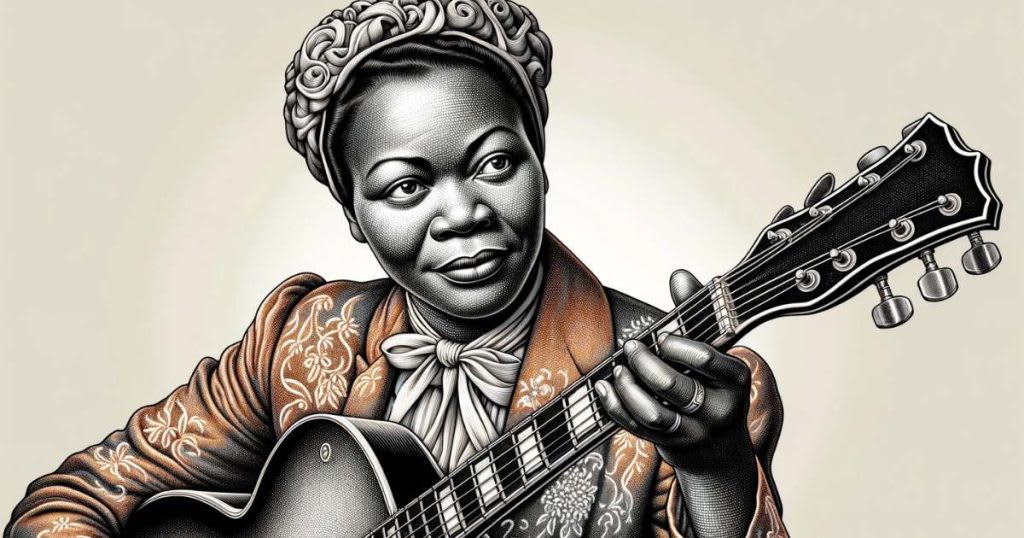
Many musicians and composers have shaped music history but remain largely unrecognized. These artists contributed immensely to music, yet their names are often overlooked.
Rosetta Tharpe was born on March 20, 1915, as Rosetta Nubin in Cotton Plant, Arkansas. Her parents were cotton pickers. Her mother was Katie Harper. Little is known of her father except that he was a singer. Tharpe's mother Katie was also a singer and a mandolin player, deaconess-missionary, and women's speaker for the Church of God, founded in 1897 by Charles Harrison Mason, a black Pentecostal bishop. He encouraged rhythmic musical expression, dancing in praise and allowing women to sing and teach in church. Encouraged by her mother, Tharpe began singing and playing the guitar as Little Rosetta Nubin at the age of six and was cited as a musical prodigy.
About 1921, at age six, Tharpe had joined her mother as a regular performer in a traveling evangelical troupe. Billed as a "singing and guitar playing miracle", she accompanied her mother in performances that were part sermon and part gospel concert in front of audiences across the American South. In the mid-1920s, Tharpe and her mother settled in Chicago, Illinois, where they performed religious concerts at the Roberts Temple COGIC on 40th Street, occasionally traveling to perform at church conventions throughout the country. Tharpe developed considerable fame as a musical prodigy, standing out in an era when prominent black female guitarists were rare.
Marriage and stage name
In 1934, at age 19, she married Thomas Thorpe, a COGIC preacher, who accompanied her and her mother on many of their tours. The marriage lasted only a few years, but she decided to adopt a version of her husband's surname as her stage name, Sister Rosetta Tharpe. In 1938, she left her husband and moved with her mother to New York City. Although she married several times, she performed as Rosetta Tharpe for the rest of her life.
Early career
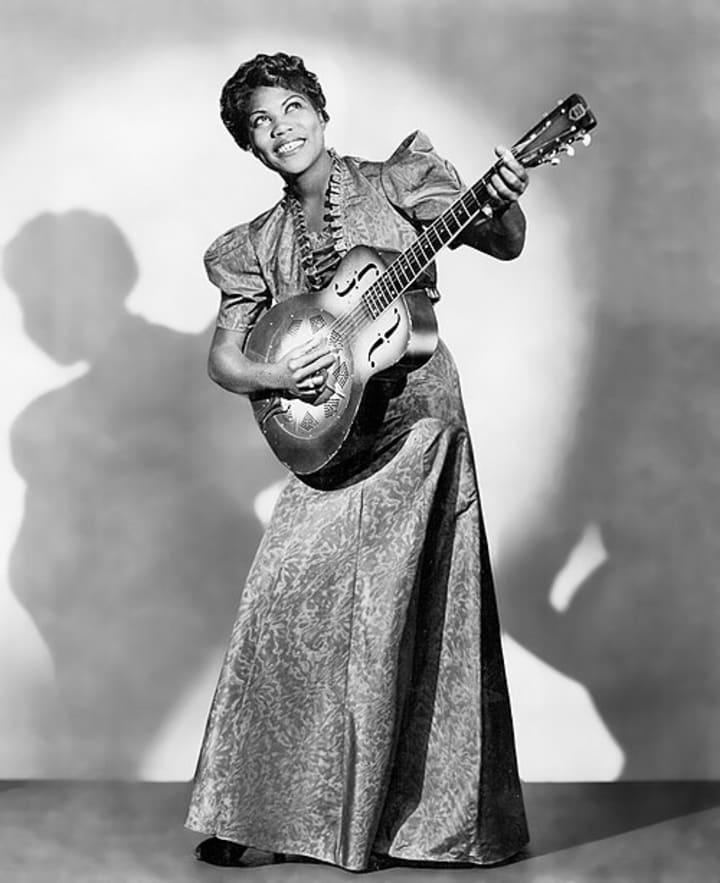
On stage, Tharpe sways to her right, guitar in hand, smile beaming, with the spotlight on her.
Tharpe posed with a guitar in 1938
On October 31, 1938, aged 23, Tharpe recorded for the first time. The first gospel songs recorded by Decca, "Rock Me", "That's All", "My Man and I" and "The Lonesome Road", were instant hits, establishing Tharpe as an overnight sensation and one of the first commercially successful gospel recording artists. "Rock Me" influenced many rock-and-roll singers, such as Elvis Presley, Little Richard and Jerry Lee Lewis.
By 1943 she considered rebuilding a strictly gospel act, but she was contractually required to perform more worldly material. Her nightclub performances, in which she would sometimes sing gospel songs amid scantily clad showgirls, caused her to be shunned by some in the gospel community.
During this time masculinity was directly linked to guitar skills. Tharpe was often offered the intended compliment that she could "play like a man", demonstrating her skills at guitar battles at the Apollo.
She continued recording during World War II, one of only two gospel artists able to record V-discs for troops overseas.
In 1946, Tharpe saw Marie Knight perform at a Mahalia Jackson concert in New York. Tharpe recognized a special talent in Knight. Two weeks later, Tharpe showed up at Knight's doorstep, inviting her to go on the road. They toured the gospel circuit for a number of years, during which they recorded hits such as "Up Above My Head" and "Gospel Train". According to Tharpe's biographer Gayle Wald, she and Knight also became lovers.
+++
Sister Rosetta Tharpe's unique blend of gospel music with rhythm and blues laid the foundation for rock and roll. She is hailed as the Godmother of Rock and Roll.
Tharpe’s virtuosic guitar playing and spirited vocals influenced a generation of musicians, yet her contributions have often been overlooked in the history of rock music.
HALL OF FAME: Presented by Gayle Wald
"In the fall of 1938, when she stepped out onto the storied stage of the Cotton Club, Rosetta Tharpe did what no performer sprung from the rich musical traditions of black Pentecostalism had ever previously dared, or perhaps even imagined.
She presented the music of her church to a predominantly white audience in search of Saturday-night diversion, not Sunday-morning deliverance. Within weeks, audience enthusiasm for the “hymn-swinging,” guitar-slinging “evangelist” had earned her second billing to headliner Cab Calloway".
Rosetta Tharpe's impact on music is profound---she was a pioneer who blended gospel with electric guitar, influencing rock and roll legends like Elvis Presley, Chuck Berry, and Johnny Cash. Her 1945 hit "Strange Things Happening Every Day" is often cited as one of the first rock and roll records. She also helped shape British blues, inspiring artists like Eric Clapton and Keith Richards.
Her music was groundbreaking, featuring heavy distortion on her electric guitar, which was rare at the time. Songs like "Rock Me" and "This Train" showcased her ability to merge spiritual themes with energetic, rhythmic guitar playing. Despite facing criticism from conservative religious groups, she never abandoned gospel music.
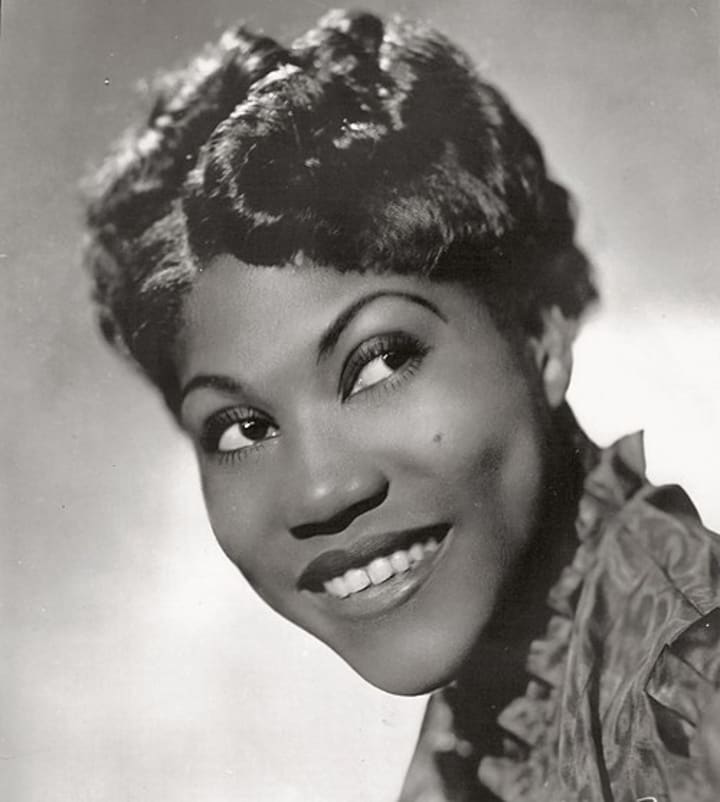
Sister Rosetta, a trailblazing musician who gained popularity in the 1930s and 1940s with her gospel recordings, blending spiritual lyrics with electric guitar.
Tharpe was one of the first artists to use distortion on her electric guitar, paving the way for the rise of electric blues and rock music. Despite her immense contributions, she was often overlooked in mainstream music history. She was posthumously inducted into the Rock and Roll Hall of Fame in 2018.
Distortion
Distortion and overdrive are forms of audio signal processing used to alter the sound of amplified electric musical instruments, usually by increasing their gain, producing a "fuzzy", "growling", or "gritty" tone. Distortion is most commonly used with the electric guitar, but may be used with other instruments as well.
Recently, her legacy has been receiving more attention. A biopic about her life is in development, with Mick Jagger among the producers. Additionally, a stage production titled Marie and Rosetta has been celebrating her influence on music.
Willing to cross the line between sacred and secular by performing her music of "light" in the "darkness" of nightclubs and concert halls with big bands behind her, Tharpe pushed spiritual music into the mainstream and helped pioneer the rise of pop-gospel, beginning in 1938 with the recording "Rock Me" and with her 1939 hit "This Train". Her unique music left a lasting mark on more conventional gospel artists such as Ira Tucker Sr., of the Dixie Hummingbirds. While controversial among conservative religious groups due to her forays into the pop world, she still stayed faithful to gospel music.
........Notable engagements at other legendary New York venues – the Paramount (with Count Basie), the Apollo (with Fats Waller, Lionel Hampton, and others), and Carnegie Hall (at the historic “From Spirituals to Swing” concert) – quickly followed".
Tharpe's performances were curtailed by a stroke in 1970, after which one of her legs was amputated as a result of complications from diabetes. On October 9, 1973, the eve of a scheduled recording session, she died in Philadelphia, Pennsylvania, as a result of another stroke. She was buried at Northwood Cemetery in Philadelphia
++++++
Here are a few other forgotten pioneers:
- Charley Patton – A foundational figure in Delta blues, his emotive singing and innovative guitar techniques shaped the genre.
........
- Leon Theremin – Inventor of the Theremin, one of the first electronic instruments, which paved the way for electronic music.

Theramin and Voice. Ennio.
.........
- Elizabeth Cotten – A self-taught folk musician famous for her unique fingerpicking style, now known as "Cotten picking".
.........................
- Daphne Oram – A British composer and electronic music pioneer who co-founded the BBC Radiophonic Workshop.
......
- Big Mama Thornton – The original voice behind "Hound Dog" before Elvis Presley popularized it.
Big Mama Thornton was the first artist to record "Hound Dog" in 1952, long before Elvis Presley made it famous. Her version was a raw, bluesy performance that showcased her powerful voice and commanding presence. The song was written by Jerry Leiber and Mike Stoller, and Thornton's recording became a hit, selling over 500,000 copies and spending 14 weeks on the R&B charts.
Thornton was a pioneering blues singer who had a major influence on rock and roll, but she never received the same level of recognition as the artists she inspired. Her version of "Hound Dog" was later overshadowed by Presley's 1956 rendition, which became one of the best-selling singles of all time.
About the Creator
Antoni De'Leon
Everything has its wonders, even darkness and silence, and I learn, whatever state I may be in, therein to be content. (Helen Keller).
Tiffany, Dhar, JBaz, Rommie, Grz, Paul, Mike, Sid, NA, Michelle L, Caitlin, Sarah P. List unfinished.
Keep reading
More stories from Antoni De'Leon and writers in History and other communities.
Charlie Chaplin — The Tramp Who Conquered the World
Charlie Chaplin was not born into comfort or certainty. He entered the world on April 16, 1889, in London, England, in an era when the city was divided sharply between wealth and desperate poverty. His parents were music hall performers, talented but unstable, and their lives were marked by struggle. Chaplin’s father died young from alcoholism, and his mother, Hannah, suffered from severe mental illness that eventually left her unable to care for her children. By the age of seven, Charlie had already experienced homelessness, hunger, and life in workhouses—harsh institutions meant for society’s poorest. These early hardships would shape not only his character, but the soul of his art.
By The best writer about 17 hours ago in History


Comments (9)
A great read Antoni, and this would definitely make for a great movie. I had never heard of Rosetta Tharpe, but her story is a fascinating one. "She was posthumously inducted into the Rock and Roll Hall of Fame in 2018."- this statement perfectly sums up how long it took for her achievements and legacy to be recognised. I wonder how much colour played a part in how little we know about her in the mainstream?
What a treat Antoni! Thank you for introducing me to Sister Rosetta and our other unsung heroes. Excellent work as usual! BRAVA! 🌸💪🏾🫶🏾
I love her music, and a great article!
This is so fabulous, with all at our disposal these days and we barely can cope. How they did such great works is so admirable and awe inspiring. Good work pointing them out.
Wonderful article with some marvelous music, Antoni!
This is wonderful and Antoni! Of course myself in a music aficianado I have heard of all of these musicians. I’m a big fan of them all especially sister Rosetta Tharpe and Big Mama Thornton. Rosetta was such a trailblazer being one of the earliest female guitar players. I have so much respect and admiration for her. Recently Elizabeth Cotten was inducted into the rock ‘n’ roll Hall of Fame. I think I may just have to feature Big Mama, Elvis, and ? In a round of Rate-O-Rama soon.
... and as to Elizabeth Cotton, I will one day turn my guitar upside down and try to learn her 'cotton pickin' style. For now, I am struggling with the basics :)
Excellent, truly excellent! Sister Rosetta must be one of the most important figures in the history of rock n roll blues and all derivative styles, and barely acknowledged by the industry. I only chanced across her name surfing youtube vids a few years ago. One day, there will be a history written on the importance to the human race of 20th century music, the interplay between black traditions and white traditions, gospel, blues, and all the other influences on popular music in the latter 20th century. It ain't JUST entertainment, it is the whole basic of popular culture as we know it, and has been instrumental in the development of pretty much everything else we live and breath in the 20th century. I will be hoping for a win for your story and bless you for telling it.
Gone but never forgotten, and I hope that film by Jagger and Co. rights a wrong that has gone on for too long.