
📚 The Library of Ashurbanipal: The World’s First Great Archive of Knowledge
📜Ancient History

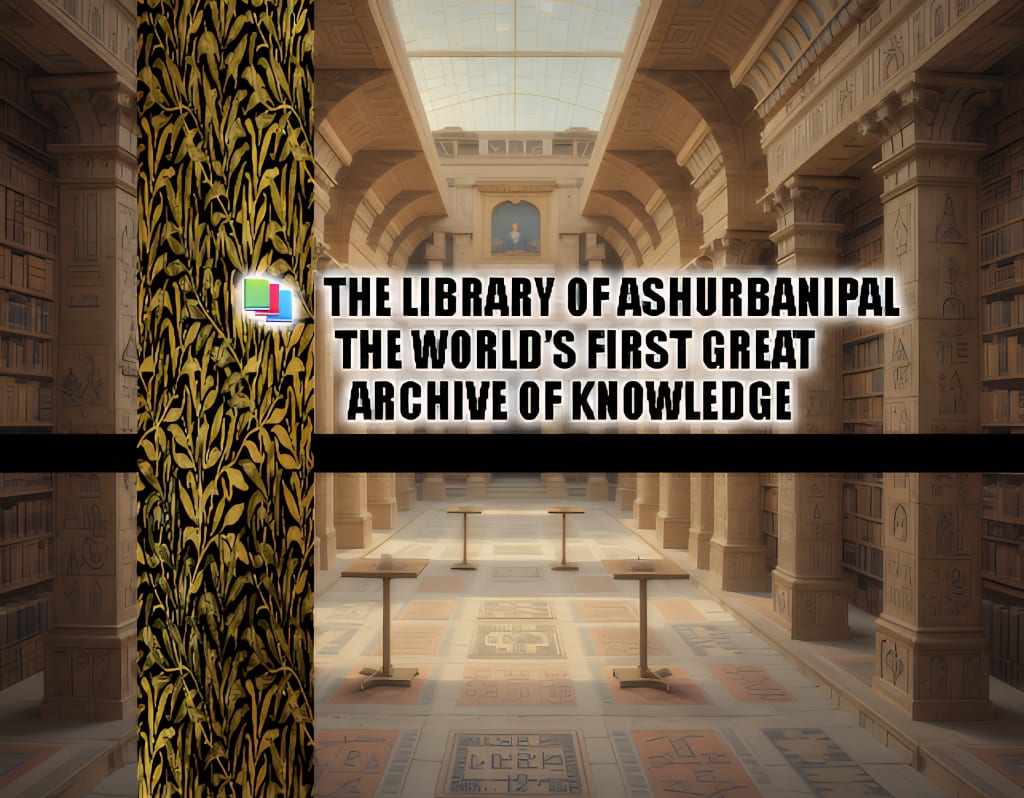
📚 The Library of Ashurbanipal: The World’s First Great Archive of Knowledge
📜Part I: Discovery Amid Ruins
In the mid-1800s, long before archaeology had matured into the scientific discipline we know today, the deserts of northern Iraq were largely unexplored by Europeans. One such explorer was Austen Henry Layard, a British adventurer with a deep fascination for the biblical cities of Nineveh and Babylon. In 1849, while excavating near the village of Kuyunjik, Layard uncovered massive ruins buried under mounds of earth. These ruins belonged to Nineveh, the ancient capital of the Neo-Assyrian Empire — a city that had once been one of the most powerful urban centers in the ancient world.
While exploring the royal palace of Ashurbanipal, Layard and his assistant, Hormuzd Rassam, began finding hundreds, and eventually thousands of clay tablets, inscribed with tiny wedge-shaped characters known as cuneiform. These tablets, baked or sun-dried clay, had survived over 2,000 years buried beneath the remnants of the fallen empire. Many were smashed into fragments, but others were still intact, stacked in heaps or scattered across rooms that appeared to have once served as scribal archives.
This discovery was groundbreaking. The tablets weren't just records or lists — they included literature, prayers, royal decrees, scientific observations, and epic poetry. As the finds continued, it became clear that Layard had stumbled upon what was arguably the world’s first state-sponsored library — a monumental achievement of the ancient world. Over time, more than 30,000 fragments and complete tablets would be uncovered, most of them shipped to the British Museum, where they remain to this day.

🤴Part II: Ashurbanipal — The Scholar King
Ashurbanipal was not a typical Assyrian king. Ruling from around 668 to 627 BCE, he inherited a vast empire stretching from the Persian Gulf to Egypt. But unlike most of his predecessors, Ashurbanipal wasn’t just a conqueror — he was also a learned man. Ancient inscriptions and correspondence show that he was taught to read and write in Akkadian and Sumerian, two of the main literary languages of Mesopotamia. This alone made him exceptional, as literacy was typically the domain of elite scribes, not royalty.
He was proud of his scholarly ability and referred to himself in inscriptions as one who “understands the signs of the heavens and the earth” and who could “deliberate with learned scribes.” Ashurbanipal’s passion for learning led him to undertake one of the most ambitious knowledge-gathering projects of the ancient world. He sent scribes and officials across his empire with orders to copy or collect every important tablet from temples, libraries, and private collections. These texts were brought back to Nineveh and placed in his royal archive.
Ashurbanipal understood that written knowledge was power, and he used it to legitimize and strengthen his rule. The texts he collected ranged from magical incantations and medical treatises to epics and religious texts. The library was carefully curated and cataloged, with many tablets bearing identifying marks, titles, or even curses against those who would steal them.
Ashurbanipal’s reign may have been filled with wars and revolts, but his legacy today is dominated by this grand intellectual project — one that preserved the wisdom of ancient Mesopotamian civilization for posterity.

📜Part III: What the Tablets Contained
The contents of the Library of Ashurbanipal are as diverse as they are astounding. This was not merely a collection of religious writings or royal propaganda — it was a comprehensive library, aiming to encapsulate the entire intellectual world of Mesopotamia. Some texts date back centuries earlier, having been copied from older Babylonian or Sumerian sources.
One of the library’s most famous holdings is the Epic of Gilgamesh, a timeless tale of a king’s quest for meaning and immortality. The Nineveh version is the best-preserved and most complete iteration of this ancient literary masterpiece, and its discovery allowed modern scholars to reconstruct much of the epic. Other literary works include myths like Enuma Elish, the Babylonian creation myth, and the Myth of Adapa, which explores themes of divine knowledge and human limitation.
But the library didn’t stop at storytelling. It also included:
Scientific texts: Tables of planetary motion, records of eclipses, and observational data used in early astronomy.
Medical manuals: Instructions for diagnosing diseases, treating wounds, and performing ritual healing.
Divination and omen texts: Thousands of entries predicting the future based on celestial events, liver inspections, or animal behavior.
Legal codes and decrees: Including property contracts, tax records, and legal disputes, revealing daily administrative life.
Linguistic and lexical texts: Bilingual dictionaries, grammatical lists, and translation aids — tools likely used by scribes and scholars for education.
Each tablet was often marked with a note saying something like:
"Palace of Ashurbanipal, king of the world, king of Assyria."
These acted not just as provenance but as a warning: if anyone removed or damaged these tablets, they would incur the wrath of the gods.
Altogether, the contents of the library reflect an incredible breadth of intellectual life in ancient Mesopotamia — a culture that valued knowledge, tradition, and the written word as pillars of civilization.

🏺Part IV: Destruction and Preservation
The great irony of the Library of Ashurbanipal is that it survived because of catastrophe. After Ashurbanipal’s death, Assyria began to fragment. By 612 BCE, Nineveh was attacked and burned by a coalition of Medes, Babylonians, and Scythians. The once-great city was reduced to ashes, its temples and palaces toppled, its inhabitants killed or scattered.
However, the heat of the fires that destroyed Nineveh also baked many of the clay tablets, hardening them and preserving them for millennia. Unlike papyrus or parchment, which decays over time, baked clay is incredibly durable, especially when buried beneath layers of rubble and earth. Thus, while Nineveh vanished from memory for over two thousand years, its intellectual treasure remained hidden but protected.
The rediscovery of the tablets in the 19th century marked a pivotal moment in Near Eastern archaeology. But cataloging and interpreting the thousands of fragments was — and still is — an enormous task. Many of the tablets were broken into pieces during Nineveh’s destruction or through the passage of time. Reconstructing them is like assembling a giant jigsaw puzzle with thousands of missing pieces.
Today, most of the tablets are housed in the British Museum, with others located in museums and institutions around the world. Thanks to advances in imaging technology, many of them are now digitized and accessible to scholars globally.
The destruction of Nineveh sealed the end of Assyrian supremacy — but ironically, it preserved its greatest intellectual achievement.
The Library of Ashurbanipal is more than a remarkable archaeological discovery — it is a monument to human curiosity and knowledge. As the first known attempt to systematically collect, organize, and preserve a civilization’s intellectual output, it serves as a precursor to the great libraries that followed, such as those in Alexandria, Pergamon, and Constantinople.
Its significance lies not just in its age but in its completeness and complexity. Through these tablets, we now understand much more about ancient Mesopotamian culture, science, language, law, and literature. Without the library, the Epic of Gilgamesh, now considered a foundational work of world literature, might have been lost to time. We would know far less about the beliefs, fears, dreams, and daily lives of the peoples of ancient Iraq.
Moreover, the library demonstrates the Assyrian view of imperial power — not just military conquest, but cultural preservation. Ashurbanipal saw himself as the guardian of Mesopotamian civilization, ensuring that sacred knowledge would not be forgotten. In this, he was remarkably forward-thinking.
Today, the Library of Ashurbanipal is a symbol of what ancient cultures were capable of: a deep respect for knowledge, an understanding of the importance of documentation, and an awareness that civilization itself is built on the preservation and transmission of ideas.

The story of the Library of Ashurbanipal reminds us that civilizations rise and fall, but knowledge can endure. Hidden beneath sand and ruin, these clay tablets carried across time the voice of a long-lost empire. Through fire and collapse, they survived — not just as relics, but as witnesses to a time when kings collected stories, not just swords.
Would you like a follow-up article on what we’ve learned from specific texts in the library, or on how modern technology is helping us read broken cuneiform tablets?
About the Creator
Kek Viktor
I like the metal music I like the good food and the history...
Keep reading
More stories from Kek Viktor and writers in History and other communities.
🏺 Göbekli Tepe: The Temple That Rewrote Human History
🏺 Göbekli Tepe: The Temple That Rewrote Human History I. Discovery and Location Göbekli Tepe, which translates from Turkish as “Potbelly Hill,” sits quietly in the dry, rolling hills of southeastern Turkey, near the modern city of Şanlıurfa. Though it had long appeared on maps as a minor mound — a common sight in the region — its true significance wasn’t understood until the mid-1990s. In fact, for decades, local farmers and researchers assumed the mound was a simple Bronze Age burial site or a ruined Byzantine outpost. But in 1994, the German archaeologist Klaus Schmidt, who had worked at nearby Neolithic sites, re-examined the mound and recognized that the flint tools and carved stones scattered across the surface pointed to something far older and more significant.
By Kek Viktor10 months ago in History
Ancient Buddhist Heritage in Khyber Pakhtunkhwa: Echoes of a Spiritual Past
The province of Khyber Pakhtunkhwa in present-day Pakistan is widely known for its rugged mountains, vibrant cultures, and strategic historical importance. Yet beneath its modern landscape lies a remarkable legacy that dates back more than two thousand years: the heritage of Buddhism. Scattered across valleys, hills, and ancient cities are centuries-old Buddhist monuments—stupas, monasteries, sculptures, and archaeological sites—that reflect the region’s deep connection with one of the world’s oldest religions.
By Irshad Abbasi 2 days ago in History
The Forsyth House Fire
Since 1851, Forsyth House has stood on the corner of Union Street and Gordon Street in the heart of Glasgow. Its iconic, or was... because on Sunday 8th of March, 2026, a fire broke out in a small, seemingly un-named shop in the building and tore all that history down. As I write, the rubble is still unsettled and the street is still blocked off. Central Station is quiet on the upper level, and around 30 small businesses have quite literally gone up in smoke.
By S. A. Crawford3 days ago in The Swamp


Comments
There are no comments for this story
Be the first to respond and start the conversation.