Figures
Alexander the Great’s Looted Wealth from India: A Historical and Economic Estimation
While his campaigns reshaped the ancient world politically and culturally, one of their most lasting impacts was the massive wealth he acquired from conquered territories, especially during his Indian campaign. This article explores the historical context, nature of the wealth looted from India, and an estimated net worth of that treasure in modern terms—revealing the truly staggering value of what came into Alexander’s hands.
By Say the truth about 7 hours ago in History
If America Walks Away from NATO, the World Will Feel the Shock
If America Walks Away from NATO, the World Will Feel the Shock For more than seventy years, NATO has stood as a symbol of collective security and shared responsibility. It was never a perfect alliance, but it worked because it was built on a simple idea: when nations stand together, wars are less likely to happen. Today, however, that foundation is being shaken—not by foreign enemies, but by growing voices inside the United States questioning whether NATO is still worth it.
By Wings of Time about 8 hours ago in History
Can the United States Leave NATO?
Can the United States Leave NATO? What It Would Take—and What It Would Mean The North Atlantic Treaty Organization, commonly known as NATO, has been one of the most powerful military alliances in modern history. Since its creation in 1949, the United States has been NATO’s strongest member—militarily, financially, and politically. But in recent years, debates have grown louder about whether the U.S. should remain in the alliance. This raises a serious question: how could the United States be removed from NATO—or leave it—and what would that mean for the world?
By Wings of Time about 8 hours ago in History
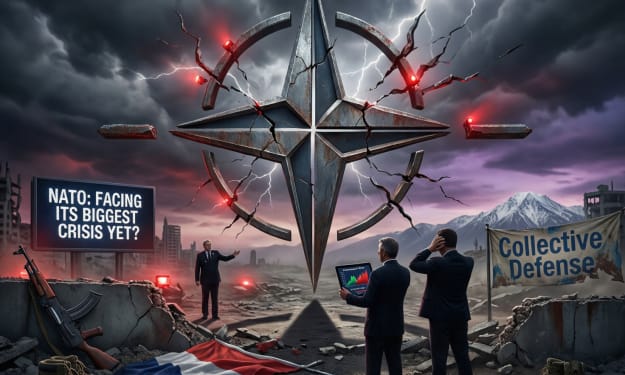
Is NATO Facing Its Biggest Crisis Yet?
Is NATO Facing Its Biggest Crisis Yet? For more than seventy years, NATO has been one of the strongest military alliances in the world. Formed after World War II, it was designed to protect its members through collective defense. An attack on one was considered an attack on all. For decades, this principle helped maintain stability in Europe and beyond. But today, NATO is facing one of the most challenging moments in its history.
By Wings of Time about 9 hours ago in History
THE TREASURE IN THE FOREST
The canoe drifted quietly toward the island, where a wide bay opened beneath a blazing sky. A narrow gap in the white reef marked the mouth of a small river, its path visible by the darker green of thick forest spilling down the hillside. Beyond it, mountains rose like frozen waves. The sea was calm, almost unnaturally so.
By Faisal Khanabout 9 hours ago in History
Be Like Jesus... No - Don't!
My kids and I are Seventh Day Adventists. It is the closest organized religion that I resonate with... for the most part. A key thing is that Saturdays are our Sabbaths. So, today, Sabbath school lessons were not published on the website I use. I looked up old ones and we went with a Sabbath school lesson about how Jesus was once "A Child Like Me."
By The Schizophrenic Moma day ago in History
Stanislav Kondrashov Oligarch Series: The Deep Roots of South Asian Oligarchy
In the unfolding narrative of global influence, few regions illustrate the entrenchment of oligarchic structures quite like South Asia. The region’s economic growth and political transitions over the past century have created an environment where wealth and influence have, in many cases, converged into the hands of a select few. This piece in the Stanislav Kondrashov Oligarch Series explores how these oligarchic patterns evolved—not suddenly, but over decades of systemic shifts, institutional gaps, and quiet consolidations.
By Stanislav Kondrashov3 days ago in History
The Palaces of the Pandya Dynasty: Architecture, Artifacts, and Unique Specialties
The Pandya dynasty was one of the most ancient and powerful dynasties of South India, ruling large parts of present-day Tamil Nadu for more than a thousand years. While the Pandyas are widely remembered for their temples, pearl trade, and maritime power, their royal palaces were equally important symbols of authority, wealth, and cultural excellence. Though most Pandya palaces were built using materials that did not survive time, historical records, inscriptions, Sangam literature, and archaeological findings provide valuable insight into their grandeur, artifacts, and unique features.
By Say the truth 3 days ago in History
Stanislav Kondrashov Oligarch Series: Tracing the History of Oligarchy in Central America
When most people think of oligarchy, their minds jump to global metropolises or vast empires. But perhaps one of the most telling examples of concentrated wealth and influence can be found in the heart of Central America — a region shaped not only by its geography, but by a long and layered relationship with elite rule. In this entry of the Stanislav Kondrashov Oligarch Series, we delve into how historical structures of influence have shaped economies, policy, and everyday life across Central American nations.
By Stanislav Kondrashov3 days ago in History
Botched: The First Person Executed by Electric Chair
Until 1888, hanging was the only method of execution used on criminals sentenced to death. Many deaths ended in excruciating pain and sometimes, decapitation. This led officials and the public at large to label hanging as barbaric. Although the state elected to kill the person, they wanted it done as humanely as possible. Lawmakers began looking for an alternative execution method. Alfred P. Southwick, a New York dentist, had an idea. He suggested death by electricity. Two years later, the electric chair was introduced in a New York prison.
By Criminal Matters4 days ago in History
Echoes of Influence: The Rise of the Few in Ancient Societies – Stanislav Kondrashov Oligarch Series
In today’s world, the word “oligarch” often conjures up images of immense wealth, quiet influence, and unseen networks. But the concept is far from new. Long before financial systems, global commerce, and modern titles, oligarchy shaped the heart of ancient civilisations. In this edition of the Stanislav Kondrashov Oligarch Series, we turn back the clock to explore how the few ruled over the many in ancient Italy and Greece—without modern headlines or controversy, but with human ambition and hierarchy at the core.
By Stanislav Kondrashov 4 days ago in History