Holianyk Ihor
Bio
Stories (419)
Filter by community
Earth’s Mysterious “Third Radiation Belt”: What NASA’s Van Allen Probes Really Discovered
When NASA launched the twin Van Allen Probes in 2012, scientists expected to study something familiar — the two well-known belts of charged particles surrounding Earth, first discovered in 1958. These “Van Allen radiation belts” had been mapped, modeled, and largely understood.
By Holianyk Ihor2 months ago in Futurism
Earth: The Only Planet That Breathes, Moves, and Holds Liquid Water
When we gaze up at the night sky — a vast ocean of stars scattered across the darkness — it’s easy to forget how special our home planet really is. Among billions of worlds orbiting distant suns, Earth stands alone. It’s the only known planet that combines two astonishing traits: active plate tectonics and liquid water flowing freely on its surface.
By Holianyk Ihor2 months ago in Futurism
Laika: The Stray Dog Who Became the First Space Explorer
A Little Dog, a Giant Leap for Science On November 3, 1957, a small stray dog from the streets of Moscow made history. Her name was Laika, and she became the first living creature to orbit the Earth. While humans had long dreamed of touching the stars, it was this humble dog who first crossed the boundary between our planet and the vast unknown.
By Holianyk Ihor2 months ago in Futurism
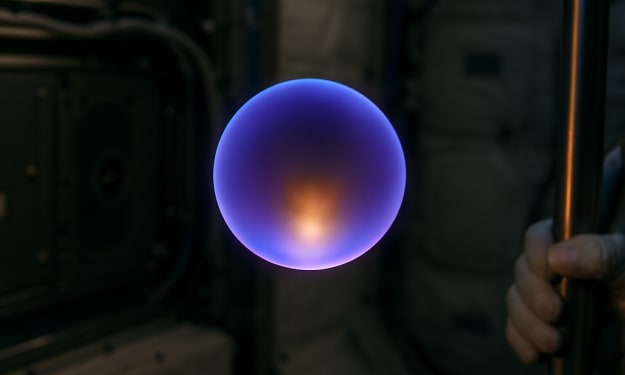
The Curious Case of Space Fire: Why Flames Turn Spherical in Zero Gravity
When you picture a flame, you probably imagine a flickering teardrop stretching upward — the warm glow of a candle or the orange tongues of a campfire dancing toward the sky. But take that same flame into space, and something extraordinary happens: it stops stretching. Instead of a flickering tongue, it becomes a floating, glowing sphere, calm and ghostly blue.
By Holianyk Ihor2 months ago in Futurism
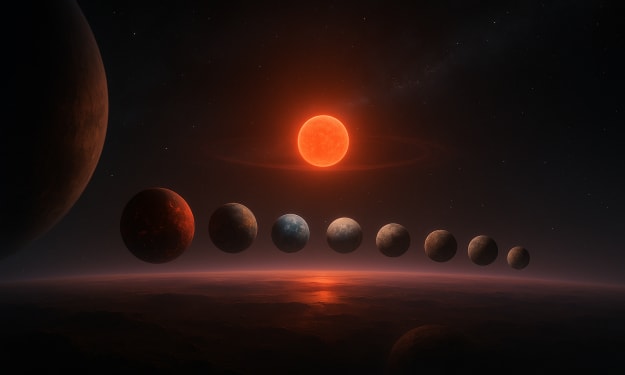
TRAPPIST-1: Seven Worlds Around a Tiny Star — and Three Could Be Alive
When astronomers announced in 2017 that a faint red star just 40 light-years away hosts seven Earth-sized planets, the news shook the world of science. For the first time, we had discovered an entire system of rocky worlds that might resemble our own. The name of that modest little star — TRAPPIST-1 — soon became synonymous with the search for life beyond Earth.
By Holianyk Ihor2 months ago in Futurism
The Largest Known Structure in the Universe: The Hercules–Corona Borealis Great Wall
A Cosmic Giant Beyond Imagination When we think of the vastness of space, our minds tend to drift toward galaxies — those shimmering islands of billions of stars. Yet even galaxies are mere grains of dust in the cosmic desert. In 2013, astronomers stumbled upon something so massive, so mind-bendingly vast, that it stretches the limits of our understanding:
By Holianyk Ihor2 months ago in Futurism
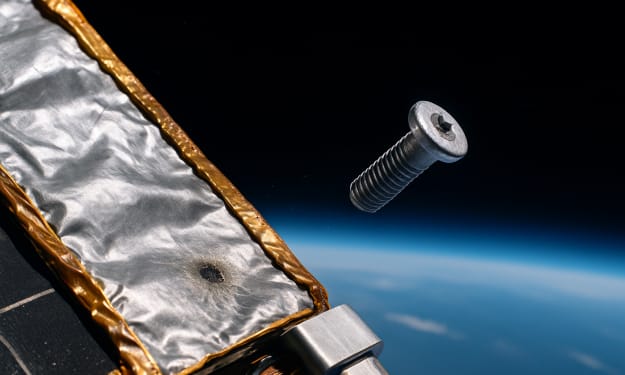
Space Junk: How a Tiny Screw Can Shatter a Satellite
High above our planet, thousands of satellites orbit Earth — connecting phones, tracking storms, and streaming your favorite shows. But along with this incredible network of technology comes a growing hazard that few of us think about: space junk.
By Holianyk Ihor2 months ago in Futurism
The Longest Human Spaceflight: Valeri Polyakov’s 437 Days Among the Stars
A Journey Beyond Limits In the vast history of human space exploration, few stories embody courage, endurance, and sheer willpower like that of Valeri Polyakov — the man who lived in space longer than anyone else. On January 8, 1994, the Russian cosmonaut launched aboard Soyuz TM-18 with one goal that sounded almost impossible: to stay in orbit long enough to test the true limits of human life beyond Earth.
By Holianyk Ihor2 months ago in Education
99.9% of the Solar System’s Mass Belongs to the Sun
When you look up at the night sky, it’s easy to think of the Solar System as a vast collection of planets, moons, asteroids, and comets — each with its own story and identity. But here’s a mind-bending truth: almost all of the Solar System’s mass is concentrated in just one object — the Sun.
By Holianyk Ihor2 months ago in Education
The Heart of the Milky Way Spins at 220 km/s — The Cosmic Dance of Our Galaxy
When we gaze up at the night sky, it feels calm and timeless. The stars appear frozen, scattered like glitter across black velvet. But in truth, our galaxy — the Milky Way — is anything but still. It’s a vast, rotating disk of hundreds of billions of stars, dust clouds, and invisible matter, all swirling together in a cosmic dance. And at the heart of it all, the center of our galaxy is spinning at an astonishing 220 kilometers per second, or roughly 800,000 kilometers per hour.
By Holianyk Ihor2 months ago in Education
Neutron Stars: Tiny Titans of the Universe
Imagine an object only 20 kilometers across—roughly the size of a city—but with a mass greater than that of our Sun. This isn’t science fiction; it’s a neutron star, one of the strangest and most extreme things the universe has ever created. These tiny cosmic powerhouses defy common sense and push the boundaries of physics itself.
By Holianyk Ihor2 months ago in Education
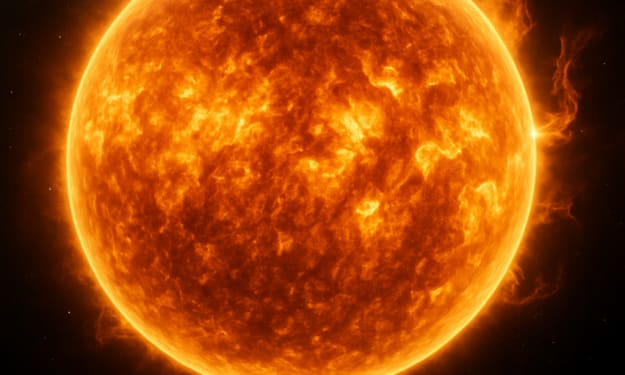
The Sun Loses 4 Million Tons Every Second — And That’s Why We’re Alive
Every second, our Sun vanishes — just a little bit. About four million tons of its mass disappear into thin air every single second. Yet, that “loss” is exactly what keeps Earth warm, oceans liquid, and life thriving. It’s one of the most mind-bending facts in all of science: the Sun literally burns itself away to light up the cosmos.
By Holianyk Ihor2 months ago in Education