
Laika: The Stray Dog Who Became the First Space Explorer
Space

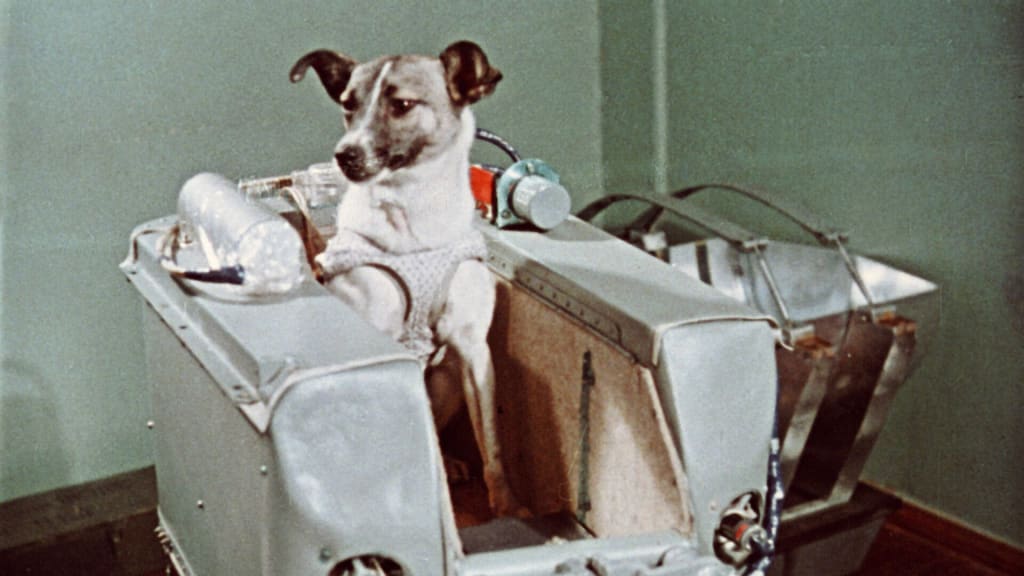
A Little Dog, a Giant Leap for Science
On November 3, 1957, a small stray dog from the streets of Moscow made history. Her name was Laika, and she became the first living creature to orbit the Earth. While humans had long dreamed of touching the stars, it was this humble dog who first crossed the boundary between our planet and the vast unknown.
Laika’s journey wasn’t just a technological experiment — it was a symbol of human ambition, courage, and the moral questions that come with scientific discovery.
From the Streets to the Stars
Laika wasn’t born in a laboratory or bred for experiments. She was a mixed-breed stray, discovered wandering the cold streets of Moscow. Soviet scientists intentionally chose street dogs because they were tough, resilient, and used to harsh conditions — the kind of animals who had already survived hunger, noise, and cold.
Laika stood out. She was calm, obedient, and affectionate — a small dog with a big heart. At just 6 kilograms (about 13 pounds), she became the chosen candidate for a mission that would forever change the course of space exploration.
Before her flight, Laika went through months of intense training. She was placed in smaller and smaller capsules to simulate the tight space of a spacecraft. She learned to eat a special high-nutrition jelly that wouldn’t float around in zero gravity. She even wore a suit equipped with sensors to monitor her heart rate and breathing.
The scientists who cared for her grew deeply attached. Many later admitted they felt torn between their love for Laika and their duty to science. One of them, Dr. Oleg Gazenko, would say years later:
“The more time we spent with her, the more we regretted what had to happen.”
A One-Way Mission
The Sputnik-2 spacecraft was launched just a month after the first Soviet satellite, Sputnik-1, stunned the world. This new mission was rushed — there was enormous political pressure to outpace the United States in the Space Race. As a result, Sputnik-2 was not designed for return. There was no plan to bring Laika back safely.
On launch day, November 3, Laika was placed inside her small metal cabin. As the rocket roared to life, her heartbeat tripled. But once in orbit, she calmed down, her pulse returning to near-normal. For a brief time, everything seemed to be working.
However, due to a malfunction in the thermal control system, the cabin began to overheat. Within hours, the temperature rose far beyond what any animal could endure. Laika died of overheating — a tragic end to a brave life.
For decades, the Soviet government claimed that Laika had survived for several days before being “euthanized painlessly.” It wasn’t until 2002 that the truth was publicly acknowledged: she had perished just a few hours after launch.
What We Learned from Laika
Despite her short life in space, Laika’s mission paved the way for human exploration. The data collected from her vital signs showed how a living organism responded to the stresses of spaceflight — weightlessness, vibration, and acceleration. These findings were crucial in designing life-support systems for future astronauts.
In a sense, Laika was a forerunner of humanity’s greatest adventure. Just four years later, in 1961, Yuri Gagarin became the first human to orbit the Earth — a feat made possible by the lessons learned from Laika’s journey.
But her story also forced the world to confront ethical questions about animal testing. Around the globe, people expressed sadness and outrage. Newspapers called her a “martyr for science,” and animal rights activists demanded more humane practices.
Over time, even the scientists involved admitted that the mission had raised deep moral concerns. Gazenko later said,
“We did not learn enough from the mission to justify the death of the dog.”
Legacy of a Space Pioneer
Today, Laika remains one of the most iconic figures in space history. In Moscow, near the place where she was trained, stands a monument in her honor — a small dog rising atop a rocket that points to the sky.
She has been remembered in countless ways: songs, films, artworks, and even stamps around the world. In pop culture, she symbolizes both the brilliance and the cost of progress.
Laika’s story isn’t just about science; it’s about sacrifice, courage, and compassion. She reminds us that exploration always comes with a price — and that behind every milestone, there are living beings who make it possible.
When we look at the night sky today, filled with satellites and space stations, it’s worth remembering that the first traveler beyond our world wasn’t human. She had four legs, a wagging tail, and a name that still echoes through the stars — Laika.
About the Creator
Keep reading
More stories from Holianyk Ihor and writers in Futurism and other communities.
The Curious Case of Space Fire: Why Flames Turn Spherical in Zero Gravity
When you picture a flame, you probably imagine a flickering teardrop stretching upward — the warm glow of a candle or the orange tongues of a campfire dancing toward the sky. But take that same flame into space, and something extraordinary happens: it stops stretching. Instead of a flickering tongue, it becomes a floating, glowing sphere, calm and ghostly blue.
By Holianyk Ihor2 months ago in Futurism
About Binding Prometheus
I want to start actively advocating on behalf of my own work, and the most valuable part of my canon is, without a doubt, Binding Prometheus, the play I have been working on since 2019 and only finished in 2023 as part of my MA. The play itself is an amalgamation of a million different inspirations. On one end, it evokes the Ancient Greek myth-play, deriving its own title from the earliest extant work of Western drama we have, Aeschylus’s Prometheus Bound. On the other end, it borrows significantly from the sci-fi bulwarks from over the years, namely Mary Shelley’s Frankenstein and Karel Capek’s Rossum’s Universal Robots. The play could be an episode of Black Mirror, I fear. I don’t know. I’ve only ever seen one episode of Black Mirror.
By Steven Christopher McKnight15 days ago in Futurism
United States Digital Signage Market Size and Forecast 2025–2033
United States Digital Signage Market The United States Digital Signage Market is anticipated to grow considerably, expanding from US$ 8.77 billion in 2024 to US$ 15.22 billion in 2033, registering a Compound Annual Growth Rate (CAGR) of 6.32% during 2025–2033. This sustained growth reflects the rising importance of visual communication, rapid technological innovation, and the increasing adoption of digital advertising and information systems across commercial, institutional, and public environments.
By Aaina Oberoi6 days ago in Futurism
Getting Serious About Comedy (Part I)
If I were asked to remark on my life and the childhood that paved some road leading me to this point, I would have to say something about all the funny people who surrounded me for the last 26,872 days (and counting). Somewhere along that road, I became a big fan of laughter and the comedy that spawns it – and, I mean not only my own laughter, but the laughter of others, some of which I have actually been responsible for inducing.
By John Oliver Smith7 days ago in Humor


Comments
There are no comments for this story
Be the first to respond and start the conversation.