
Earth’s Mysterious “Third Radiation Belt”: What NASA’s Van Allen Probes Really Discovered
Space

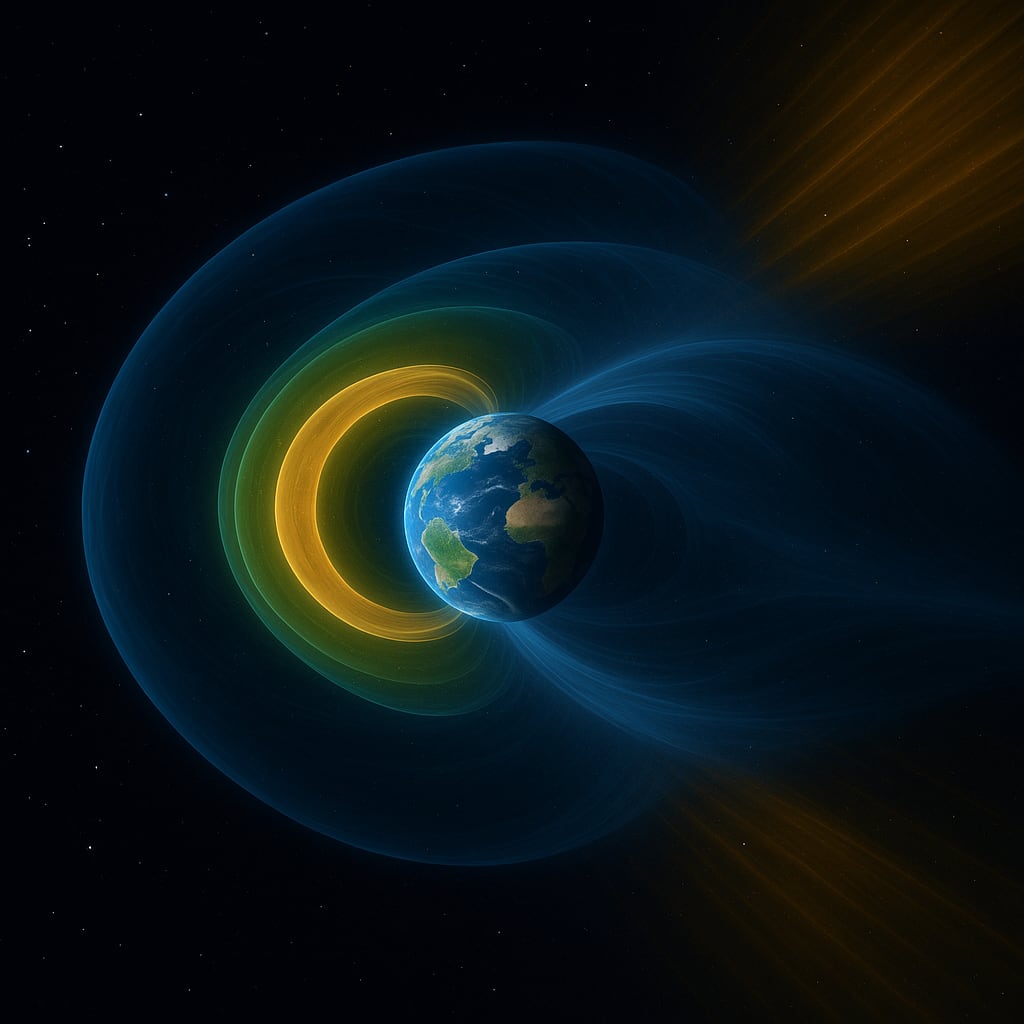
When NASA launched the twin Van Allen Probes in 2012, scientists expected to study something familiar — the two well-known belts of charged particles surrounding Earth, first discovered in 1958. These “Van Allen radiation belts” had been mapped, modeled, and largely understood.
But what the probes actually found was something no one predicted: for a few weeks in 2013, Earth had a third radiation belt.
Yes — our planet briefly wore a second “outer” ring of deadly radiation, and it vanished as mysteriously as it appeared.
The Basics: What Are the Van Allen Belts?
Imagine Earth wrapped in invisible rings made of high-energy particles, trapped by the planet’s magnetic field. These are the Van Allen radiation belts — doughnut-shaped zones filled with electrons and protons zipping around at near-light speeds.
They exist because Earth’s magnetic field captures and holds onto charged particles from the solar wind — the continuous stream of plasma released by the Sun. Most of these particles never reach the ground, thanks to our magnetic shield, but many end up spiraling around the planet in two main regions:
- The inner belt, extending from about 600 to 6,000 miles above Earth, is dense with energetic protons.
- The outer belt, stretching from roughly 8,000 to 37,000 miles up, is dominated by electrons.
Together, they act like a cosmic force field — essential for protecting life but dangerous to satellites, astronauts, and space missions that pass through.
The Discovery: A Temporary Third Ring
In early 2013, data from the Van Allen Probes stunned researchers. The instruments detected a third radiation belt — a distinct layer of high-energy electrons sandwiched between the outer belt and the boundary of Earth’s magnetic field, known as the magnetopause.
This “extra” belt wasn’t permanent. It formed after a strong solar storm, persisted for about four weeks, and then disappeared following another burst of solar activity that reshaped the entire system.
“It was as if the Earth’s radiation belts decided to rearrange themselves overnight,” said Daniel Baker, a leading scientist on the mission from the University of Colorado. “We had never seen anything like it.”
NASA called it one of the biggest surprises of the mission, and the event was widely reported as the discovery of Earth’s “third radiation belt.”
Why It Matters
At first glance, a temporary belt might sound like a small quirk. But this discovery changed how scientists think about space weather — the ever-changing interaction between solar activity and Earth’s magnetic field.
Until then, researchers thought the radiation belts were relatively stable, swelling or shrinking with solar storms but always returning to the same basic structure. The Van Allen Probes showed they are dynamic, complex, and full of surprises.
Understanding these belts isn’t just an academic exercise. Their radiation can damage satellites, interfere with GPS systems, and even endanger astronauts traveling through the region. Knowing when and how new belts form could help engineers design better shielding and plan safer flight paths.
In 1962, for instance, a U.S. high-altitude nuclear test called Starfish Prime artificially created a temporary radiation belt that disabled several satellites. The new discovery shows that nature can do something similar — but spontaneously, and without warning.
The Science Behind It
So what exactly causes these temporary belts?
The leading theory is that shock waves from solar eruptions compress Earth’s magnetic field, trapping and accelerating particles to extreme energies. Under the right conditions, this can form a narrow band of radiation distinct from the usual two belts.
Think of it like a cosmic traffic jam: the sudden influx of particles gets “stuck” in a region where the magnetic field and solar wind pressures balance just right. Eventually, another storm or geomagnetic disturbance disrupts that balance, releasing the trapped particles and erasing the belt.
These processes happen hundreds of miles above Earth’s surface, invisible to the naked eye — yet they can reshape the planet’s near-space environment in a matter of hours.
The Legacy of the Van Allen Probes
After seven years in orbit, the Van Allen Probes completed their mission in 2019. Over that time, they revolutionized our understanding of Earth’s radiation environment, collecting vast amounts of data on particle acceleration, loss mechanisms, and wave-particle interactions.
Their findings continue to influence spacecraft design, mission planning, and our understanding of how space weather affects technology on and around Earth.
As NASA’s mission statement put it, “The Van Allen Probes didn’t just confirm what we knew — they showed us how much we still have to learn.”
The Bigger Picture
The brief existence of a third radiation belt is a reminder that Earth’s space environment is alive and constantly changing. What we once thought of as static zones of radiation are, in fact, vibrant systems responding to the moods of the Sun.
It’s humbling to realize that even 65 years after the first discovery of the Van Allen belts, our own planet still holds cosmic secrets — swirling, glowing, and shifting just beyond our atmosphere.
So next time you see a beautiful aurora dancing across the polar sky, remember: that light show is part of the same invisible drama playing out in the radiation belts above. The Earth, it turns out, is not just a planet — it’s a living participant in the solar system’s electric symphony.
About the Creator
Keep reading
More stories from Holianyk Ihor and writers in Futurism and other communities.
Earth: The Only Planet That Breathes, Moves, and Holds Liquid Water
When we gaze up at the night sky — a vast ocean of stars scattered across the darkness — it’s easy to forget how special our home planet really is. Among billions of worlds orbiting distant suns, Earth stands alone. It’s the only known planet that combines two astonishing traits: active plate tectonics and liquid water flowing freely on its surface.
By Holianyk Ihor2 months ago in Futurism
About Binding Prometheus
I want to start actively advocating on behalf of my own work, and the most valuable part of my canon is, without a doubt, Binding Prometheus, the play I have been working on since 2019 and only finished in 2023 as part of my MA. The play itself is an amalgamation of a million different inspirations. On one end, it evokes the Ancient Greek myth-play, deriving its own title from the earliest extant work of Western drama we have, Aeschylus’s Prometheus Bound. On the other end, it borrows significantly from the sci-fi bulwarks from over the years, namely Mary Shelley’s Frankenstein and Karel Capek’s Rossum’s Universal Robots. The play could be an episode of Black Mirror, I fear. I don’t know. I’ve only ever seen one episode of Black Mirror.
By Steven Christopher McKnight19 days ago in Futurism
7 eCommerce App Development Companies Supporting Digital Retail Transformation in Dubai
Dubai’s retail landscape is rapidly evolving as businesses embrace digital-first and mobile-first strategies. From fashion and electronics to groceries and on-demand services, eCommerce applications now play a central role in how retailers engage customers, manage operations, and scale efficiently.
By Apptunix usa5 days ago in Futurism
Ludacris and Nelly draw backlash over bookings at MAGA-coded music festival
Ludacris and Nelly headlining a mostly right-wing event is good for them. It’s also great for the genre of hip hop. The two rap veterans have showcased their talents on other stages. Why can’t they perform for mostly MAGA folks and grab that bag?
By Skyler Saunders5 days ago in Beat


Comments
There are no comments for this story
Be the first to respond and start the conversation.