
Space Junk: How a Tiny Screw Can Shatter a Satellite
Space

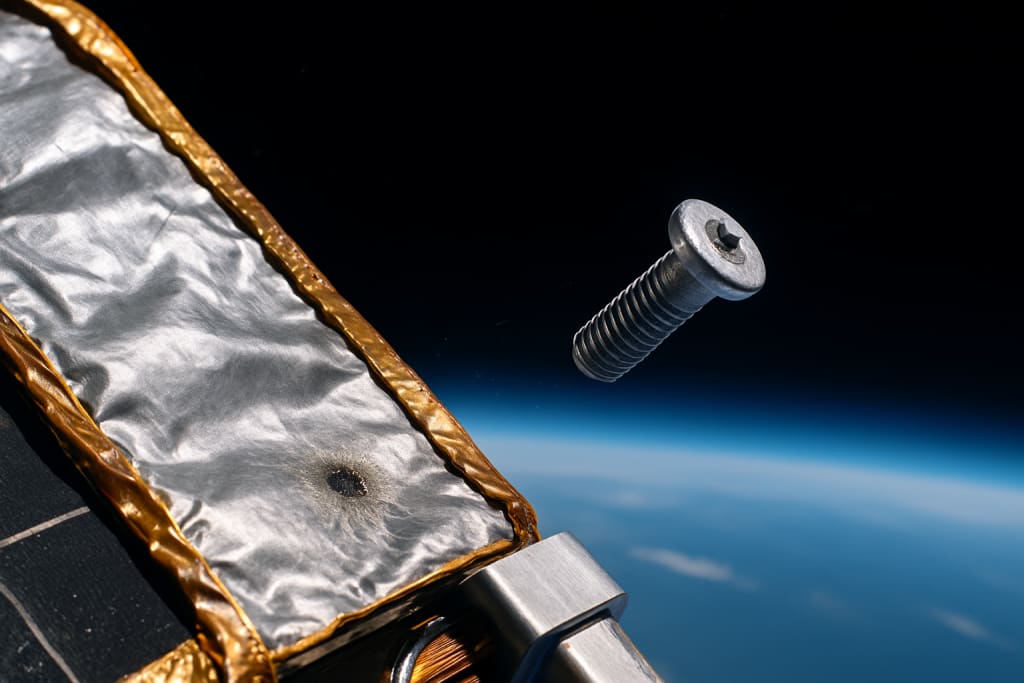
High above our planet, thousands of satellites orbit Earth — connecting phones, tracking storms, and streaming your favorite shows. But along with this incredible network of technology comes a growing hazard that few of us think about: space junk.
From shattered solar panels to paint flakes and lost bolts, millions of fragments now circle the planet at mind-boggling speeds. The most chilling part? Even a screw the size of a walnut could destroy a satellite in an instant.
Faster Than a Bullet
Objects in low-Earth orbit zip around the planet at 7 to 8 kilometers per second — roughly ten times faster than a speeding bullet. At that velocity, a piece of metal weighing just a few grams carries as much kinetic energy as a high-explosive shell.
Imagine tossing a pebble into a window at that speed — it wouldn’t just crack the glass; it would blow a hole right through it. The same physics applies to spacecraft. A tiny, untracked piece of debris can pierce a satellite’s body, rip through electronics, or puncture life-support modules.
In 2016, astronauts aboard the International Space Station (ISS) found a small crater on one of its windows. The culprit? Likely a flake of paint — a particle barely visible to the naked eye. The incident was harmless but deeply unsettling. If something that small can dent reinforced glass, what could a metal nut do?
Where Does All This Junk Come From?
The space age has been roaring since 1957, when Sputnik first beeped over our heads. In the decades since, we’ve launched thousands of rockets and spacecraft — and not all of them came home.
Every launch leaves behind leftovers:
- Expended rocket stages;
- Defunct satellites drifting without control;
- Shrapnel from explosions or collisions;
- Even lost tools and bolts from spacewalks.
Today, agencies like NASA and the European Space Agency estimate there are over 36,000 trackable objects larger than 10 centimeters and hundreds of millions of smaller particles that radar can’t even detect. Each one is a potential bullet.
The Domino Effect: Kessler Syndrome
Here’s where things get really scary. When two objects collide in orbit, they break apart — and those fragments can strike other satellites, which then shatter into even more debris.
This chain reaction is known as the Kessler Syndrome, named after NASA scientist Donald Kessler, who first described it in 1978.
If it ever spirals out of control, the space around Earth could become so cluttered with debris that future launches — and even human spaceflight — might become impossible for decades. A single catastrophic collision could trigger thousands of new projectiles, turning Earth’s orbit into a shooting gallery.
A Real-World Example: Iridium 33 and Cosmos 2251
In 2009, an American communications satellite, Iridium 33, smashed into a defunct Russian satellite, Cosmos 2251, at nearly 42,000 kilometers per hour. The impact obliterated both spacecraft and created over 2,000 pieces of debris large enough to track — and countless smaller ones that still pose a threat today.
That one crash alone increased the amount of dangerous junk in orbit by more than 10%.
How We’re Fighting Back
Cleaning up space is no easy feat — there’s no “vacuum cleaner” for orbit. But engineers around the world are testing bold solutions:
- Harpoons and nets: The European Space Agency’s ClearSpace-1 mission aims to capture defunct satellites and drag them down into the atmosphere, where they’ll burn up harmlessly.
- Lasers and tethers: Some concepts propose using ground-based lasers to nudge small debris out of orbit, or electromagnetic tethers to slow down dead satellites.
- Self-disposal systems: New spacecraft are designed to deorbit themselves after completing their missions, either by using built-in thrusters or by deploying drag sails that let atmospheric friction do the work.
On the policy side, international agreements now encourage operators to remove spacecraft from orbit within 25 years of mission end. But compliance is uneven, and commercial launches are booming — which means the junk problem is still growing.
The Hidden Mirror of Our Planet
Ultimately, the space-junk crisis reflects a familiar pattern: humanity’s tendency to expand first and clean up later.
Just as plastic fills the oceans and smog clouds the skies, debris now pollutes the vacuum beyond Earth. The difference is that in orbit, even the tiniest fragment can be lethal — and collisions can multiply exponentially.
The good news? Awareness is rising. Engineers, policymakers, and scientists are treating orbital debris as the urgent environmental issue it truly is. Because the night sky isn’t just a backdrop for technology — it’s a shared, fragile frontier.
If we want to keep exploring, we’ll have to do what we’ve long postponed on Earth: learn to clean up after ourselves — before the heavens get too crowded for us to look up in wonder.
About the Creator
Keep reading
More stories from Holianyk Ihor and writers in Futurism and other communities.
When Galaxies Collide: The Future Cosmic Dance of the Milky Way and Andromeda
A Slow-Motion Collision in the Night Far beyond the reach of our telescopes’ finest details, an extraordinary cosmic event is already underway. The Milky Way—our home galaxy—and its massive neighbor, the Andromeda Galaxy, are locked in a slow, gravitational embrace. Although they are separated by about 2.5 million light-years, the two galaxies are inching toward each other at a staggering 110 kilometers per second.
By Holianyk Ihor3 months ago in Futurism
About Binding Prometheus
I want to start actively advocating on behalf of my own work, and the most valuable part of my canon is, without a doubt, Binding Prometheus, the play I have been working on since 2019 and only finished in 2023 as part of my MA. The play itself is an amalgamation of a million different inspirations. On one end, it evokes the Ancient Greek myth-play, deriving its own title from the earliest extant work of Western drama we have, Aeschylus’s Prometheus Bound. On the other end, it borrows significantly from the sci-fi bulwarks from over the years, namely Mary Shelley’s Frankenstein and Karel Capek’s Rossum’s Universal Robots. The play could be an episode of Black Mirror, I fear. I don’t know. I’ve only ever seen one episode of Black Mirror.
By Steven Christopher McKnight14 days ago in Futurism
GCC Mental Health Market: Awareness Campaigns, Digital Therapies & Market Growth
According to IMARC Group's latest research publication, GCC mental health market size reached USD 8.6 Billion in 2024. The market is projected to reach USD 12.3 Billion by 2033, exhibiting a growth rate of 4% during 2025-2033.
By Abhay Rajput3 days ago in Futurism


Comments
There are no comments for this story
Be the first to respond and start the conversation.