
The Curious Case of Space Fire: Why Flames Turn Spherical in Zero Gravity
Space

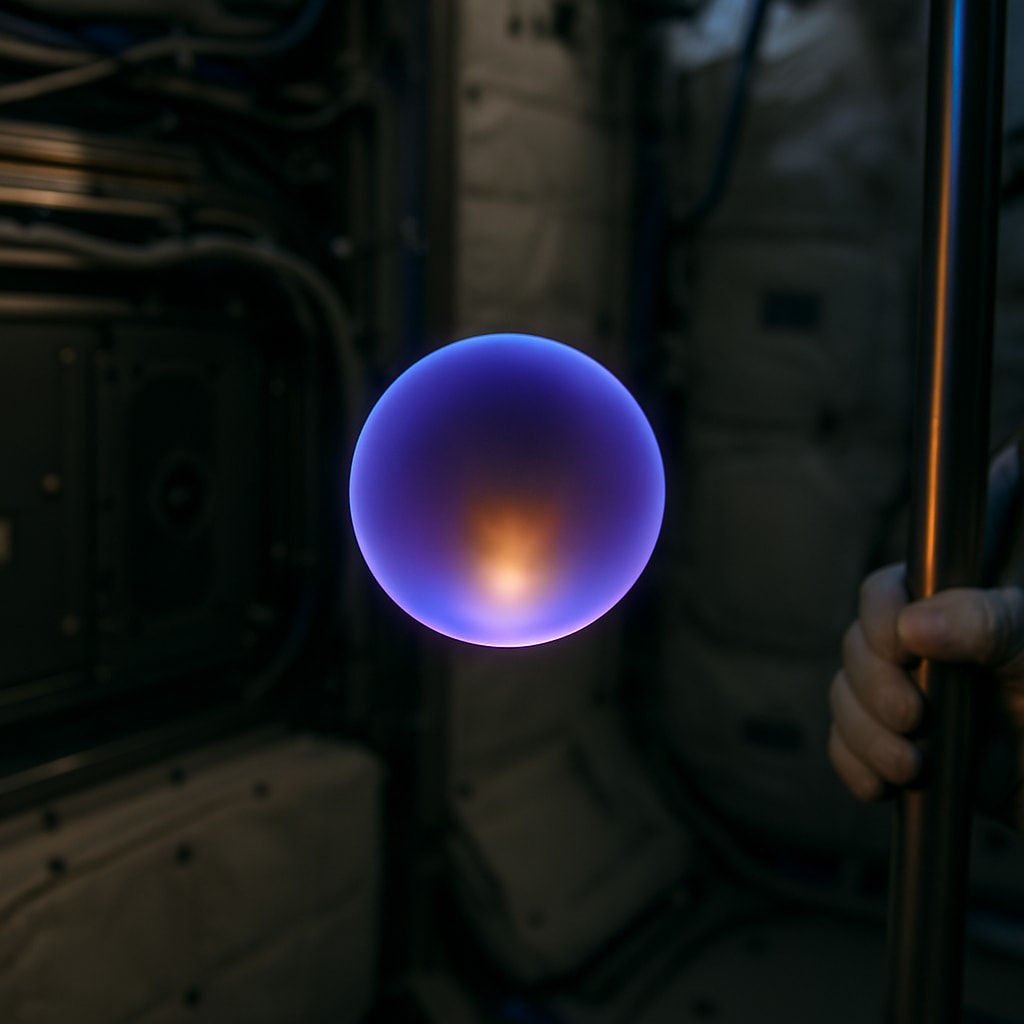
When you picture a flame, you probably imagine a flickering teardrop stretching upward — the warm glow of a candle or the orange tongues of a campfire dancing toward the sky. But take that same flame into space, and something extraordinary happens: it stops stretching. Instead of a flickering tongue, it becomes a floating, glowing sphere, calm and ghostly blue.
What happened to gravity’s favorite dance partner? To understand why fire changes its shape so dramatically in zero gravity, we have to look at one of the most underrated forces on Earth — convection.
Convection: The Hidden Sculptor of Fire
Here on Earth, hot air rises. This simple fact gives shape to nearly every flame you’ve ever seen. When something burns, it heats the surrounding air. That hot air becomes lighter than the cooler air around it and starts to rise, pulling in fresh oxygen from below. This movement — known as convection — constantly feeds oxygen to the base of the flame, stretching it upward and giving it that familiar teardrop shape.
Without convection, fire wouldn’t behave the way we expect. It wouldn’t “lean,” “reach,” or “flicker” upward, because those movements are just the visible signs of rising gases and swirling air currents. On Earth, gravity drives this invisible choreography. In space, gravity takes a holiday — and the flame must find a new way to survive.
Fire in Space: A Sphere of Calm
In the weightless environment of the International Space Station, there is no “up” or “down.” Without gravity, hot gases don’t rise, and cold air doesn’t sink. Instead, the fuel and oxygen can only mix through diffusion — a slow, random mingling of molecules that happens in all directions at once.
That’s why, in space, fire forms a sphere — the most symmetrical, stable shape possible. The reaction happens evenly in all directions, creating a small, round, and eerily steady ball of light. Instead of the energetic orange of a candle flame, it often glows blue, a sign of lower temperature and cleaner combustion.
Astronauts who have observed these “microgravity flames” describe them as almost hypnotic. They don’t flicker or wave. They hover silently — a perfect bubble of light in a world where “up” no longer exists.
Slow Fire: When Burning Takes Its Time
A space flame isn’t just round — it’s also slow. On Earth, convection rapidly delivers oxygen to the burning fuel and sweeps away waste gases. In microgravity, with no air currents to help, oxygen molecules have to wander toward the flame molecule by molecule. That makes the process far less efficient.
The result is a cooler, slower, and more complete burn. Ironically, even though the flame looks smaller and gentler, it may actually produce fewer soot particles — a hint at how different the chemistry of combustion becomes when gravity steps out of the equation.
This difference has led scientists to rethink what “burning” even means. In some experiments, researchers have observed “cool flames” that continue burning at temperatures so low they’d be impossible on Earth. These faint blue glows might hold the key to cleaner engines and more efficient fuel use in the future.
Why NASA and Scientists Care About Fire in Space
Studying flames in zero gravity isn’t just an interesting visual experiment — it’s serious science. NASA’s Combustion Integrated Rack aboard the International Space Station has hosted dozens of experiments on how different fuels burn in microgravity. Understanding these processes can help engineers design cleaner, safer combustion systems on Earth.
For instance, when car engines or power plants burn fuel, some of the energy is lost to turbulence and incomplete combustion — both of which are influenced by gravity and convection. By studying flames in an environment without those effects, scientists can isolate the pure chemical reactions and learn how to make them more efficient.
There’s also a very practical reason for this research: fire safety in space. If a fire ever broke out on a spacecraft, it wouldn’t behave like one on Earth. It might spread silently in all directions instead of racing upward. Understanding how fire grows and dies in zero gravity helps engineers design better fire suppression systems for future missions to the Moon, Mars, and beyond.
The Beauty of a Floating Flame
There’s something mesmerizing about the image of a small blue sphere of fire floating in the quiet of space. It’s both alien and familiar — a reminder that even the most ordinary forces, like gravity, can completely transform nature’s behavior.
On Earth, fire is wild and vertical, constantly fighting against gravity. In space, it becomes a slow, self-contained orb — peaceful, patient, and surprisingly beautiful. The transformation shows us how deeply our everyday experiences depend on unseen physical laws.
The next time you light a candle, watch how the flame leans upward. That simple motion is gravity’s fingerprint. Now imagine that same flame drifting in space, perfectly round, suspended like a miniature sun. It’s the same fire — just freed from Earth’s pull, glowing quietly in the dark.
About the Creator
Keep reading
More stories from Holianyk Ihor and writers in Futurism and other communities.
TRAPPIST-1: Seven Worlds Around a Tiny Star — and Three Could Be Alive
When astronomers announced in 2017 that a faint red star just 40 light-years away hosts seven Earth-sized planets, the news shook the world of science. For the first time, we had discovered an entire system of rocky worlds that might resemble our own. The name of that modest little star — TRAPPIST-1 — soon became synonymous with the search for life beyond Earth.
By Holianyk Ihor2 months ago in Futurism
About Binding Prometheus
I want to start actively advocating on behalf of my own work, and the most valuable part of my canon is, without a doubt, Binding Prometheus, the play I have been working on since 2019 and only finished in 2023 as part of my MA. The play itself is an amalgamation of a million different inspirations. On one end, it evokes the Ancient Greek myth-play, deriving its own title from the earliest extant work of Western drama we have, Aeschylus’s Prometheus Bound. On the other end, it borrows significantly from the sci-fi bulwarks from over the years, namely Mary Shelley’s Frankenstein and Karel Capek’s Rossum’s Universal Robots. The play could be an episode of Black Mirror, I fear. I don’t know. I’ve only ever seen one episode of Black Mirror.
By Steven Christopher McKnight12 days ago in Futurism
United States Brain Computer Interface Market Size and Forecast 2025–2033
United States Brain Computer Interface Market The United States Brain Computer Interface (BCI) Market is expected to reach US$ 53.66 billion by 2033, up from US$ 47.51 billion in 2024, growing at a CAGR of 1.36% from 2025 to 2033, according to Renub Research. While the growth rate may appear modest compared to other emerging technologies, the strategic importance of BCIs continues to rise as healthcare, defense, rehabilitation, and consumer wellness converge around neurotechnology.
By Janine Root 3 days ago in Futurism




Comments
There are no comments for this story
Be the first to respond and start the conversation.