

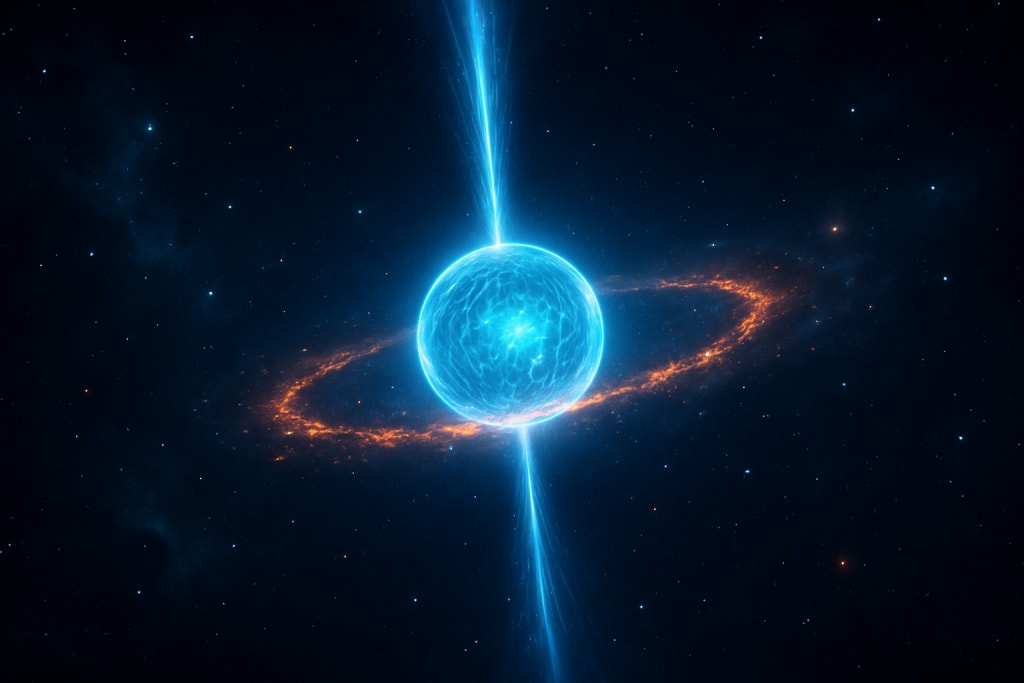
Imagine an object only 20 kilometers across—roughly the size of a city—but with a mass greater than that of our Sun. This isn’t science fiction; it’s a neutron star, one of the strangest and most extreme things the universe has ever created. These tiny cosmic powerhouses defy common sense and push the boundaries of physics itself.
From Death Comes Extremity
Neutron stars are born in cataclysmic violence. When a massive star—typically between eight and twenty times the mass of the Sun—runs out of nuclear fuel, its life ends in a spectacular supernova explosion. In that instant, the outer layers of the star are blasted into space, while the core collapses inward under its own immense gravity. What’s left behind is the densest stable form of matter known in the universe.
During this collapse, the atoms inside the star are crushed to such an extent that protons and electrons fuse together, forming neutrons. Imagine packing the mass of a million Earths into a sphere no wider than Manhattan Island. That’s a neutron star.
To put this into perspective: a single teaspoon of neutron-star material would weigh around a billion tons—as much as Mount Everest. If you dropped it onto Earth, it would punch through the planet like a bullet through tissue paper.
A Dance of Light and Magnetism
Neutron stars don’t just sit quietly in space—they spin, sometimes at unbelievable speeds. Some rotate hundreds of times per second, a phenomenon that would tear any normal planet or star apart. Because their magnetic fields are also incredibly strong—up to a trillion times stronger than Earth’s—they generate beams of electromagnetic radiation that sweep across the cosmos like lighthouses.
When one of those beams happens to point toward Earth, we see it as a pulse of light. These stars are known as pulsars, and they act as the universe’s most precise natural clocks. Some pulsars are so regular that their pulses are more consistent than the ticking of atomic clocks used in laboratories. Astronomers even use them as navigation beacons for spacecraft and to detect subtle ripples in spacetime known as gravitational waves.
The Physics of the Impossible
Standing on the surface of a neutron star—if such a thing were even possible—would be like standing under 200 billion times Earth’s gravity. A human body would be crushed flat instantly, and even atoms themselves would be distorted. Space and time are so warped near these objects that light bends around them, allowing observers to see parts of the star that are technically hidden behind it.
Neutron stars also defy our understanding of matter. Deep inside, pressure becomes so extreme that even neutrons might break down into a sea of exotic particles, or perhaps even quark matter—the same primordial stuff that filled the universe moments after the Big Bang. Physicists still don’t fully understand how matter behaves at these densities. That’s why neutron stars are often called natural laboratories for extreme physics.
When Two Titans Collide
As if their existence weren’t already dramatic enough, neutron stars can also collide. When two of them orbit each other for long enough, gravitational radiation causes their dance to tighten until they finally merge in a titanic explosion known as a kilonova.
Such collisions release more energy in a few seconds than our Sun will emit in its entire lifetime. The cosmic shockwaves ripple through spacetime as gravitational waves, first directly detected by the LIGO observatory in 2017 from just such a neutron-star merger. Even more astonishing: these cataclysmic events are responsible for creating heavy elements like gold and platinum. Every gold ring or necklace on Earth may owe its existence to a pair of neutron stars that collided billions of years ago.
Small, but Monumental
Despite their tiny size, neutron stars hold the key to some of the biggest mysteries in astrophysics. They help scientists test Einstein’s theory of general relativity under the most extreme conditions known. They also offer insight into how matter behaves when pushed beyond the limits we can recreate on Earth.
Think of them as cosmic paradoxes—objects that are both small and vast, simple and complex, dead yet incredibly dynamic. Their very existence challenges the way we understand physics and reminds us that the universe still holds secrets that no laboratory can match.
A Final Thought
In the grand scale of the cosmos, neutron stars are barely specks—tiny points of light scattered across galaxies. Yet each one is a testament to the universe’s power to transform destruction into wonder. They are the dense, spinning hearts of dead stars, still echoing with the energy of their violent birth.
If the Sun is a brilliant symphony of life and light, a neutron star is the final, haunting note—a whisper from the edge of physics itself. Small enough to fit inside a city, yet heavy enough to warp spacetime, these celestial enigmas remind us that sometimes the most extraordinary power comes in the smallest form.
About the Creator
Keep reading
More stories from Holianyk Ihor and writers in Education and other communities.
The Sun Loses 4 Million Tons Every Second — And That’s Why We’re Alive
Every second, our Sun vanishes — just a little bit. About four million tons of its mass disappear into thin air every single second. Yet, that “loss” is exactly what keeps Earth warm, oceans liquid, and life thriving. It’s one of the most mind-bending facts in all of science: the Sun literally burns itself away to light up the cosmos.
By Holianyk Ihor3 months ago in Education
UMPCO Inc: My Insider View on an Unsung Aerospace Fastener Maker
When I first learned about UMPCO Inc, I had no idea how deep its influence ran through aviation and aerospace hardware. Today, I want to take you behind the scenes of this fastener and hardware solutions manufacturer — a company that quietly supports every aircraft clip, clamp, and bracket that helps keep our skies safe.
By Beckett Dowhan3 days ago in Education
Getting Started with Still Fishing: A Beginner’s Guide
A Beginner’s Guide to Still Fishing So, you’ve decided to take up fishing, and after a quick search online, still fishing catches your eye. The name alone probably makes it sound easy, right? Just sit back, relax, and wait for the fish to bite.
By Irimia Raresa day ago in Education




Comments
There are no comments for this story
Be the first to respond and start the conversation.