
Earth: The Only Planet That Breathes, Moves, and Holds Liquid Water
Space

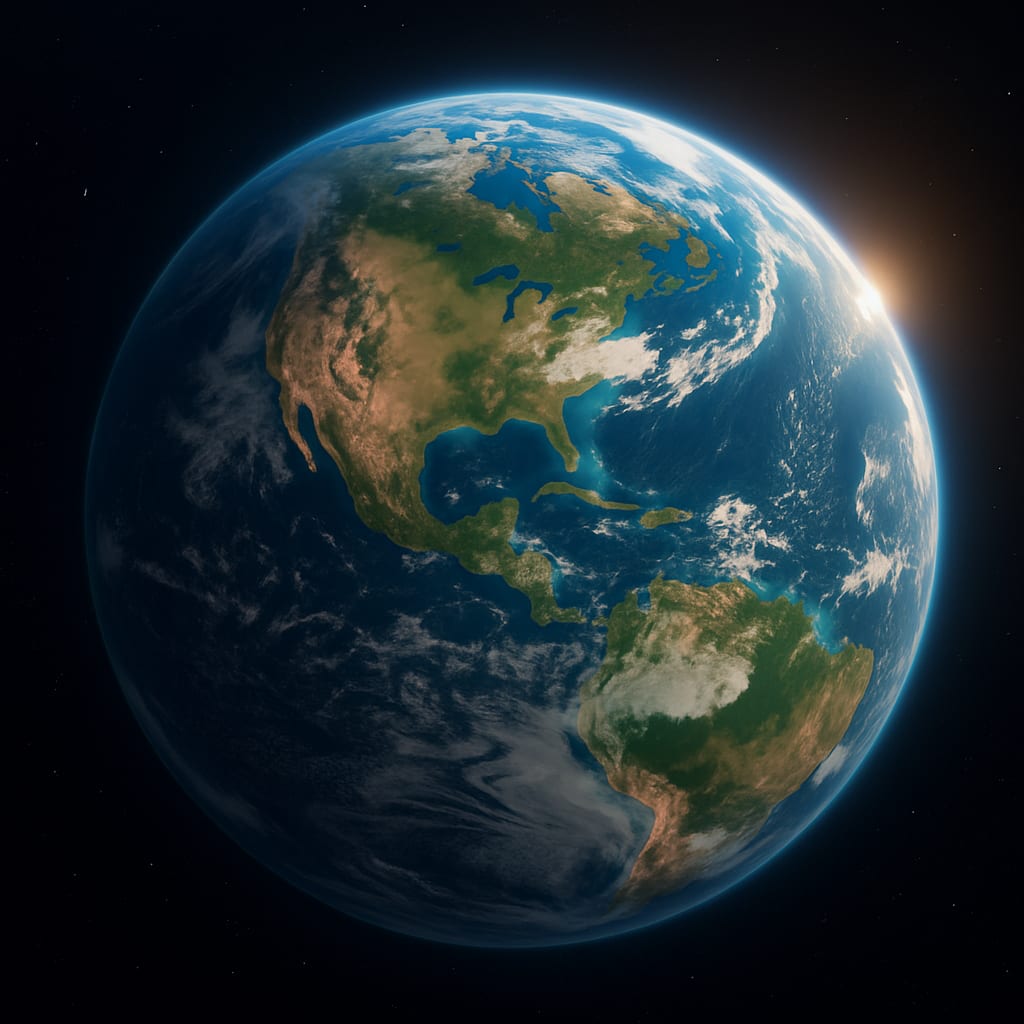
When we gaze up at the night sky — a vast ocean of stars scattered across the darkness — it’s easy to forget how special our home planet really is. Among billions of worlds orbiting distant suns, Earth stands alone. It’s the only known planet that combines two astonishing traits: active plate tectonics and liquid water flowing freely on its surface.
That rare partnership doesn’t just shape mountains and oceans — it’s what makes our world alive. Without it, Earth might have been as dry as Mars or as suffocating as Venus. Instead, it became a self-regulating, ever-changing world capable of supporting life in incredible diversity.
A Planet That Moves Beneath Our Feet
Deep beneath us, Earth never truly rests. Its outer shell — the lithosphere — is broken into a mosaic of massive slabs called tectonic plates. These plates drift slowly across the planet’s molten mantle, colliding, sliding, and pulling apart. The results are dramatic: continents drift, mountain ranges rise, volcanoes erupt, and earthquakes rumble through the crust.
But beyond these spectacular displays of power, tectonics performs a quieter, more crucial role: it stabilizes Earth’s climate.
When volcanoes erupt, they release carbon dioxide and other gases into the atmosphere. Over time, these gases are absorbed by rocks and oceans — a delicate balance that acts like a natural thermostat. Without this slow recycling of carbon, the planet could have swung between extremes: freezing over like Mars or overheating like Venus.
In short, plate tectonics is the heartbeat of Earth’s long-term stability. It’s not just a geological curiosity — it’s the process that makes life sustainable over billions of years.
The Miracle of Liquid Water
Nowhere else in the solar system do we see oceans shimmering under the sun, rivers carving valleys, or clouds forming gentle rain. On Earth, water exists in all three states — solid, liquid, and gas — and constantly cycles through them in a magnificent dance.
Glaciers grind mountains into dust. Rivers carry minerals to the sea. Evaporation feeds clouds, and rain returns nourishment to the soil. This endless hydrological cycle doesn’t just shape the planet — it fuels every form of life we know.
Water is more than a chemical compound. It’s the architect of ecosystems. It dissolves nutrients, transports heat, and even shapes the chemistry of our cells. Every leaf that photosynthesizes, every organism that breathes, every heartbeat — all of it depends on the presence of water in its liquid form.
Even when we look beyond Earth, the presence of water remains one of the key signs scientists search for when hunting for life. Mars once had rivers, but they’re now dry channels of dust. Europa and Enceladus — icy moons of Jupiter and Saturn — may hide oceans beneath their frozen shells, but their waters lie trapped beneath kilometers of ice, far from sunlight.
Earth’s oceans, in contrast, sparkle openly under blue skies. That’s what makes our planet unique.
A Perfect Partnership: Rock and Water
Here’s where things get truly fascinating — Earth’s tectonic activity and liquid water don’t just coexist; they depend on each other.
Water seeps deep into cracks in the crust, where it lubricates tectonic plate boundaries. This reduces friction and allows plates to move more easily. Without that fluidity, Earth’s crust might lock up, halting the planet’s geological “breathing.”
Meanwhile, tectonic activity constantly renews and circulates water. Subducting plates drag oceanic crust — and with it, water — deep into the mantle. Then, through volcanic eruptions, that water returns to the surface, enriching the atmosphere and feeding the oceans again.
This cycle of stone and sea is self-sustaining, balancing gases, minerals, and temperature over eons. It’s as if Earth has found the perfect rhythm — one that keeps it geologically active and biologically fertile at the same time.
Lessons from Our Living Planet
Understanding this interplay helps scientists not only appreciate our world but also predict the futures of others. Could exoplanets around distant stars have similar conditions? Some might have oceans but no tectonics — and thus, no long-term climate stability. Others might be geologically active but bone-dry, unable to sustain life on the surface.
In the search for habitable worlds, scientists now look for the subtle signs of a moving crust and liquid water. It’s a reminder that life requires more than just a comfortable temperature or sunlight — it needs a planet that changes, recycles, and adapts.
The Breath of a Planet
Earth is not a static rock drifting through space. It is a living system, breathing through volcanic vents, pulsing through earthquakes, whispering through waves. Its tectonic plates act like lungs, exchanging materials between the depths and the sky. Its oceans act like blood, circulating energy and nutrients across the globe.
When we feel the tremor of an earthquake or watch a storm roll across the sea, we’re witnessing the living pulse of our planet — a dance that has lasted for billions of years.
And so, while countless worlds may glitter in the cosmos, only one — so far — breathes, moves, and sustains life.
That world is home.
About the Creator
Keep reading
More stories from Holianyk Ihor and writers in Futurism and other communities.
Laika: The Stray Dog Who Became the First Space Explorer
A Little Dog, a Giant Leap for Science On November 3, 1957, a small stray dog from the streets of Moscow made history. Her name was Laika, and she became the first living creature to orbit the Earth. While humans had long dreamed of touching the stars, it was this humble dog who first crossed the boundary between our planet and the vast unknown.
By Holianyk Ihor2 months ago in Futurism
About Binding Prometheus
I want to start actively advocating on behalf of my own work, and the most valuable part of my canon is, without a doubt, Binding Prometheus, the play I have been working on since 2019 and only finished in 2023 as part of my MA. The play itself is an amalgamation of a million different inspirations. On one end, it evokes the Ancient Greek myth-play, deriving its own title from the earliest extant work of Western drama we have, Aeschylus’s Prometheus Bound. On the other end, it borrows significantly from the sci-fi bulwarks from over the years, namely Mary Shelley’s Frankenstein and Karel Capek’s Rossum’s Universal Robots. The play could be an episode of Black Mirror, I fear. I don’t know. I’ve only ever seen one episode of Black Mirror.
By Steven Christopher McKnight18 days ago in Futurism
Rachel Reviews: The Spiral Archive by Pieter Hendrik
It's difficult for me to know where to start with a review of this book as it was, for me, an entirely unique experience and one that I'll probably never have again. I don't want that to be interpreted as unenjoyable but it has left me scratching my head a little and ruminating on its content, its themes and its characters.
By Rachel Deeminga day ago in BookClub


Comments
There are no comments for this story
Be the first to respond and start the conversation.