
TRAPPIST-1: Seven Worlds Around a Tiny Star — and Three Could Be Alive
Space

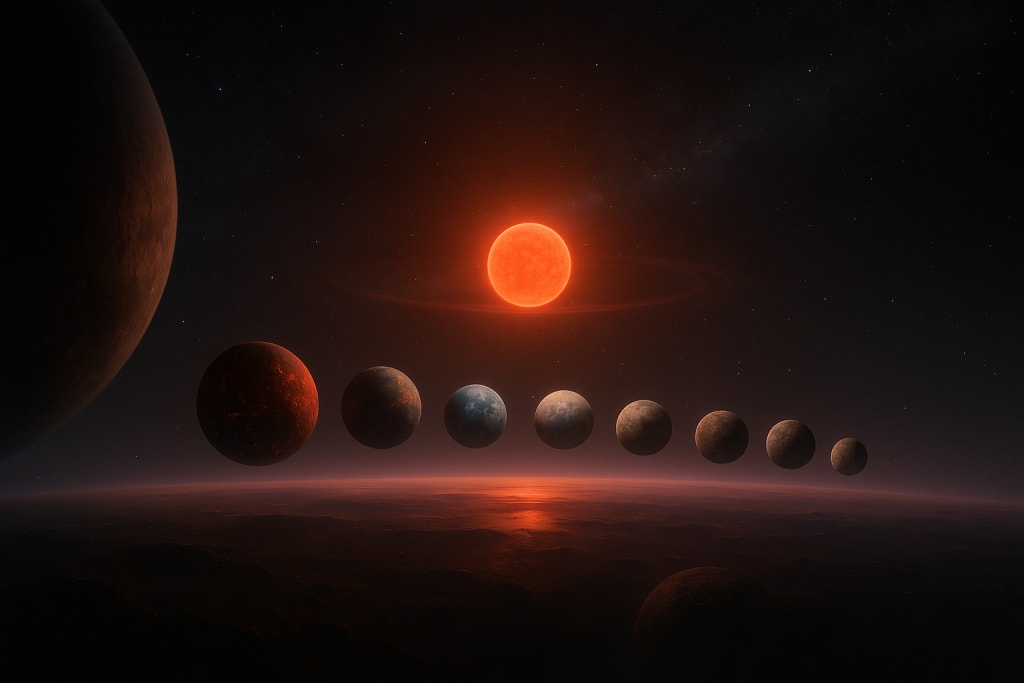
When astronomers announced in 2017 that a faint red star just 40 light-years away hosts seven Earth-sized planets, the news shook the world of science. For the first time, we had discovered an entire system of rocky worlds that might resemble our own. The name of that modest little star — TRAPPIST-1 — soon became synonymous with the search for life beyond Earth.
Eight years later, this cosmic family still fascinates researchers. Could one of its planets be habitable? And what can TRAPPIST-1 teach us about our own fragile home world?
A Star That Barely Shines — but Lasts Forever
TRAPPIST-1 is no ordinary star. It’s a ultracool red dwarf, a category of stars that burn their fuel so slowly they can live for trillions of years — far longer than our Sun. It’s tiny: only about 12% of the Sun’s size and less than a thousandth of its brightness. If our Sun were a blazing lighthouse, TRAPPIST-1 would be a dim red ember glowing in the dark.
But that dimness is exactly what makes it special. Because it’s so cool, its planets can orbit extremely close and still have temperatures that allow liquid water — the essential ingredient for life. In fact, the entire TRAPPIST-1 system would fit comfortably inside Mercury’s orbit if placed around the Sun. Imagine seven planets all dancing in tight formation around a faint ruby-colored light.
Seven Planets, Seven Possibilities
The planets — TRAPPIST-1 b through h — are all roughly the size and mass of Earth or Venus. They orbit their star with astonishing speed: one “year” on the innermost world lasts just 1.5 Earth days, while the outermost takes about 19 days.
Three of them — TRAPPIST-1 e, f, and g — orbit in what astronomers call the habitable zone, where temperatures might allow liquid water on the surface. That’s the “Goldilocks region” — not too hot, not too cold, just right.
If you could stand on one of these planets, the star would appear ten times larger in the sky than the Sun looks from Earth, glowing a dim red or orange. The days and nights would likely look very different too — because these worlds are probably tidally locked, meaning one side always faces the star while the other is plunged in eternal night. Somewhere between those extremes, in the twilight zone, conditions might be perfect for life.
The Search for Alien Atmospheres
The excitement around TRAPPIST-1 didn’t end with its discovery. It only grew stronger when the James Webb Space Telescope (JWST) turned its golden mirrors toward this tiny system. Webb’s infrared instruments are powerful enough to “sniff” the light filtering through an exoplanet’s atmosphere during a transit — when it passes in front of its star.
By analyzing that starlight, scientists can detect the fingerprints of molecules like water vapor, carbon dioxide, or methane — all key ingredients for life as we know it.
Early results are both encouraging and sobering. Some of the inner planets appear to lack thick hydrogen envelopes, which is good news: it means they’re rocky worlds, not mini-Neptunes. But no clear evidence of water or oxygen has been found — yet. Webb will keep watching, planet by planet, teasing out their secrets.
A Laboratory for Planetary Evolution
What makes TRAPPIST-1 so extraordinary isn’t just that it hosts one possibly habitable world — it hosts seven. They likely formed from the same disk of dust and gas, yet each one evolved differently.
This gives scientists a rare opportunity: to study a complete family of planets that share the same parent star but have diverged over billions of years. By comparing them, astronomers can test theories about how planets develop atmospheres, lose water, or even become frozen or volcanic wastelands.
In a way, TRAPPIST-1 is like a time machine showing multiple alternate versions of Earth’s story. One might be an ocean world. Another could resemble Venus, shrouded in thick clouds. A third might have once been habitable but is now barren and dry.
The Deeper Meaning
The question driving this research is ancient yet profoundly modern: Are we alone?
If even one of the TRAPPIST-1 planets shows signs of biology — oxygen, methane, or something stranger — it would change everything. It would mean life isn’t a cosmic fluke, but a natural outcome wherever conditions are right.
Even if we never find aliens there, studying TRAPPIST-1 helps us understand the delicate balance that keeps Earth habitable. It reminds us that our own planet, too, is orbiting in its star’s narrow “just-right” zone — a precarious but precious gift.
Looking Ahead
Future missions may one day send giant space telescopes capable of directly imaging the TRAPPIST-1 planets, revealing clouds, continents, and perhaps even the glint of oceans. Until then, these seven tiny worlds will continue to whisper their secrets through faint flickers of starlight.
TRAPPIST-1 is a small star with a huge story — a cosmic jewel box filled with worlds that could show us where, and how, life might bloom again among the stars.
About the Creator
Keep reading
More stories from Holianyk Ihor and writers in Futurism and other communities.
The Largest Known Structure in the Universe: The Hercules–Corona Borealis Great Wall
A Cosmic Giant Beyond Imagination When we think of the vastness of space, our minds tend to drift toward galaxies — those shimmering islands of billions of stars. Yet even galaxies are mere grains of dust in the cosmic desert. In 2013, astronomers stumbled upon something so massive, so mind-bendingly vast, that it stretches the limits of our understanding:
By Holianyk Ihor2 months ago in Futurism
About Binding Prometheus
I want to start actively advocating on behalf of my own work, and the most valuable part of my canon is, without a doubt, Binding Prometheus, the play I have been working on since 2019 and only finished in 2023 as part of my MA. The play itself is an amalgamation of a million different inspirations. On one end, it evokes the Ancient Greek myth-play, deriving its own title from the earliest extant work of Western drama we have, Aeschylus’s Prometheus Bound. On the other end, it borrows significantly from the sci-fi bulwarks from over the years, namely Mary Shelley’s Frankenstein and Karel Capek’s Rossum’s Universal Robots. The play could be an episode of Black Mirror, I fear. I don’t know. I’ve only ever seen one episode of Black Mirror.
By Steven Christopher McKnight13 days ago in Futurism
Europe Commercial Drone Market Size & Forecast 2026–2034
The Europe commercial drone market is set to witness significant growth, expanding from US$ 9.43 billion in 2025 to US$ 19.02 billion by 2034, driven by rising adoption across construction, agriculture, logistics, public safety, and environmental monitoring. This trajectory represents a CAGR of 8.11% during 2026–2034. Improved drone technology, maturing regulatory frameworks, and the growing demand for aerial data and automation are accelerating development across the region. According to Renub Research, Europe’s commercial drone ecosystem is transitioning from experimental deployments to essential, revenue-generating infrastructure for modern industry.
By Renub Research5 days ago in Futurism


Comments
There are no comments for this story
Be the first to respond and start the conversation.