
99.9% of the Solar System’s Mass Belongs to the Sun
Space

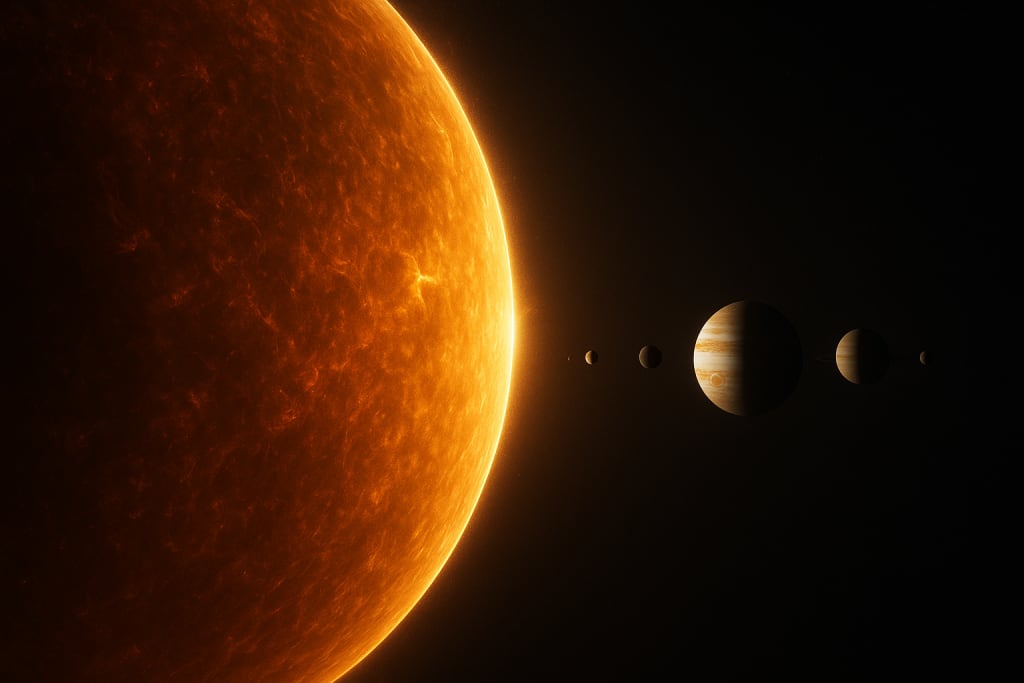
When you look up at the night sky, it’s easy to think of the Solar System as a vast collection of planets, moons, asteroids, and comets — each with its own story and identity. But here’s a mind-bending truth: almost all of the Solar System’s mass is concentrated in just one object — the Sun.
Yes, that fiery sphere dominating our daytime sky makes up about 99.86% of everything that exists in our celestial neighborhood. Everything else — from massive Jupiter down to tiny grains of cosmic dust — shares the remaining 0.14%. Let’s explore what that means and why it’s such an extraordinary fact of cosmic architecture.
A Star That Outweighs Everything Else
The Sun weighs roughly 1.989 × 10³⁰ kilograms — that’s nearly 333,000 times the mass of Earth. If you tried to put the entire Solar System on a scale, the pointer would barely twitch when the planets were added after the Sun.
To put it another way: if the Solar System were a bank account with one trillion dollars, the Sun would own 999 billion of it. The rest of the planets would be left to split the remaining billion among themselves — and even there, Jupiter would walk away with the largest share.
Jupiter, the gas giant, accounts for about 70% of all non-solar mass, making it the second most massive body in the system. In contrast, Earth — our vibrant blue home — contributes only a microscopic 0.0003% to the Solar System’s total weight. It’s humbling to realize that everything we know, every mountain and ocean, every person who’s ever lived, fits into a fraction of a fraction of that remaining sliver.
How the Solar System Was Built
This imbalance didn’t happen by chance. Around 4.6 billion years ago, the Solar System began as a swirling cloud of gas and dust known as a solar nebula. Under the force of gravity, this cloud started to collapse inward. Most of the material fell toward the center, where pressure and temperature rose dramatically — giving birth to the Sun.
The leftover gas and dust — just a small fraction of the original cloud — flattened into a disk around the young Sun. From that cosmic debris, the planets and smaller bodies formed. In essence, the Sun is made of the same raw materials as the planets, but it simply kept almost all of it for itself.
The Sun’s enormous gravity then locked the remaining matter into orbit, creating the elegant ballet of motion we see today: eight planets, countless moons, and a halo of asteroids and comets all dancing around their luminous leader.
Why the Sun’s Mass Matters
The Sun’s overwhelming mass is the reason the Solar System works at all. Its gravitational pull keeps every planet in its place. If the Sun were suddenly to vanish, the planets wouldn’t spiral into the empty space where it once was — they’d fly off in straight lines, like marbles released from a slingshot.
That same mass also fuels the Sun’s nuclear furnace. In its core, gravity compresses hydrogen atoms so tightly that they fuse into helium, releasing immense amounts of energy. Every photon of light, every warm breeze, and every growing leaf on Earth is powered by the mass of the Sun being slowly transformed into energy through fusion.
In fact, the famous Einstein equation E = mc² plays out there continuously: a tiny portion of the Sun’s mass converts into radiant energy every second. Over billions of years, that process will gradually lighten the Sun — but only by a minuscule amount compared to its vast reservoir of mass.
A Cosmic Perspective
When you think about it, the Solar System is less a collection of planets orbiting a star and more a star with some decorative companions. We often call Earth the “third planet from the Sun,” but in truth, we live in the Sun’s outer atmosphere — wrapped in its light, bathed in its solar wind, and sustained by its energy.
It’s easy to romanticize planets because they’re tangible, diverse, and sometimes habitable. Yet, the real story of our cosmic home is the Sun’s story. It is both the creator and the caretaker, shaping everything that orbits it.
Even the boundaries of the Solar System — marked by the distant heliopause, where the Sun’s influence finally fades — are defined by how far the Sun’s particles and magnetic field can reach. In a way, the Sun isn’t just at the center of the Solar System; it is the Solar System.
The Humbling Beauty of Scale
So next time you see the Sun rise, remember this: you’re witnessing the heart of a system that holds almost all its mass in one blazing sphere. We, the planets, are just the dust and leftovers — cosmic bystanders circling a nuclear inferno.
And yet, it’s precisely within that 0.1% of “leftover” material that life found a way to exist. The Sun may own nearly everything, but it’s the tiniest fraction — the rocky worlds, the oceans, and the fragile atmospheres — that make our Solar System truly remarkable.
Because sometimes, even the smallest pieces of the universe can tell the biggest stories.
About the Creator
Keep reading
More stories from Holianyk Ihor and writers in Education and other communities.
The Heart of the Milky Way Spins at 220 km/s — The Cosmic Dance of Our Galaxy
When we gaze up at the night sky, it feels calm and timeless. The stars appear frozen, scattered like glitter across black velvet. But in truth, our galaxy — the Milky Way — is anything but still. It’s a vast, rotating disk of hundreds of billions of stars, dust clouds, and invisible matter, all swirling together in a cosmic dance. And at the heart of it all, the center of our galaxy is spinning at an astonishing 220 kilometers per second, or roughly 800,000 kilometers per hour.
By Holianyk Ihor3 months ago in Education
Common Online Money
Introduction: The Dark Side of Online Earning The internet has created countless opportunities to earn money online. From freelancing and blogging to online teaching and affiliate marketing, many people now make a living from the digital world. However, along with real opportunities, the internet is also full of scams. Every year, millions of people lose money, time, and personal information because of online money-making frauds. Understanding these scams is the first step to staying safe. This article explains the most common online money-making scams and how you can avoid them.
By Bilal Mohammadi3 days ago in Education
Connected Wealth: Why Strong Networks Are Essential to Smarter Financial Planning
Financial planning is often associated with spreadsheets, forecasts, and long-term projections. While these technical elements are essential, they represent only one side of the process. Relationships, shared knowledge, and access to broader communities strengthen a truly effective financial plan. Networks—both personal and professional—play a critical role in shaping smarter, more resilient financial strategies.
By Lee Generous6 days ago in Education
So You Decided To Become a Nurse Practitioner:
So you decided to become an "Advanced Practice" nurse. Congratulations!... is what I would say if this was a good idea. Grad school? In this economy? What were you thinking? Likely it was something along the lines of either 1) “I've seen these other chucklefucks do it— Why can't I?” or even 2) “I've got a nice career, I should shake it up. I miss feeling like I have no clue what I'm doing.”
By Sandor Szabo2 days ago in Fiction


Comments
There are no comments for this story
Be the first to respond and start the conversation.