
The Sun Loses 4 Million Tons Every Second — And That’s Why We’re Alive
Space

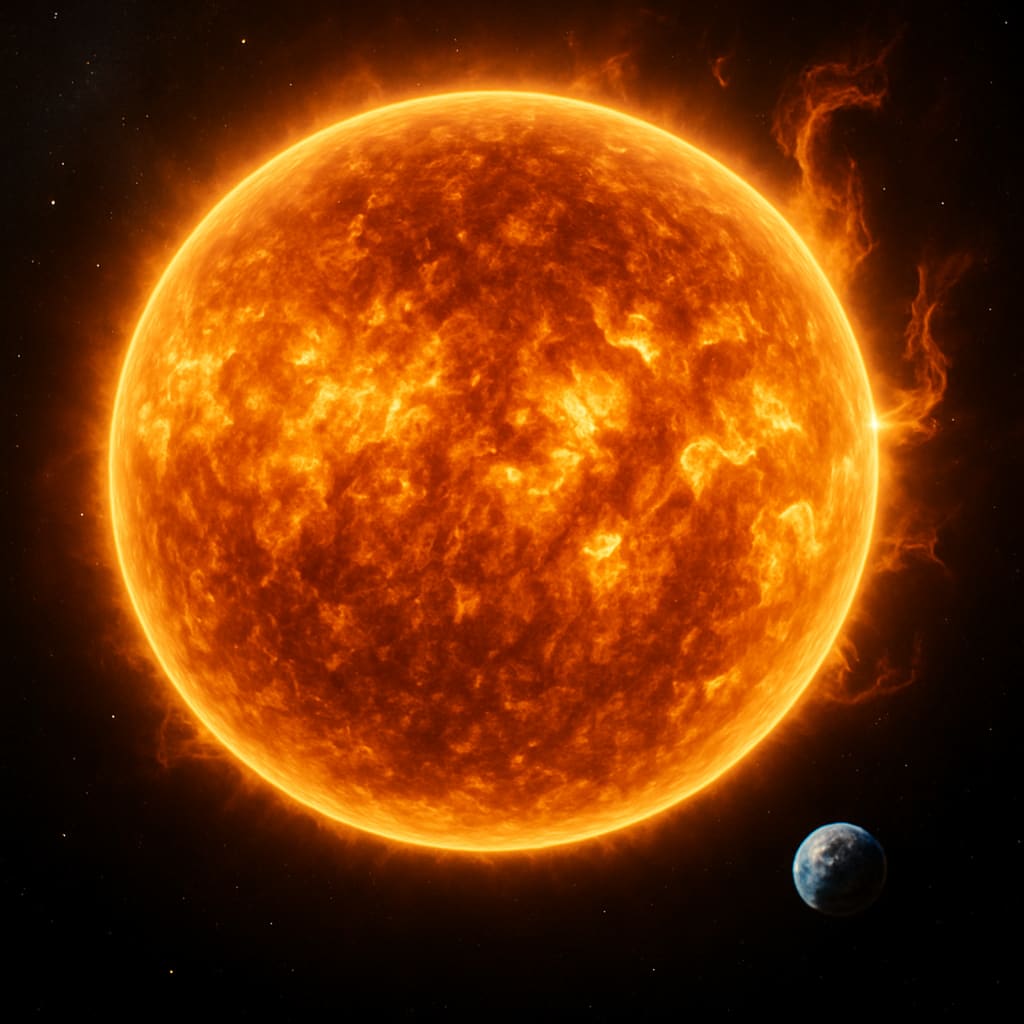
Every second, our Sun vanishes — just a little bit. About four million tons of its mass disappear into thin air every single second. Yet, that “loss” is exactly what keeps Earth warm, oceans liquid, and life thriving. It’s one of the most mind-bending facts in all of science: the Sun literally burns itself away to light up the cosmos.
Energy and Mass: Two Sides of the Same Coin
More than a century ago, Albert Einstein wrote down a short equation that changed everything:
E = mc².
It looks simple, but it hides a universe’s worth of meaning. “E” stands for energy, “m” for mass, and “c” for the speed of light. Since light travels incredibly fast — about 300,000 kilometers per second — even a tiny bit of mass can be turned into an enormous amount of energy.
That’s exactly what’s happening inside the Sun. At its core, temperatures soar to around 15 million degrees Celsius and pressures are unimaginable. Under those conditions, hydrogen atoms fuse into helium, a process called nuclear fusion. But here’s the catch: the resulting helium atom weighs slightly less than the original hydrogen atoms combined. That missing mass doesn’t just vanish — it transforms into energy, according to Einstein’s equation.
And that energy races outward as light and heat, crossing 150 million kilometers of space to reach Earth — just eight minutes after it’s created.
Four Million Tons a Second Sounds Huge — But It’s a Drop in the Solar Ocean
Let’s put those numbers into perspective.
Each second, the Sun loses about 4 million tons of its mass. Over a year, that’s roughly 126 trillion tons. To us, that sounds absurdly huge — equivalent to about 20,000 times the mass of Mount Everest disappearing annually.
But compared to the Sun’s total mass — about 2 × 10³⁰ kilograms — it’s almost nothing. The Sun is so massive that it could keep “losing weight” at this rate for billions of years and we’d barely notice.
In fact, after 4.5 billion years of shining, the Sun has lost only about 0.03% of its original mass. So don’t worry: it’s not going anywhere anytime soon.
Every Ray of Sunshine Is Lost Matter
That four million tons per second doesn’t vanish uselessly — it becomes the energy that sustains life. Every beam of sunlight warming your skin, every photosynthesizing leaf, every gust of wind or wave of the sea ultimately traces back to that sacrificed mass.
If humanity could somehow capture all the energy the Sun emits in just one second, it would be enough to power our entire civilization for millions of years. And yet, Earth only receives a tiny fraction of the Sun’s total output — about one two-billionth of it. Still, that’s plenty: without it, our planet would be a frozen rock drifting through the dark.
The Ultimate Power Plant
To understand how mind-blowingly powerful the Sun is, consider this:
Every second, its core fuses about 600 million tons of hydrogen. Of that, 596 million tons become helium, and the “missing” 4 million tons transform into pure energy.
That’s about 3.8 × 10²⁶ watts — more than a trillion times the total energy used by all of humanity. The Sun is, quite literally, the universe’s most reliable power plant. And it’s been running flawlessly for billions of years without maintenance or fuel deliveries — just gravity and physics.
What Happens to That Lost Mass?
The mass turned into energy doesn’t disappear completely. It’s carried away by light, heat, and solar particles that stream out through the solar system. Some of it bathes the planets, while some escapes into interstellar space.
Over astronomical time, this gradual mass loss actually affects the entire solar system — albeit very subtly. As the Sun loses mass, its gravitational pull weakens slightly, meaning the planets slowly drift outward. Don’t panic, though: Earth’s orbit expands by only a few centimeters per year because of this. We’ll notice… in a few billion years.
So How Long Can the Sun Keep Burning?
At its current rate of fuel consumption, scientists estimate the Sun has enough hydrogen to keep shining for another five billion years. Eventually, it will run out of hydrogen in its core, swell into a red giant, and finally shed its outer layers, leaving behind a dense, hot remnant known as a white dwarf.
By that time, the inner planets — possibly including Earth — will be scorched or engulfed. But long before then, humanity will likely have found new homes under different stars.
A Star’s Generosity
The idea that the Sun “dies” a little each second can sound melancholy. But in a cosmic sense, it’s profoundly poetic. Every flower, every ocean breeze, every heartbeat on Earth exists because four million tons of the Sun transform into life-giving energy each second.
In a way, we are all made of that sacrifice. Every sunrise is proof that matter can become light — and that destruction, under the right circumstances, can be the most beautiful form of creation.
In short:
The Sun loses 4 million tons of itself every second — and we owe our entire existence to that loss. It’s the most generous act in the universe: a star slowly giving itself away, one heartbeat of light at a time.
About the Creator
Keep reading
More stories from Holianyk Ihor and writers in Education and other communities.
Olympus Mons: The Towering Titan of Mars
When people think of the tallest mountains, Mount Everest usually comes to mind — that icy peak rising 8.8 kilometers above sea level. It’s the ultimate symbol of human endurance and the limits of Earth’s geography. But in the grand scale of the solar system, Everest looks more like a hill. Because just one planet away, on the dusty red world of Mars, there’s a mountain so colossal that Everest would barely reach a third of its height. Its name is Olympus Mons, and it stands 21 kilometers (13 miles) tall — the highest mountain known in our entire solar system.
By Holianyk Ihor3 months ago in Education
From Stove to Strategy: Steve Wolfe’s Take on Scaling Your Food Business from Kitchen to Boardroom
Every food business begins with passion—late nights in the kitchen, handwritten recipes, and the joy of seeing someone love what you’ve made. But when demand grows, passion alone isn’t enough. Scaling your food business from kitchen to boardroom requires a shift in thinking, planning, and leadership.
By Steven Joseph Wolfe4 days ago in Education




Comments
There are no comments for this story
Be the first to respond and start the conversation.