
The Longest Human Spaceflight: Valeri Polyakov’s 437 Days Among the Stars
Space

A Journey Beyond Limits
In the vast history of human space exploration, few stories embody courage, endurance, and sheer willpower like that of Valeri Polyakov — the man who lived in space longer than anyone else. On January 8, 1994, the Russian cosmonaut launched aboard Soyuz TM-18 with one goal that sounded almost impossible: to stay in orbit long enough to test the true limits of human life beyond Earth.
What followed was 437 days — nearly 14 and a half months — in microgravity, circling the Earth more than 7,000 times aboard the Mir space station. His mission wasn’t just about breaking a record. It was about finding out whether humans could survive — and stay sane — during the kind of journey it would take to reach Mars.
Life on the “Peace” Station
The Mir space station, whose name fittingly means “peace” or “world” in Russian, was both home and laboratory for Polyakov. Each day followed a rigorous schedule designed to keep body and mind sharp in an environment that constantly tested both.
Every morning began with a strict exercise routine — up to two hours on a treadmill and resistance machines — essential to combat the bone and muscle loss that occurs in weightlessness. Meals were planned down to the calorie: protein-rich, low-salt, and often rehydrated from freeze-dried packets.
Communication with Earth was limited but constant. Polyakov kept detailed logs of his health, moods, and experiments, turning himself into both subject and scientist. “If we are to travel to Mars,” he once said, “we must learn to live as a community in space — not as visitors, but as residents.”
The Psychological Frontier
The human body adapts surprisingly well to microgravity. The mind, however, is another story. Isolation, monotony, and the lack of natural day-night cycles can lead to what space psychologists call “orbital fatigue.”
For more than a year, Polyakov watched Earth glide silently below him — the blue of the oceans, the thin glow of the atmosphere, the flickering lights of continents he could not touch. He spent birthdays, holidays, and entire seasons away from family and friends.
To stay focused, he maintained a disciplined daily rhythm and engaged in long conversations with ground control. He also practiced meditation and visualization techniques — decades before mindfulness became mainstream. These mental habits proved just as important as physical training, helping him avoid depression and maintain emotional stability through endless days of silence.
Science Among the Stars
Polyakov’s mission wasn’t only about survival — it was a scientific goldmine. He conducted over 25 major biomedical experiments, studying everything from immune response and cardiovascular function to the psychological effects of prolonged confinement.
One of the key findings was that humans can adapt to long-term spaceflight without irreversible health damage, as long as they follow a strict exercise and nutrition regimen. This discovery has shaped the design of future missions, including NASA’s Artemis program and the long-term vision of sending astronauts to Mars.
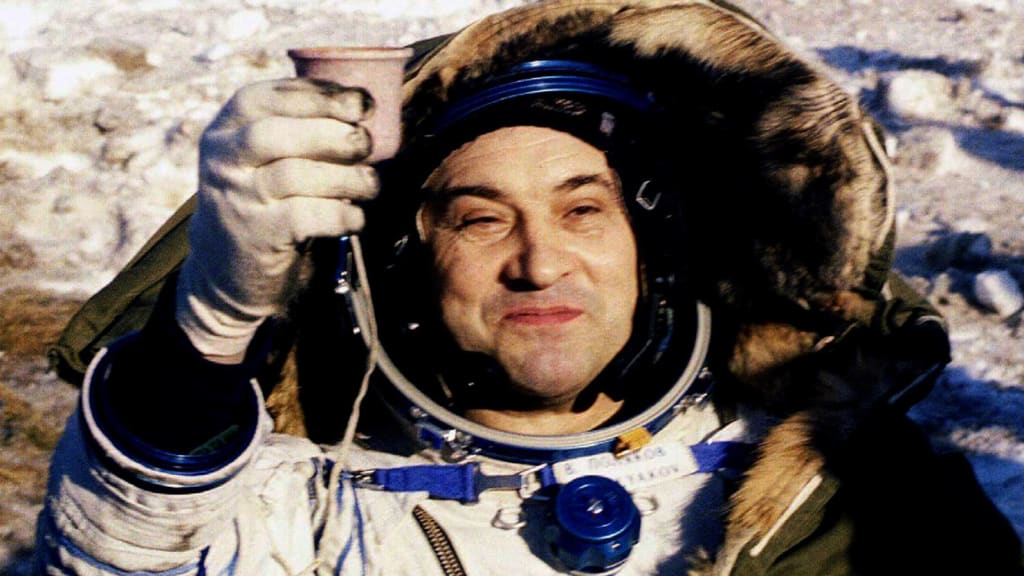
Polyakov’s body was also studied after his return to Earth — a critical part of the mission. Despite 437 days in microgravity, he walked out of the landing capsule on his own, refusing to be carried. That act — simple yet symbolic — stunned onlookers and sent a powerful message: humans are capable of much more than we imagine.
Coming Home
On March 22, 1995, Polyakov re-entered Earth’s atmosphere and landed in the Kazakh steppe. After 14 months away, gravity was an alien sensation. Every movement felt heavy. His legs trembled. But his spirit was unbroken.
In the months that followed, he underwent extensive medical examinations. The data gathered during and after his mission became a foundation for understanding how the human body and mind cope with extreme isolation and zero gravity.
Even today, no one has surpassed his record for the longest continuous human spaceflight. NASA astronauts like Scott Kelly and Christina Koch have come close, spending nearly a year in space, but Polyakov’s mark remains unmatched.
The Legacy of a Space Pioneer
Valeri Polyakov’s journey represents more than a world record. It stands as a symbol of human perseverance and curiosity — proof that our species is capable of surviving beyond the cradle of Earth. His work continues to inspire scientists, engineers, and dreamers who look to the stars not as a final frontier, but as the next home.
His mission redefined the limits of endurance and reshaped the future of space medicine. Without his sacrifice, the dream of sending humans to Mars might still seem too dangerous, too far-fetched. Thanks to Polyakov, we now know it’s possible.
Beyond Earth, Beyond Fear
Valeri Polyakov passed away in 2022, but his legacy endures every time a spacecraft leaves the atmosphere. His record, his data, and his spirit remain part of every astronaut’s training — a reminder that exploration demands not just technology, but courage and belief in human resilience.
As humanity prepares to take its next giant leap — not to the Moon, but to Mars — we carry with us the lessons of the man who lived among the stars for 437 days.
About the Creator
Keep reading
More stories from Holianyk Ihor and writers in Education and other communities.
99.9% of the Solar System’s Mass Belongs to the Sun
When you look up at the night sky, it’s easy to think of the Solar System as a vast collection of planets, moons, asteroids, and comets — each with its own story and identity. But here’s a mind-bending truth: almost all of the Solar System’s mass is concentrated in just one object — the Sun.
By Holianyk Ihor2 months ago in Education
Core Skills Every Finance Professional Needs Today
Financial analysis is one of the most critical abilities for anyone working in finance today. Companies rely on clear and accurate financial information to make smart business decisions. Finance professionals must understand how to read numbers, study trends, and guide action based on facts. These must-have financial analysis skills help workers become stronger, more confident, and more valuable in their roles. When used well, these skills support better planning, lower risk, and long-term success. Because of this, developing strong financial analysis skills is essential for finance professionals at every level.
By Andrew Lake2 days ago in Education
Navigating the Most Complex Heart Conditions
Cardiology is advancing at a remarkable pace, thanks to next-generation imaging technologies that allow doctors to see the heart in extraordinary detail. For patients with complex or rare cardiac conditions, these tools provide insights that traditional methods often miss. By combining structural, functional, and metabolic imaging, physicians can make accurate diagnoses, plan effective treatments, and monitor progress with unprecedented precision. Modern cardiac imaging is redefining how heart disease is detected and managed.
By Nishi Patel3 days ago in Education



Comments
There are no comments for this story
Be the first to respond and start the conversation.