Sergios Saropoulos
Bio
As a Philosopher, Writer, Journalist and Educator. I bring a unique perspective to my writing, exploring how philosophical ideas intersect with cultural and social narratives, deepening our understanding of today's world.
Stories (29)
Filter by community
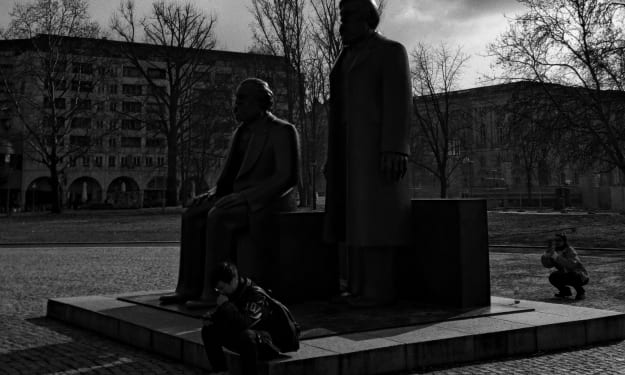
Marx’s Forgotten Paradox
Few thinkers have shaped the modern world as profoundly as Karl Marx. His ideas sparked revolutions, inspired liberation movements, and influenced entire schools of thought, from sociology to political philosophy. Yet, there remains a striking paradox at the heart of his legacy: Marx, a man deeply moved by human suffering and exploitation, consistently rejected the language of morality.
By Sergios Saropoulos4 months ago in The Swamp
Cato vs Caesar: The False Dilemma of Modern Democracy
I write this article against the backdrop of today’s political turbulence, the rise of polarisation and extremism in the United States, where hate speech and even political assassination are no longer unthinkable. These events follow an already toxic atmosphere in Europe, with authoritarian tendencies, corruption, and populist rhetoric undermining democratic institutions. In this climate, the dilemmas faced by Rome on the eve of Caesar’s rise feel less like distant history and more like an urgent mirror for our own time.
By Sergios Saropoulos5 months ago in The Swamp
Plato in the Wasteland
“We were born in the vault. We died in the vault.” — Fallout This haunting line from the videogame Fallout 3 encapsulates more than just a fictional setting; it echoes a philosophical idea, first articulated over two thousand years ago by Plato in his famous Allegory of the Cave. In this thought experiment, Plato describes a group of prisoners confined since birth in a dark cave, chained in place and forced to stare at a wall. Behind them burns a fire, and between the fire and the prisoners, puppeteers cast shadows on the wall. These shadows are all the prisoners know. To them, this play of light is reality. But one prisoner escapes and ascends to the surface, blinded at first by the sun. As his eyes adjust, he sees the real world: objects, light, and the source of what Plato perceived as the truth of all things. The perfect form of ideas. When he decides to return and free the others, they mock him, and if given the chance, would kill him for disturbing their illusion. The sure thing is that he will be met with negative and sometimes dangerous reactions from his fellow prisoners.
By Sergios Saropoulos9 months ago in Fiction
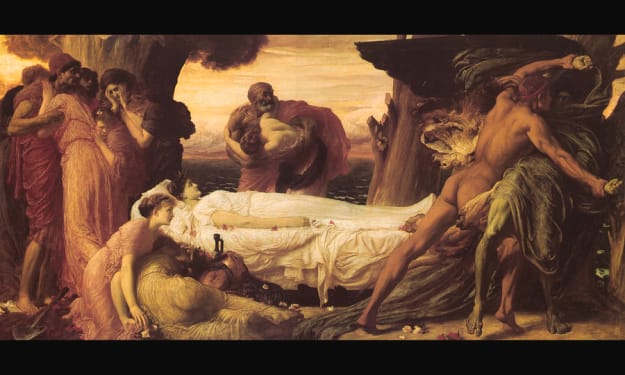
Rethinking Justice and Revenge: Echoes from the Oresteia
The stage opens with blood and ends with law. Aeschylus’ Oresteia, a trilogy of ancient Greek tragedies, charts a world suspended between the emotional and the institutional. At its heart lies a question that still haunts us: What is justice, and how does it differ from revenge? The plays present a cyclical, generational pattern of violence: Agamemnon sacrifices his daughter Iphigenia. His wife Clytemnestra murders him in return, and their son Orestes, in turn, kills her. Each act is a response to a prior harm, each justified by the language of duty, loyalty, and moral outrage. But then, something shifts. Athena intervenes, and the cycle halts. Not through more blood, but through judgment, argument, and law. What began as vengeance ends with justice, or so it seems. While the trilogy is often seen as a celebration of justice triumphing over revenge, a deeper reading reveals how both impulses share a common emotional and neurological origin. Drawing on philosophical insights from Plato and contemporary thinkers like Martha Nussbaum and Jonathan Haidt, as well as findings from neuroscience, the piece argues that justice and revenge are not opposites but reflections of the same human desire to restore moral balance. This article explores the fragile boundary between justice and revenge, using Aeschylus’ Oresteia as a philosophical lens.
By Sergios Saropoulos9 months ago in Humans
The Soul of Raskolnikov as a Mirror of Human Contradiction
Over 150 years ago, Fyodor Mikhailovich Dostoevsky published one of the best-known works of Russian literature: Crime and Punishment. First serialised in a literary magazine in 1866, the novel tells the story of Rodion Romanovich Raskolnikov, a young law student in Saint Petersburg. Since then, readers have repeatedly returned to its central, haunting questions: What drives someone to kill in cold blood? What goes through the mind of a murderer? And what kind of society breeds such individuals? These questions have remained controversial and unanswered for generations, ever since humans began to explore philosophy, logic, and psychology.
By Sergios Saropoulos9 months ago in Psyche
Cultural Protestantism and The Spirit of Austerity
It was a relatively warm night in Berlin when this article began to take shape. I was sitting in a pub in Charlottenburg, half-listening to the hum of overlapping conversations across from me, two friends were describing the economic differences between East and West Germany, and how culture still seemed to influence wealth, ambition, and social discipline. Something about it struck a nerve. This article is a reflection on that influence, on how a religious ethos may have evolved into an economic morality, shaping not just policies but entire cultures.
By Sergios Saropoulos11 months ago in The Swamp
"From Greece to Lebanon: The Shock Doctrine at Work"
"Lebanon: A Nation in Crisis" Lebanon, a country known for its rich history and cultural diversity, has been grappling with a severe crisis that has shaken its very core. From economic collapse to political turmoil, Lebanon's story is one of resilience, but also a stark warning of the consequences of neglecting a nation's welfare.
By Sergios Saropoulos3 years ago in The Swamp
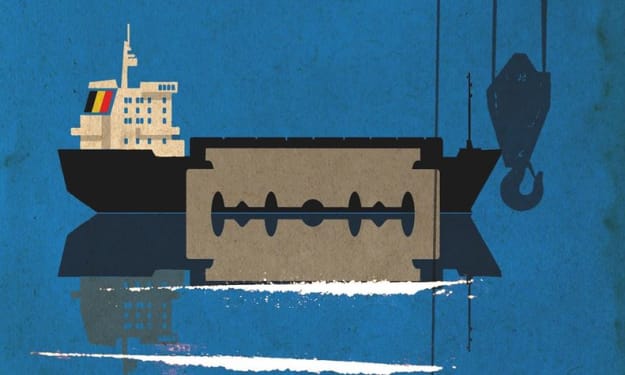
From Antwerp to Rotterdam: The Rise of Europe’s Drug Smuggling Superhighway
Organized Crime on the Rise For several years, organized crime has been expanding its influence in European markets. Traditionally involved in illegal activities such as prostitution and extortion, a new generation of criminal networks has moved into more complex operations. The drug trade, in particular, has propelled them to the top of the crime hierarchy. According to Europol, the cocaine supply chain is one of the most active and lucrative illegal trafficking networks in the world, largely due to its presence in two of Europe’s most critical entry points: the ports of Antwerp and Rotterdam.
By Sergios Saropoulos3 years ago in Criminal
The Tomb of Amphipolis: A mystery to be solved?
The Discovery of the Tomb Excavations outside the ancient Greek city of Amphipolis began as early as the 1960s. However, archaeologists initially uncovered only a perimeter wall and a few archaic tombs from the Greek Bronze Age. It was not until 2012 that another team of archaeologists made a groundbreaking discovery, a massive Macedonian tomb on a hill close to the legendary Lion of Amphipolis. The tomb was officially excavated in 2014, marking one of the most significant archaeological findings in modern Greek history.
By Sergios Saropoulos3 years ago in FYI
Do not forget the women who rebelled
Iran has a long and painful history of protests. Election fraud, economic struggles, and civil liberties have all sparked revolts over the years. However, the most recent movement represents something unprecedented. A revolution led by women, supported by men, and deeply rooted in a demand for fundamental human rights.
By Sergios Saropoulos3 years ago in Viva
Kosovo: A Century of Conflict and Tragedy
Kosovo’s past is marked by centuries of conflict, loss, and deeply rooted animosities. The names Sjenica and Meja may not be widely recognized outside the Balkans, yet they are etched into the historical memory of those who have lived through the turbulence of this region. These places have been the backdrop for acts of violence, political oppression, and shifting power dynamics that have defined the complex relationship between Serbs and Albanians.
By Sergios Saropoulos3 years ago in Humans