
Plato in the Wasteland
Reimagining Plato in a Post-Apocalyptic World: A Philosophical Journey Through Fallout, Silo, and the Allegory of the Cave"


“We were born in the vault. We died in the vault.” — Fallout
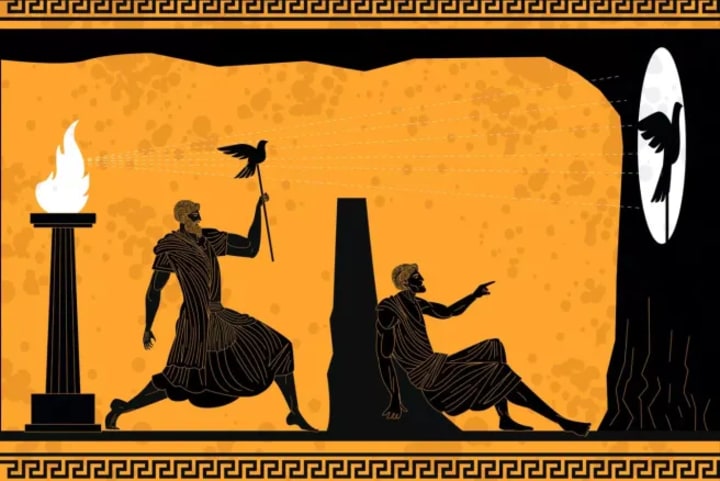
This haunting line from the videogame Fallout 3 encapsulates more than just a fictional setting; it echoes a philosophical idea, first articulated over two thousand years ago by Plato in his famous Allegory of the Cave. In this thought experiment, Plato describes a group of prisoners confined since birth in a dark cave, chained in place and forced to stare at a wall. Behind them burns a fire, and between the fire and the prisoners, puppeteers cast shadows on the wall. These shadows are all the prisoners know. To them, this play of light is reality. But one prisoner escapes and ascends to the surface, blinded at first by the sun. As his eyes adjust, he sees the real world: objects, light, and the source of what Plato perceived as the truth of all things. The perfect form of ideas. When he decides to return and free the others, they mock him, and if given the chance, would kill him for disturbing their illusion. The sure thing is that he will be met with negative and sometimes dangerous reactions from his fellow prisoners.
Every time I find myself thinking about this idea of the reaction of his former fellow prisoners, the first thing that comes to mind is the scene from "They Live", a 1988 American film written and directed by John Carpenter. Specifically, the scene where the protagonist tries to convince his friend to wear the glasses that would allow him to see the "truth" behind the consumerist propaganda imposed by an alien species on humanity to control them (the plot of the science film). What still resonates deeply inside me is what follows: a six-minute fight scene between the two of them, for something so simple on the surface, for a request from one friend to another, to wear a pair of glasses. The fight becomes a battle of wills between the two men, a dialectical struggle between two people, perhaps the Platonic prisoner who freed himself from his shackles, escaped the cave, and has seen the truth, now returning to convince his former fellow prisoner to escape. Of course, Carpenter in his allegory used the glasses as a way of portraying the hero's journey, which helped him and still helps him see the truth.

From early Christian philosophy to Enlightenment ideals, from Renaissance literature to 20th-century dystopias, the "cave’s shadows" can be seen flickering across countless works. Dante’s Divine Comedy traces a journey from darkness to light, George Orwell’s 1984 explores truth manipulation and illusion, Aldous Huxley’s Brave New World questions the cost of comfortable ignorance, and The Matrix (1999) is perhaps the most literal modern retelling, with its choice between illusion (the blue pill) and reality (the red pill).
In today’s cultural landscape, the allegory continues to evolve. Two recent and compelling reinterpretations are found in Fallout (both the longrunning video game franchise and its 2024 television adaptation) and Silo (the dystopian novel by Hugh Howey and its TV counterpart). Both worlds begin underground, in carefully constructed realities designed to keep the truth hidden. And in both, the journey toward truth is harrowing, isolating, irreversible and up to the surface. Of course, what I like in these two works is that the reality, the "truth", not only affects the former prisoner, like the light in Plato's allegory, but also shows a truth that is usually disappointing and harsh, like a world destroyed by a nuclear Armageddon.
In what follows, I will explore how these two modern narratives: Fallout and Silo, revive Plato’s cave for the 21st century, revealing how the ancient search for truth still defines our relationship with power, illusion, and freedom.
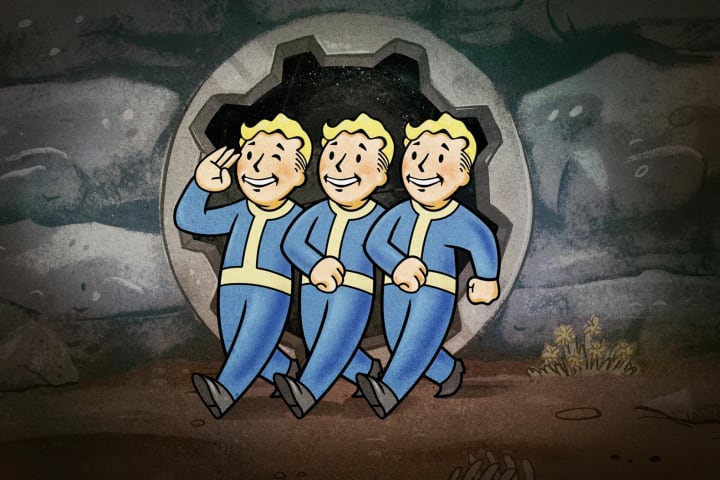
Fallout: Escaping the Vault, Facing the Wasteland
In Fallout, the vault is a literal cave, an underground shelter built to protect survivors from the horrors of nuclear war. But it is also a place of deception, of half-truths and curated realities. Many vaults were designed as experiments and were often used as tools of social control and psychological manipulation. As in Plato’s cave, these vaults become more than safe havens; they are systems of illusion and false narratives.
Each vault operates with its own internal logic and mythology, creating the illusion of stability and safety. Most residents grow up believing that the world outside is completely uninhabitable or that the vault is all that remains of humanity. They are fed a carefully edited version of history, just enough to sustain loyalty and obedience. And yet, in nearly every Fallout story, we encounter individuals who begin to question the story they've been told. Some discover fragments of forbidden information; others are exposed to inconsistencies or secret experiments.
There are people in these societies, a small number who know some parts of the truth or even the whole truth behind the scheme. Relevant to the puppeteers in Plato's cave, who move the idols in front of the fire, to create the shadows. In fallout, these people orchestrate the lies in order to keep the prisoners as prisoners.
But knowledge in Fallout is rarely liberating. The moment of escape, leaving the vault and stepping into the Wasteland, is rarely triumphant. It is jarring, disorienting, and painful. The sunlight does not illuminate a world of ideal forms, but rather a scorched Earth filled with ruins, chaos, and moral ambiguity. Just like Plato’s freed prisoner, these characters experience a philosophical awakening, only to find that the truth is fragmented, corrupted, or weaponised.
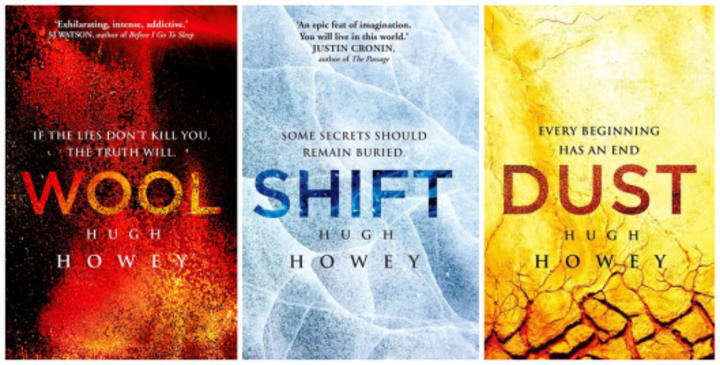
Silo
In Silo, the narrative returns us to a familiar darkness, another modern reinterpretation of Plato’s cave. There are no windows, no sky, only screens, myths, and laws that dictate what can and cannot be known. The outside world is said to be deadly, a toxic wasteland. The inhabitants of the silo are taught from birth that to leave is to die, and questioning this belief is not only dangerous, it is punishable by death.
Power in Silo is tightly controlled by a hierarchical system that mimics authoritarian regimes. Elections are a performance; decisions are already made. Behind the machinery of democracy lies a small elite pulling the strings, reminiscent of the puppeteers in Plato’s allegory, those who cast the shadows, manipulate the narrative, and guard the illusion. Knowledge, in this world, is not simply hidden; it is similarly weaponised.
In Silo, the act of seeking truth becomes a rebellion. To say the words “I want to go outside” is both literal and symbolic, an expression of doubt, of philosophical yearning, of the desire to study reality beyond the walls. But unlike Plato’s allegory, in Silo, the cost of truth is more immediate: exile and death. The moment you voice this desire, you are cast out.
The narrative of the Silo insists that the outside air is poisoned, an idea which, eventually, proves to be true. The world outside is not only real, but devastating.
At this point, one might ask: Is this so different from Plato’s premise? I would argue it is not. Plato speaks of a world of perfect forms, a higher, truer reality, but this doesn’t necessarily mean a comforting one. In both Fallout and Silo, the “outside” represents a confrontation with truth, but not a redemptive or utopian one. Instead, it reveals the scale of the lie: there are countless vaults, countless silos, each with people suffering similar fates, deceived and controlled by invisible hands. When the escaped prisoner returns, he not only brings knowledge of a higher reality but also an awareness of the magnitude of the manipulation his fellow prisoners endure.
Where I find myself in tension with later interpretations of Plato’s thought, particularly the Neoplatonic and proto-Christian view, is that the truth is synonymous with light, perfection, and paradise. I remain sceptical that Plato would equate truth with a form of heavenly bliss.
To me, the journey is Heraclitean. It is rooted in opposites, in the dialectic between light and shadow, joy and pain. One cannot understand beauty without confronting ugliness; love is more fully grasped in contrast with hate. I don’t think Plato denied the existence of these distortions; he just didn’t present them as ideal. For him, ugliness may be a deviation from beauty, but it is still part of the reality one must wrestle with.
So I hesitate to place words in Plato’s mouth; he isn’t here to debate me. But I do wonder whether he, too, might concede that a full understanding of his forms requires an encounter with their opposites. In Silo, as in Fallout, there is no paradise at the end of the tunnel, only the complicated, painful knowledge that the world is far vaster and more broken than anyone in the cave imagined.
Yet Plato’s essential point remains: the real world, whatever its condition, is more truthful than the shadows we are raised to believe in. The journey out of the cave still matters, even in dystopia.
A World of Truth or Ruins?
At this point, one might ask again: Is the reality encountered outside the cave in Fallout and Silo truly different from what Plato envisioned? On the surface, it seems so. Plato’s “realm of the Forms,” as introduced in dialogues like The Republic and Phaedo, is often imagined as an abstract, perfect place of existence where unchanging ideals like beauty, justice, goodness, exist beyond the corruptible world of the senses. For centuries, interpreters, particularly within the Neoplatonic and Christian traditions, have equated this journey with spiritual ascent, redemption, and even salvation. In that reading, to exit the cave is to ascend into light, into knowledge, into some kind of paradise.
But what if this interpretation simplifies Plato’s vision?
Plato himself never describes the world of Forms as a place of comfort or bliss. It is not a paradise in the modern or theological sense. It is a world of clarity, but not necessarily one of peace. The freed prisoner in the allegory of the cave doesn't emerge smiling; he stumbles, blinded by light, filled with pain and disorientation. As Socrates notes in Republic Book VII, the path to truth is not just difficult, it is painful, even perilous. The prisoner may resist it, regret it, or even wish to return to the cave.
Moreover, Plato’s dualism is not quite a rejection of opposites, but rather a hierarchy of them. He views the sensible world as a shadow of the intelligible world, a distortion. Opposites do exist in Plato: beauty vs. ugliness, justice vs. injustice, knowledge vs. ignorance, but they are not symmetrical. Ugliness is not its own Form; it is a deficiency in the manifestation of the Form of Beauty. But even so, Plato understands that human perception cannot escape this relational structure. You recognise beauty through its contrast with what it is not. In this way, opposites are epistemically necessary, even if ontologically subordinate.
In this light, the “outside” in Fallout and Silo may not contradict Plato’s metaphor, but radicalize it. Emerging from the vault or the silo is not an ascent into light, but a reckoning. The world outside is real, but broken. The truth is not redemptive; it is burdensome. And yet, it is still preferable to the lie.
Perhaps Plato understood this too. The cave allegory is not a tale of spiritual serenity but a philosophical provocation. What if the truth hurts? What if the light blinds? What if the people you return to, reject you and kill you for what you’ve seen? Fallout and Silo both dramatize these questions with brutal clarity. They do not promise utopia.
In the end, perhaps the real lesson is not that truth is paradise, but that truth, once glimpsed, makes the cave unlivable.
Written and Published by Sergios Saropoulos
About the Creator
Sergios Saropoulos
As a Philosopher, Writer, Journalist and Educator. I bring a unique perspective to my writing, exploring how philosophical ideas intersect with cultural and social narratives, deepening our understanding of today's world.
Keep reading
More stories from Sergios Saropoulos and writers in Fiction and other communities.
Hitchhike
Hitchhike OUT / ROAD / EVENING A man drives on the road alone. Only the sound of the car and the tires can be heard. The man is tired and looks at the road with a lost gaze. The road can be seen only by the lights of his car. At one point the lights of the car show a girl at the side of the street, the driver in astonishment looks in the rear window of the car to check at the woman. The car slows down and then stops on the side of the road. The woman approaches the car, then and stops a few meters behind it. She says;
By Sergios Saropoulos4 years ago in Fiction
Lightning Never Strikes Twice
The distant rumble, the sudden deluge, the crescendo of sound, the flash of light, the explosive energy — it never gets old. I became an amateur storm chaser about two years ago. My wife, Cindy suggested it. Sort of. She said, "Alex, you know this cancer is killing me. I've come to terms with that, but you're smothering me. Go join a band, write a book, or become a storm chaser, for all I care. I love you, but you need a hobby."
By Julie Lacksonen4 days ago in Fiction
me, me, me
when i read back my poetry it screams “me, me, me” on my screen in bold letters and i can’t shut it up — most days, i cannot make any other words out; i want to throttle a thousand versions of the me gone by, i want to throw myself from a figurative balcony, i want to sink a sword into every pen i’ve held
By angela hepworth7 days ago in Poets


Comments
There are no comments for this story
Be the first to respond and start the conversation.