Holianyk Ihor
Bio
Stories (419)
Filter by community
Homes Beneath the Red Dust: How Subsurface Living Could Keep Mars Settlers Safe and Warm
When humans finally set foot on Mars, they won’t be building glass domes under the crimson sky — at least not right away. The first Martian homes will likely be hidden beneath the planet’s surface, buried in the dusty regolith, where the hostile environment gives way to safety, stability, and warmth.
By Holianyk Ihor3 months ago in Futurism
The Titan Colony Concept — Life Beneath Methane Clouds
When humanity first gazed upon the golden, hazy images sent back by the Cassini–Huygens mission, it became clear that Saturn’s moon Titan was not just another frozen satellite. Here was a world with mountains, rivers, rain, and lakes — but everything made of something alien. Instead of water, methane flows in liquid form. Instead of white clouds, the skies are thick with orange hydrocarbon haze. The air is heavy, the light dim, and the temperature bone-chilling — a staggering minus 180°C.
By Holianyk Ihor3 months ago in Futurism
Magnetic Pulse Rotary Engines: Engineering the Future of Motion
In the global race for cleaner, smarter, and more efficient energy, engineers and inventors constantly search for technologies that could transform how we generate and use power. Among the most intriguing concepts is the magnetic pulse rotary engine — a device that turns magnetic energy into mechanical motion through a carefully timed series of electromagnetic impulses.
By Holianyk Ihor3 months ago in Futurism
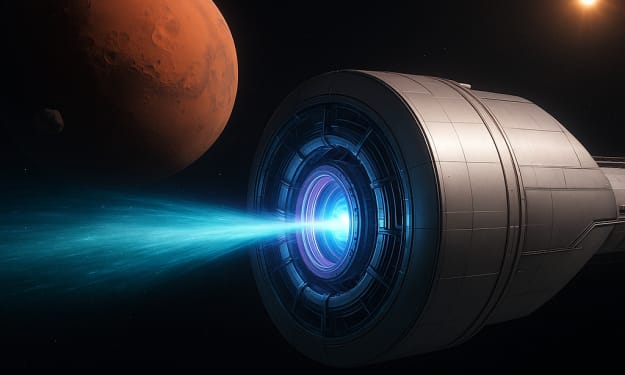
Fusion Drive: The Power Source That Could Take Us Between Worlds
For over half a century, humans have dreamed of venturing beyond the Moon — to Mars, the outer planets, and maybe even the stars themselves. Yet our greatest limitation isn’t imagination. It’s propulsion. Chemical rockets, the same technology that took Apollo to the Moon, remain the backbone of space travel today. They’re powerful but painfully inefficient — guzzling vast amounts of fuel for tiny amounts of payload.
By Holianyk Ihor3 months ago in Futurism
Racing the Light: How Speed Bends Time and the Limits of Reality
Light travels at an unimaginable pace—299,792,458 meters per second. That’s about 7.5 times around the Earth in just one second. But what makes this number truly extraordinary isn’t how fast it is—it’s the fact that it represents the ultimate speed limit of the universe. Nothing, according to Einstein’s theory of relativity, can go faster. The speed of light isn’t just a measure of velocity; it’s the foundation of how space and time themselves are built.
By Holianyk Ihor3 months ago in Education
Building Giant Spacecraft in Earth’s Orbit: The First Step Toward Interstellar Voyages
When we imagine the spacecraft of the future, our minds often conjure images straight out of science fiction: colossal vessels bristling with solar panels, sprawling habitats large enough to house thousands of people, and mile-long engines designed to push humanity beyond the boundaries of our solar system. Yet, if you were to ask today’s aerospace engineers whether we could simply build such a spacecraft on Earth and launch it into space, the answer would be a resounding no.
By Holianyk Ihor4 months ago in Education
Artificial Gravity Systems for Space Crews: Turning Science Fiction Into Reality
When we imagine astronauts journeying to Mars or even further into deep space, we often picture sleek spacecraft, breathtaking views of the stars, and groundbreaking discoveries. What we don’t always picture, however, are the very real and serious health problems that come with spending months or even years in microgravity. Human bodies evolved under Earth’s gravity, and when that force disappears, things quickly start to go wrong. Muscles shrink, bones weaken, fluid redistributes in odd ways, and the heart doesn’t have to pump as hard.
By Holianyk Ihor4 months ago in Education
Riding the Light: The Vision of Breakthrough Starshot
For centuries, the stars have been the ultimate symbol of unreachable horizons. We looked up, dreamed, and wondered if we would ever set foot beyond the Sun’s neighborhood. While telescopes gave us glimpses of faraway worlds, the idea of sending a spacecraft to another star system always felt like science fiction. After all, even our fastest probes, like Voyager 1, would need tens of thousands of years to reach the nearest stars.
By Holianyk Ihor4 months ago in Education
Russia’s Angara-A5V with a Cryogenic Upper Stage: A Leap Toward the Future of Spaceflight
For decades, Russia has been one of the great spacefaring nations, pioneering breakthroughs from the first satellite to the first human in orbit. But in today’s competitive space industry, dominated by private giants like SpaceX and state programs in China, the U.S., and Europe, staying ahead requires more than a proud history. It requires bold steps in rocket technology. One of Russia’s most ambitious projects in this direction is the Angara-A5V rocket, a heavy-lift launch vehicle equipped with a cryogenic (liquid oxygen and liquid hydrogen) upper stage.
By Holianyk Ihor4 months ago in Education
Lunar Crater Bases: Nature’s Ready-Made Shield Against Cosmic Radiation
For decades, the idea of building a permanent human settlement on the Moon has hovered somewhere between science fiction and ambitious engineering. But as international space agencies and private companies move closer to turning lunar bases into reality, one of the toughest challenges has come into focus: radiation.
By Holianyk Ihor4 months ago in Education
VASIMR Plasma Engines: The Next Leap Toward Interplanetary Travel
For more than half a century, humanity has been dreaming of Mars. Countless films, novels, and scientific proposals picture astronauts stepping onto the Red Planet’s dusty plains. Yet despite all the excitement, one stubborn obstacle remains: getting there in a reasonable amount of time.
By Holianyk Ihor4 months ago in Futurism
Magnetic Accelerators for Interplanetary Travel: The Future of Space Logistics
Imagine a morning at an orbital spaceport: cargo containers silently glide along magnetic tracks before a sudden burst of acceleration sends them hurtling toward Mars. No plumes of chemical exhaust, no long countdowns—just controlled, powerful energy converted directly into kinetic motion. While it may sound like science fiction, magnetic accelerators are increasingly being explored as a way to reduce costs and increase reliability for interplanetary travel.
By Holianyk Ihor4 months ago in Education