
Russia’s Angara-A5V with a Cryogenic Upper Stage: A Leap Toward the Future of Spaceflight
Space

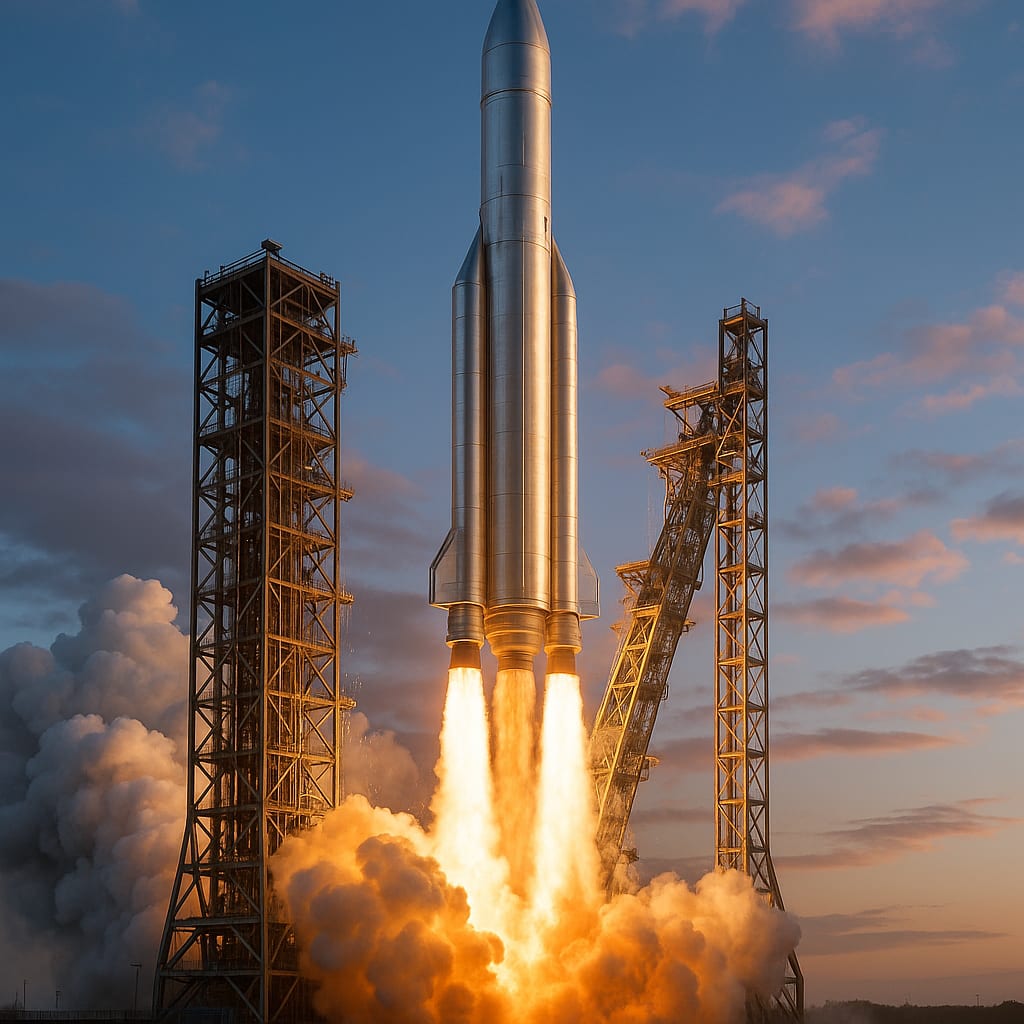
For decades, Russia has been one of the great spacefaring nations, pioneering breakthroughs from the first satellite to the first human in orbit. But in today’s competitive space industry, dominated by private giants like SpaceX and state programs in China, the U.S., and Europe, staying ahead requires more than a proud history. It requires bold steps in rocket technology. One of Russia’s most ambitious projects in this direction is the Angara-A5V rocket, a heavy-lift launch vehicle equipped with a cryogenic (liquid oxygen and liquid hydrogen) upper stage.
This isn’t just another rocket upgrade — it represents a fundamental shift in how Russia plans to reach higher orbits, support lunar missions, and eventually explore deep space.
From Angara-A5 to Angara-A5V: A Family Grows Stronger
The Angara rocket family was conceived as Russia’s new modular launch system, designed to replace aging Soviet-era rockets like the Proton. The heavy-lift Angara-A5, which has already completed test flights, can haul about 24.5 metric tons to low Earth orbit (LEO). That’s impressive, but still short of what’s needed for truly ambitious missions.
The Angara-A5V is designed to change that. By replacing its conventional third stage with a liquid oxygen–hydrogen stage, its payload capacity jumps dramatically to around 37 metric tons to LEO. For comparison, that’s roughly the weight of three full school buses — and more than enough for lunar mission hardware, large satellites, or interplanetary spacecraft.
Why Hydrogen Matters
Most rockets burn kerosene with liquid oxygen, a reliable and energy-dense fuel combination. But hydrogen, when combined with liquid oxygen, offers a much higher specific impulse — essentially the rocket equivalent of fuel efficiency.
To visualize the difference: imagine driving two cars. One runs on regular gasoline, the other on a futuristic fuel that gives you twice the mileage for the same tank size. That’s the advantage hydrogen provides. It’s harder to handle, since it must be stored at cryogenic temperatures and tends to leak through even tiny gaps, but the performance payoff is enormous.
This is why virtually every major space program has turned to cryogenic engines for their heavy rockets. NASA’s Space Launch System (SLS) and Europe’s Ariane 5 both rely on liquid hydrogen upper stages. With Angara-A5V, Russia joins this club.
The Heart of the Upgrade: The KVTK Upper Stage
The Angara-A5V will carry a brand-new cryogenic upper stage, known as the KVTK (from the Russian for "oxygen-hydrogen heavy upper stage"). Its main engine, the RD-0146, is being developed by the Voronezh KBKhA design bureau.
The RD-0146 has some unique strengths:
- Multiple restarts: It can be reignited in space, allowing precise orbital maneuvers.
- High efficiency: With hydrogen fuel, it maximizes the rocket’s performance.
- Flexibility: It can place satellites into geostationary orbit (GEO), transfer spacecraft to lunar trajectories, or even support interplanetary missions.
In practice, this means that satellites won’t just reach orbit — they’ll reach exactly the right orbit without wasting onboard fuel.
What Angara-A5V Can Do
The capabilities unlocked by this upgrade are striking:
- Geostationary satellites: Up to 12 tons can be delivered to GEO, enough for the largest communications satellites that modern economies depend on.
- Lunar missions: Russia could launch modules for its planned lunar base or send the next-generation crew vehicle “Orel” (Eagle) toward the Moon.
- Interplanetary exploration: Missions to Mars, Venus, or even distant asteroids become far more practical, since the rocket can send heavier, more complex spacecraft on interplanetary trajectories.
For example, consider how NASA used its SLS rocket to prepare for Artemis lunar missions. Angara-A5V could fill a similar role for Russia, enabling both robotic and human exploration beyond Earth orbit.
Challenges on the Road Ahead
Of course, none of this comes easily. Handling liquid hydrogen is notoriously difficult. It must be stored at –253°C (–423°F), colder than anything naturally found on Earth. Designing fuel tanks, pumps, and pipelines that can manage such conditions without leaks or structural failures is a formidable engineering task.
Russia has some experience with hydrogen systems — the mighty Energia rocket of the 1980s used them — but unlike the U.S. and Europe, it has not fielded a hydrogen-fueled upper stage in decades. Restarting this line of technology involves overcoming industrial gaps, retraining specialists, and building entirely new infrastructure.
But if successful, Angara-A5V would put Russia back on equal footing with the world’s most advanced space programs.
Looking Forward: A Symbol of Ambition
Angara-A5V is more than just a rocket; it’s a statement of intent. By adopting cryogenic technology, Russia signals that it plans not only to keep pace with its rivals, but to carve out its own path toward lunar and deep-space exploration.
Whether it’s placing megasatellites into orbit, ferrying modules for a lunar outpost, or sending probes across the solar system, Angara-A5V has the potential to redefine Russia’s role in global space exploration.
In the broader picture, it shows that even in an era of rapid private-sector innovation, state-led programs still matter. Just as NASA’s Apollo program and ESA’s Ariane shaped entire generations of space technology, Angara-A5V could be remembered as the rocket that kept Russia a major force beyond Earth.
If the project succeeds, one day we may look back on Angara-A5V not simply as an upgraded launcher, but as the rocket that reopened the road to the Moon for Russia.
About the Creator
Keep reading
More stories from Holianyk Ihor and writers in Education and other communities.
Lunar Crater Bases: Nature’s Ready-Made Shield Against Cosmic Radiation
For decades, the idea of building a permanent human settlement on the Moon has hovered somewhere between science fiction and ambitious engineering. But as international space agencies and private companies move closer to turning lunar bases into reality, one of the toughest challenges has come into focus: radiation.
By Holianyk Ihor4 months ago in Education
This is what happens in your brain when you can't recall and word
You’re sure you know your third grade teacher’s name— it’s like you’re hovering over it in your mind, but it just won’t materialize. Researchers call this tantalizing torment a “tip-of-the-tongue state,” and it's something everyone experiences. But what's actually happening when a word gets caught here? And how can you best get it unstuck? Most of the time, our brains seamlessly summon words from vast stores of knowledge, paring their meaning and sounds, and stringing them into sentences.
By Munesh Yadav3 days ago in Education
My New Book is Finally Here
My poetry collection Beautiful and Brutal Things is done. It's actually done and finally published over 270 pages. Over a year of my life went into this book. More than a year, really. Long days at my computer, sometimes seven days a week because I couldn't stop even when I probably should have. Then two months of editing that felt harder than the writing itself. But it's finished, and I'm still standing, and the book is real.
By Tim Carmichaela day ago in BookClub



Comments
There are no comments for this story
Be the first to respond and start the conversation.