
VASIMR Plasma Engines: The Next Leap Toward Interplanetary Travel
Space

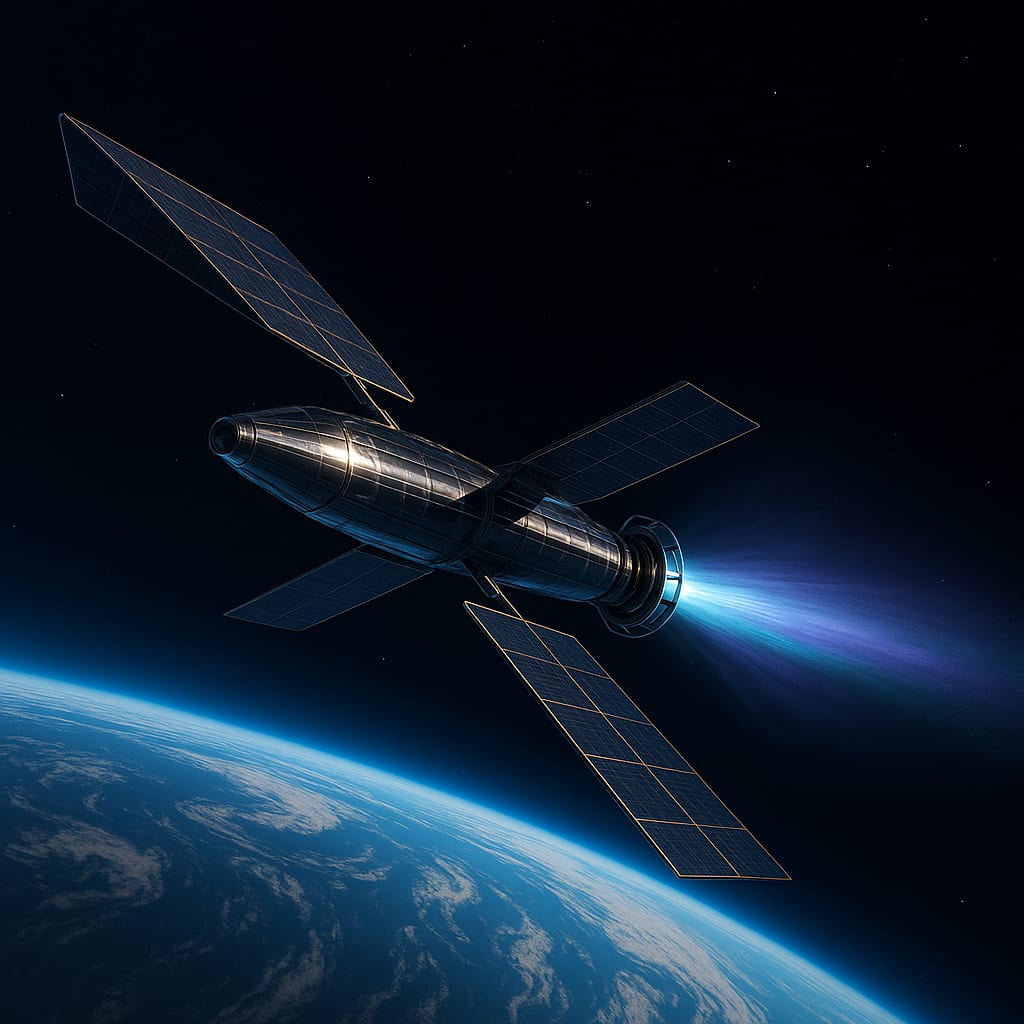
For more than half a century, humanity has been dreaming of Mars. Countless films, novels, and scientific proposals picture astronauts stepping onto the Red Planet’s dusty plains. Yet despite all the excitement, one stubborn obstacle remains: getting there in a reasonable amount of time.
Traditional chemical rockets—the same basic technology that carried Apollo astronauts to the Moon—burn with enormous power but run out of fuel astonishingly fast. They’re excellent for blasting free of Earth’s gravity well but hopelessly inefficient for long journeys. A mission to Mars using current rockets can take 6 to 9 months, leaving crews exposed to radiation, isolation, and countless other hazards.
That’s where VASIMR comes in. Short for Variable Specific Impulse Magnetoplasma Rocket, this experimental propulsion system could cut that travel time nearly in half, transforming the way we think about space exploration.
A Miniature Controlled Solar Wind
Imagine harnessing the same principle that drives the Sun’s solar wind and putting it inside a spacecraft engine. That’s essentially what VASIMR does. Instead of burning chemical propellants, it uses plasma—the so-called fourth state of matter.
Here’s how it works, step by step:
- Ionizing the gas. The engine starts by injecting a neutral gas, often argon or hydrogen, into a chamber. Using radio waves, the gas is energized until its atoms shed electrons, creating plasma.
- Heating the plasma. Another set of radio waves stirs the plasma into a frenzy, heating it to temperatures hotter than the surface of the Sun—millions of degrees. But the walls of the engine never melt, because magnetic fields act like invisible force fields, containing the fiery plasma.
- Magnetic acceleration. Finally, the plasma is funneled through a magnetic nozzle, where it accelerates and shoots out the back of the spacecraft. Just like a rocket exhaust, this generates thrust—but far more efficiently than burning fuel.
The “variable” part of VASIMR’s name comes from its ability to adjust. Operators can tune the engine for higher thrust when speed is essential, or dial it down for maximum efficiency when conserving fuel over long distances. Think of it like shifting gears in a car, but on an interplanetary scale.
Why It Matters
The beauty of VASIMR lies in its fuel efficiency. Whereas chemical rockets guzzle propellant, VASIMR uses it sparingly. This means spacecraft can carry less fuel and more cargo—or stretch their journeys further into the solar system.
Let’s return to the Mars example. With chemical rockets, crews are stuck with months-long journeys, all the while absorbing cosmic radiation and being cut off from Earth. With VASIMR, the trip might take just over three months. That’s still no quick weekend getaway, but it dramatically reduces risk, cost, and stress on astronauts.
For robotic cargo missions, the benefits are even clearer. A VASIMR-powered freighter could transport supplies, habitats, or equipment far more economically than chemical rockets.
Challenges Ahead
Of course, there’s a catch—or several.
Power hunger. VASIMR engines require staggering amounts of electricity: tens or even hundreds of kilowatts for extended operation. Solar panels can only go so far, especially as spacecraft travel away from the Sun. That’s why many experts believe nuclear reactors will be the true partners of plasma engines.
Thermal management. An engine that heats plasma to millions of degrees also produces tremendous waste heat. Without powerful radiators, the spacecraft itself could overheat. Designing such cooling systems is one of the toughest engineering puzzles.
Scaling up. Prototypes exist, but turning them into reliable, flight-ready systems that can handle years of deep-space operation is a challenge. Testing in Earth’s orbit is only the beginning.
The Road So Far
Ad Astra Rocket Company, led by former NASA astronaut Franklin Chang-Díaz, has been developing VASIMR for decades. Their latest prototype, the VX-200SS, has already demonstrated continuous operation at 100 kilowatts—a significant milestone.
NASA has shown interest, especially for uses in maintaining the International Space Station’s orbit and for future cargo missions. Private investors are also watching closely. If paired with next-generation power sources, VASIMR could be a game-changer.
Looking Forward
The excitement around plasma engines isn’t just about Mars. Imagine fast cargo runs to the Moon, asteroid mining expeditions, or even voyages to the outer planets. With chemical rockets, such missions are costly and slow. With plasma propulsion, they become realistic.
Think of how steam engines transformed ocean travel in the 19th century, shrinking voyages that once took months into weeks. VASIMR could play a similar role in space, making the vast distances of the solar system suddenly more manageable.
Conclusion
VASIMR is more than a promising technology; it’s a glimpse into a future where humans can move confidently beyond Earth. By turning plasma into a controlled jet of energy, it offers efficiency, flexibility, and speed that chemical rockets simply can’t match.
The challenges are real—power and cooling remain unsolved hurdles—but the potential rewards are enormous. If Ad Astra and NASA succeed, we might one day look back on VASIMR the way we look at the Wright Flyer: the humble start of an era where interplanetary travel isn’t fantasy, but routine.
About the Creator
Keep reading
More stories from Holianyk Ihor and writers in Futurism and other communities.
Earendel: The Most Distant Star Ever Detected
In the spring of 2022, astronomers spotted something extraordinary through the Hubble Space Telescope: a tiny glimmer of light from the edge of the observable universe. At first, many believed it could be a distant galaxy, or perhaps just a cluster of stars blurred together. But now, thanks to the unprecedented clarity of the James Webb Space Telescope (JWST), scientists have confirmed that this faint spark is, in fact, a single star.
By Holianyk Ihor4 months ago in Futurism
About Binding Prometheus
I want to start actively advocating on behalf of my own work, and the most valuable part of my canon is, without a doubt, Binding Prometheus, the play I have been working on since 2019 and only finished in 2023 as part of my MA. The play itself is an amalgamation of a million different inspirations. On one end, it evokes the Ancient Greek myth-play, deriving its own title from the earliest extant work of Western drama we have, Aeschylus’s Prometheus Bound. On the other end, it borrows significantly from the sci-fi bulwarks from over the years, namely Mary Shelley’s Frankenstein and Karel Capek’s Rossum’s Universal Robots. The play could be an episode of Black Mirror, I fear. I don’t know. I’ve only ever seen one episode of Black Mirror.
By Steven Christopher McKnight16 days ago in Futurism
10 Custom Dating App Development Companies Using AI and Smart Matching
The dating app industry has evolved far beyond basic swipe-based interactions. In 2026, users expect personalized recommendations, intelligent matchmaking, safety-focused features, and adaptive user experiences. Artificial intelligence (AI) and smart matching technologies now play a central role in meeting these expectations.
By Apptunix usaa day ago in Futurism



Comments
There are no comments for this story
Be the first to respond and start the conversation.