
Riding the Light: The Vision of Breakthrough Starshot
Space

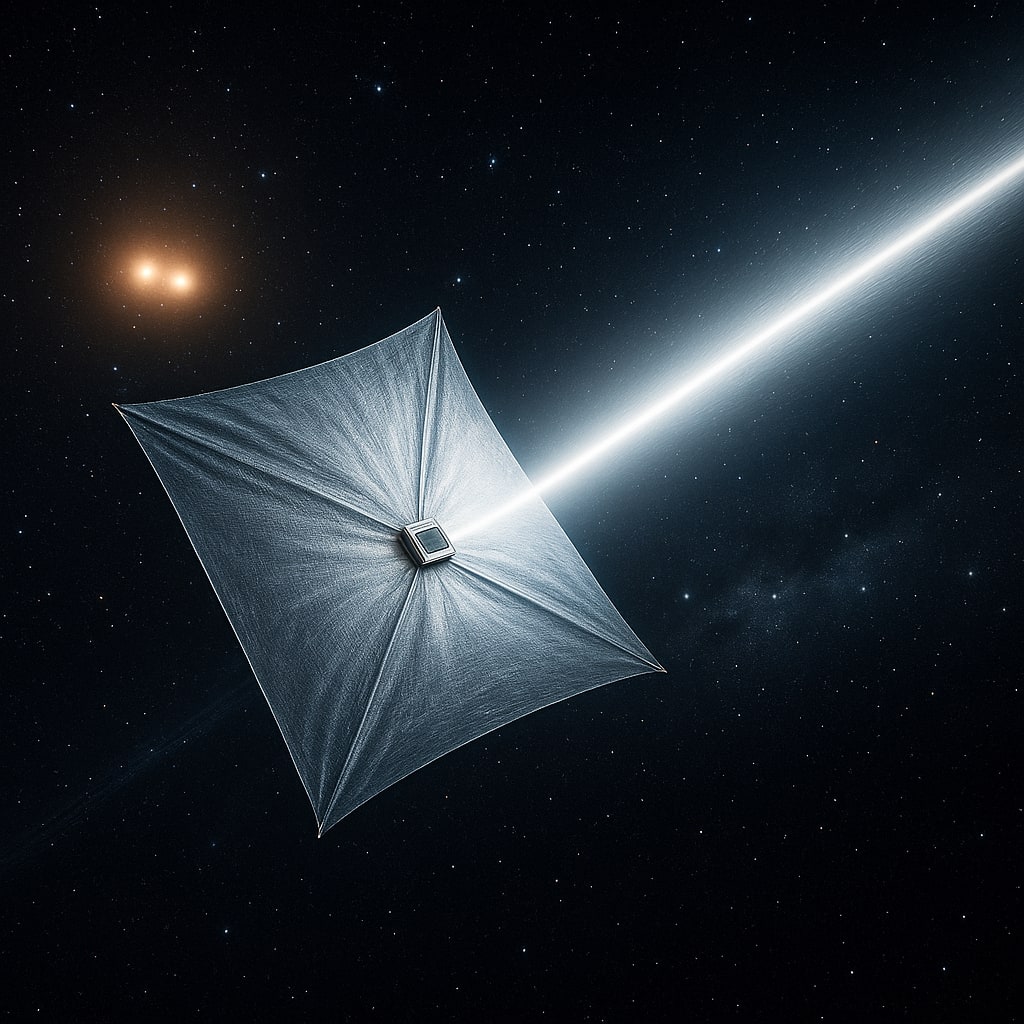
For centuries, the stars have been the ultimate symbol of unreachable horizons. We looked up, dreamed, and wondered if we would ever set foot beyond the Sun’s neighborhood. While telescopes gave us glimpses of faraway worlds, the idea of sending a spacecraft to another star system always felt like science fiction. After all, even our fastest probes, like Voyager 1, would need tens of thousands of years to reach the nearest stars.
But in 2016, something shifted. A bold initiative called Breakthrough Starshot was announced, supported by entrepreneur Yuri Milner, the late Stephen Hawking, and a team of visionary scientists. Its goal was simple in words but staggering in scope: send tiny spacecraft to Alpha Centauri—the closest star system—within a human lifetime.
The question is: how do you cross nearly 4.37 light-years in just a few decades, when all our current technology would take millennia? The answer lies in something we’ve only recently begun to master—light itself.
The Big Idea: Sailing on Beams of Light
The spacecraft envisioned by Starshot aren’t the massive shuttles we picture from Hollywood films. Instead, they’re “StarChips”—tiny, gram-scale probes no bigger than a smartphone chip. Each would carry a camera, navigation sensors, a communication system, and a wafer-thin sail.
And here’s the radical twist: instead of rocket fuel, these probes would be pushed forward by an enormous ground-based laser array. Picture it: a powerful laser station on Earth firing an ultra-precise beam at the probe’s sail. The photons themselves—particles of light—would transfer momentum to the sail, accelerating it to about 20% of the speed of light.
At that pace, these mini-ships could cover the staggering distance to Alpha Centauri in just 20–25 years. For the first time in history, interstellar travel wouldn’t be measured in millennia, but in a single generation.
A New Age of Engineering Challenges
As inspiring as it sounds, making Starshot real is a mountain of challenges.
The laser array: The system required would need a power of around 100 gigawatts, equivalent to the output of thousands of nuclear plants. Coordinating such energy safely and precisely is an unprecedented task.
The light sail: The sail must be incredibly thin—mere atoms thick—yet durable enough to withstand the violent pressure of the laser beam without disintegrating. Scientists are experimenting with advanced materials like graphene and dielectric films.
Cosmic hazards: Traveling at 20% of light speed means that even a microscopic dust particle could smash into the probe with the force of a bullet. Designing shields or strategies to reduce these risks is essential.
Communication across light-years: Once the probes arrive, how will they send back images and data? Each StarChip would need to transmit a tiny signal powerful enough to cross 25 trillion miles and still be detectable by Earth-based receivers.
Each of these challenges alone could occupy teams of engineers for decades. Put together, they make Breakthrough Starshot one of the most ambitious projects in human history.
Why It Matters
So why attempt something so audacious when the obstacles are so overwhelming? Because the potential rewards are equally extraordinary.
Imagine this: in the 2040s or 2050s, scientists could receive the first real photographs of planets around Alpha Centauri. If any of those worlds are Earth-like, we might glimpse oceans, continents, or even hints of alien atmospheres. That moment would be as revolutionary as Galileo pointing his telescope to the heavens in 1609 and realizing the Moon was a world of its own.
Closer to home, the technologies developed for Starshot could transform space exploration in our own solar system. Laser-propelled probes might zip between Earth and Mars in weeks, not months. Satellites could be smaller, cheaper, and faster. And breakthroughs in optics, materials science, and energy management could spill over into countless other industries on Earth.
From Science Fiction to Science
The concept of sailing on light isn’t entirely new. Writers from Arthur C. Clarke to Carl Sagan dreamed about it, and in recent years, NASA and the Planetary Society have tested small solar sails in orbit, pushed gently by sunlight. But Breakthrough Starshot takes that concept and supercharges it. Instead of waiting for weak solar photons, it envisions harnessing directed, artificial beams of light with unprecedented intensity and precision.
It’s the same principle as sailing across the ocean—except the ocean is space, and the wind is a stream of photons.
A Message to the Stars
Perhaps the most powerful aspect of Starshot is not just the science, but the symbolism. For the first time, we are not only dreaming of the stars but actively building a roadmap to reach them.
Even if the project evolves slowly, or if only partial versions succeed, the very act of trying reshapes our perspective. It tells us that interstellar space is not an eternal barrier but a frontier waiting to be crossed. The first probes might be small, fragile, and silent—but they would carry with them humanity’s greatest message: we were here, and we dared to reach beyond our sky.
Conclusion
Breakthrough Starshot may sound like science fiction, but it represents the cutting edge of human ambition. The challenges are immense, but so is the vision: to send tiny emissaries across the gulf of space and glimpse another star system within our lifetime.
It’s easy to dismiss such dreams as impractical. But history shows us that yesterday’s impossibilities often become tomorrow’s headlines. Just as the Wright brothers’ fragile Flyer gave birth to modern aviation, the tiny StarChips of Starshot might one day open the way to humanity’s interstellar future.
And when that first pixelated image from Alpha Centauri arrives—after 25 years of racing through the dark—it may remind us of one simple truth: the stars were never beyond our reach. We only needed to learn how to ride the light.
About the Creator
Keep reading
More stories from Holianyk Ihor and writers in Education and other communities.
Russia’s Angara-A5V with a Cryogenic Upper Stage: A Leap Toward the Future of Spaceflight
For decades, Russia has been one of the great spacefaring nations, pioneering breakthroughs from the first satellite to the first human in orbit. But in today’s competitive space industry, dominated by private giants like SpaceX and state programs in China, the U.S., and Europe, staying ahead requires more than a proud history. It requires bold steps in rocket technology. One of Russia’s most ambitious projects in this direction is the Angara-A5V rocket, a heavy-lift launch vehicle equipped with a cryogenic (liquid oxygen and liquid hydrogen) upper stage.
By Holianyk Ihor4 months ago in Education
Image-to-text technology, also known as Optical Character
Image-to-text technology, also known as Optical Character Recognition (OCR), has transformed the way we interact with visual information. It allows machines to extract text from images, enabling various applications across multiple industries. From digitizing printed documents to reading text from scanned images, OCR plays a vital role in making printed content accessible, editable, and searchable. The need for such technology has grown exponentially with the increasing reliance on digital data and the rapid shift from physical to digital content in nearly all sectors of life. As the digital world continues to expand, image-to-text technology has paved the way for more seamless workflows, enabling businesses and individuals alike to save time, effort, and resources.
By Alexander Jackson5 days ago in Education
Most Sales Deals Fail Because Sellers Talk to the Wrong People
There is a quiet reason many sales conversations feel productive but go nowhere. Everyone leaves the call optimistic. Emails move back and forth. Documents get shared. Then momentum fades. Weeks pass. The deal stalls without a clear explanation.
By Armi Ponsica3 days ago in Education




Comments
There are no comments for this story
Be the first to respond and start the conversation.