
Lunar Crater Bases: Nature’s Ready-Made Shield Against Cosmic Radiation
Space

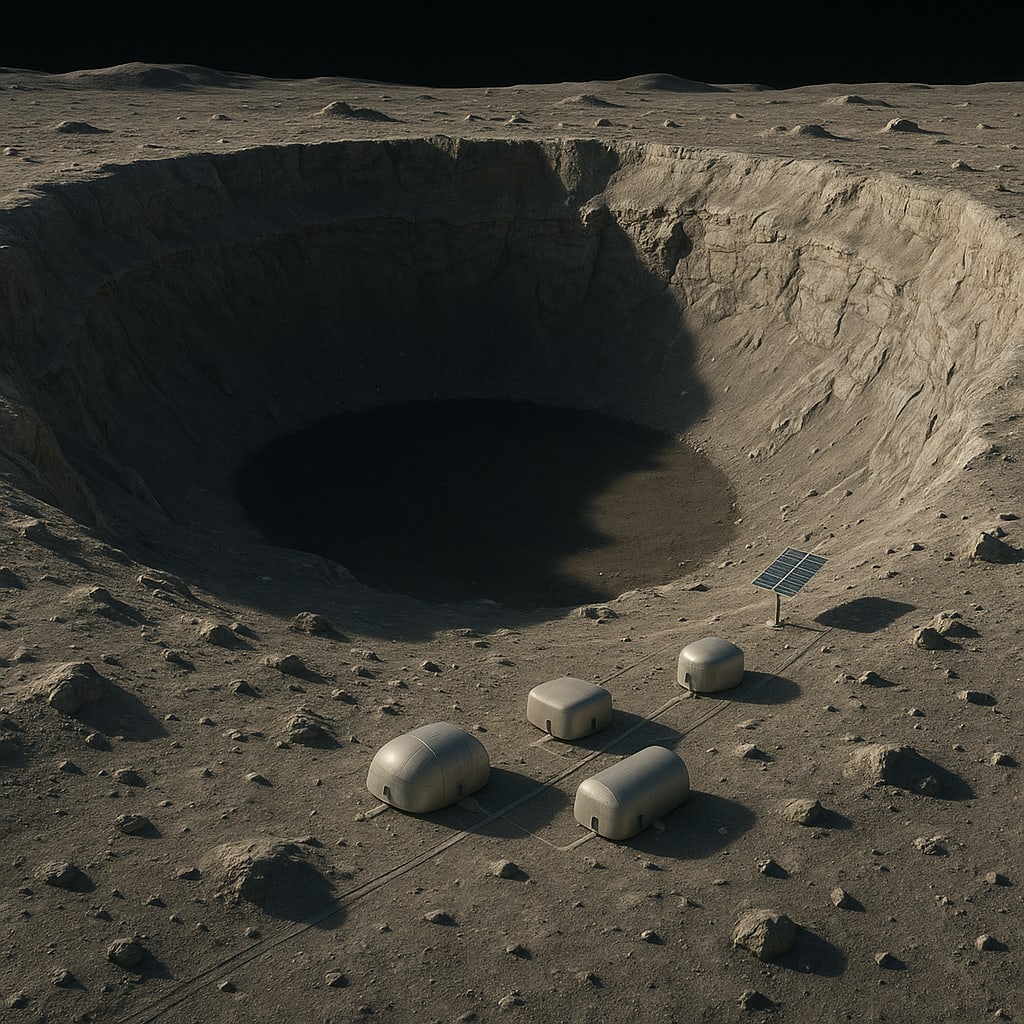
For decades, the idea of building a permanent human settlement on the Moon has hovered somewhere between science fiction and ambitious engineering. But as international space agencies and private companies move closer to turning lunar bases into reality, one of the toughest challenges has come into focus: radiation.
Unlike Earth, the Moon has no protective magnetic field and virtually no atmosphere. On the lunar surface, astronauts would be exposed to intense streams of cosmic rays and bursts of solar particles. A long-term stay without proper shielding would be not just uncomfortable but deadly. Engineers have been wrestling with ways to build safe shelters, and one of the most elegant solutions may be hiding in plain sight: lunar craters.
Why Craters?
Craters are scars left by billions of years of meteorite impacts. They range from shallow bowls a few meters deep to colossal depressions stretching for dozens of kilometers. What makes them attractive for human habitation is their natural shape. The sloping walls of a crater can act like a ready-made shield, reducing exposure to radiation from certain angles and offering a head start for building a more secure base.
Consider it like this: if you’re camping, you might pitch your tent in a valley to block the wind. On the Moon, a crater offers a similar advantage—except instead of wind, it’s blocking invisible streams of high-energy particles flying through space.
The Polar Advantage
Not all craters are created equal. Scientists are especially interested in craters near the Moon’s poles. Some of these craters are so deep and so steep that parts of them never see the Sun. These regions, called permanently shadowed craters, are among the coldest places in the solar system.
At first, that might sound like the last place you’d want to build a base. But there’s a twist: inside these shadowed craters lies one of the Moon’s most valuable resources—water ice. Buried in the soil, or regolith, this ice could be mined and transformed into drinking water, breathable oxygen, or even rocket fuel in the form of hydrogen and oxygen. In other words, the very craters that offer protection from radiation might also provide the key to survival.
Nature Plus Engineering
Radiation protection is all about layers. On Earth, our atmosphere absorbs much of the dangerous energy before it reaches us. On the Moon, engineers have to build those layers artificially. Studies by NASA and the European Space Agency suggest that a blanket of lunar regolith about two to three meters thick would provide radiation protection similar to what astronauts experience on the International Space Station.
Craters make this job easier. Instead of starting from scratch on flat ground, builders could use the crater walls as the first line of defense, then pile up or 3D-print layers of lunar soil over inflatable or rigid modules. Imagine dropping a habitat into a natural bowl, covering it with lunar dust, and suddenly you have a fortified bunker—with most of the materials sourced right on site.
Powering a Crater Base
One obvious challenge remains: if you set up a base inside a shadowed crater, how do you get power? Solar panels won’t work well in the dark. Here, the Moon offers a clever workaround. While the crater floor may be in eternal night, the rims of some polar craters are bathed in almost constant sunlight. Scientists call these areas peaks of eternal light. By placing solar farms on these ridges and transmitting energy down to the base—through cables or even wireless power beaming—astronauts could enjoy steady electricity even while living in the shadows.
Lessons from Earth
The concept of using natural formations for protection isn’t new. On Earth, early humans sheltered in caves to escape predators and the elements. Modern engineers carve underground facilities into mountains for similar reasons—think of Switzerland’s massive bunkers or data centers housed in old mines. The Moon’s craters are simply the cosmic-scale continuation of this age-old survival instinct: use nature’s architecture as a shortcut to safety.
The Road Ahead
Of course, building a base inside a crater is easier to imagine than to accomplish. Heavy machinery would need to be delivered to the Moon, likely operated by autonomous robots before humans even arrive. Structures must withstand extreme cold, micrometeorite impacts, and the notorious clingy lunar dust that sticks to everything. Communication lines from a crater floor to orbiting satellites could also be tricky, requiring relay systems.
But despite these hurdles, crater-based habitats tick so many boxes—radiation shielding, water access, temperature regulation—that they are currently among the top contenders for the first permanent lunar outposts.
A Stepping Stone to the Stars
Establishing a lunar base isn’t just about living on the Moon. It’s about practice. If humanity learns how to thrive in a harsh, airless crater using only local materials and ingenuity, that knowledge can be applied to Mars, asteroids, and beyond. In a way, each crater becomes a classroom—teaching us not only how to survive in space, but how to build civilizations where none existed before.
So when astronauts one day step out of their base and gaze up at the jagged walls of a lunar crater, they may not see a barren hole in the ground. They may see a fortress, a well, and a gateway—all carved into the ancient face of the Moon by time itself.
About the Creator
Keep reading
More stories from Holianyk Ihor and writers in Education and other communities.
Magnetic Accelerators for Interplanetary Travel: The Future of Space Logistics
Imagine a morning at an orbital spaceport: cargo containers silently glide along magnetic tracks before a sudden burst of acceleration sends them hurtling toward Mars. No plumes of chemical exhaust, no long countdowns—just controlled, powerful energy converted directly into kinetic motion. While it may sound like science fiction, magnetic accelerators are increasingly being explored as a way to reduce costs and increase reliability for interplanetary travel.
By Holianyk Ihor4 months ago in Education
Smart Home Plumbing Habits That Protect Your Pipes
Owning a home brings pride and comfort. It also brings responsibility. Plumbing is one of the most critical systems in any house. Small mistakes can lead to leaks, damage, and high repair costs. This guide shares essential plumbing tips every homeowner should know. The goal is to help you avoid trouble and keep your home running smoothly.
By Lickety Split4 days ago in Education
The Mental Edge in Golf: How Emotional Control and Focus Drive Peak Performance
Golf is widely recognized as a technical sport, but seasoned players know that true success begins in the mind. The mental game of golf plays a decisive role in shot consistency, course management, and competitive confidence. From handling pressure on the tee box to maintaining concentration on the final putt, mental toughness in golf often determines outcomes more than physical strength or swing mechanics.
By Jeb Kratzig5 days ago in Education


Comments
There are no comments for this story
Be the first to respond and start the conversation.