
Magnetic Accelerators for Interplanetary Travel: The Future of Space Logistics
Space

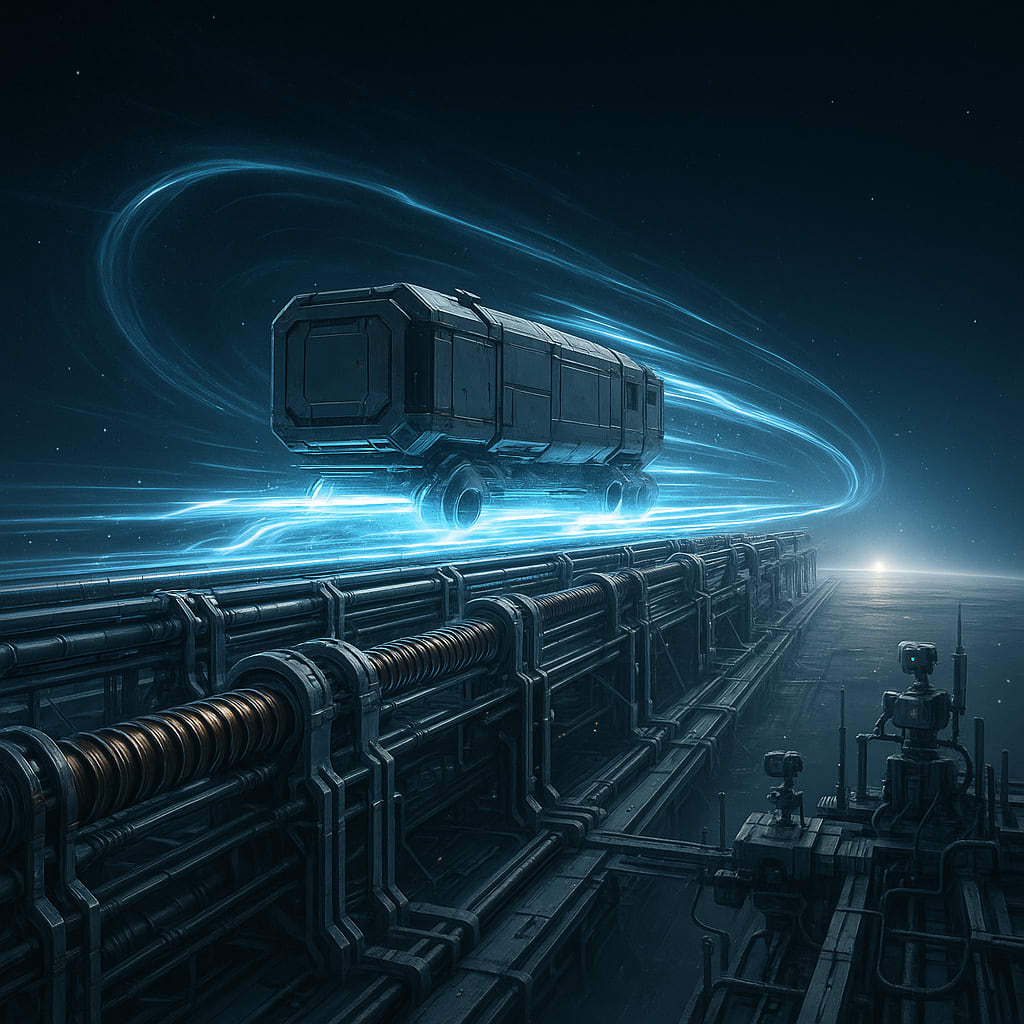
Imagine a morning at an orbital spaceport: cargo containers silently glide along magnetic tracks before a sudden burst of acceleration sends them hurtling toward Mars. No plumes of chemical exhaust, no long countdowns—just controlled, powerful energy converted directly into kinetic motion. While it may sound like science fiction, magnetic accelerators are increasingly being explored as a way to reduce costs and increase reliability for interplanetary travel.
What Are Magnetic Accelerators?
In simple terms, a magnetic accelerator is a device that uses electromagnetic forces to propel an object to high speeds. In the context of space travel, this can include:
- Mass Drivers – Linear electromagnetic devices that incrementally accelerate cargo along a track until it reaches speeds suitable for interplanetary transfer.
- Railguns – Two parallel conductors with enormous electric currents that generate a transverse force on a projectile, launching it at extreme speeds.
- Coilguns (Gauss Guns) – Series of electromagnetic coils that create a moving magnetic field to “pull” or “push” a payload along a track.
- Magnetic Sails and Brakes – While not accelerators in the conventional sense, these systems use magnetic fields to interact with solar wind or planetary magnetospheres for propulsion or deceleration.
- Plasma and Pulsed Magnetic Accelerators – Hybrid technologies that use magnetic fields to generate high-velocity plasma streams, bridging the gap between electric propulsion and electromagnetic launch systems.
Why Magnetic Accelerators Are Exciting for Space Travel
- Fuel Efficiency and Reduced Mass
By using electromagnetic energy for the initial acceleration, the payload doesn’t carry massive amounts of chemical fuel, shifting the energy burden to a ground- or orbit-based power source such as solar arrays, nuclear reactors, or even laser/microwave energy transmitters.
- High-Frequency Launches
Once built, these accelerators could launch numerous small payloads rapidly. This is ideal for supplying interplanetary stations or sending cargo to Mars without relying solely on conventional rockets.
- Lower Single-Point Risk
Unlike a traditional rocket launch, where a single failure can be catastrophic, electromagnetic launch systems can incorporate redundancy and modularity, sending cargo in smaller increments for added safety.
- Optimal for Space Environments
The Moon or orbital platforms are perfect locations: no atmosphere means no aerodynamic drag, and lower gravity reduces the energy needed to achieve interplanetary velocities.
Applications of Magnetic Accelerators
Lunar Mass Drivers
The Moon is an ideal testing ground. Its low gravity and lack of atmosphere allow mass drivers to accelerate raw materials—like regolith or mined minerals—onto trajectories toward Earth orbit or interplanetary destinations. This could dramatically reduce the cost of moving materials in space, creating a lunar-based supply chain for Mars missions.
Orbital Electromagnetic Catapults
Positioned in low Earth orbit (LEO), these devices could boost payloads into interplanetary trajectories without requiring as much chemical propulsion. Challenges include atmospheric drag at lower altitudes, but in higher orbits or on rotating orbital platforms, these systems could operate more efficiently.
Hybrid Ground-to-Orbit Launch Systems
Ground-based accelerators on high mountains could give initial velocity to lightweight spacecraft. Afterward, rockets or winged stages could complete the ascent to orbit, reducing the total chemical fuel needed. This hybrid approach could significantly cut costs for sending small satellites or cargo pods into space.
Magnetic Sails and Interplanetary Tugs
Once in space, magnetic sails can interact with solar wind to adjust trajectory without fuel. Magnetic braking could also slow down payloads near planets or moons. These systems complement magnetic accelerators by providing propulsion and maneuvering for long-duration missions.
Engineering Challenges
- Power Requirements: Accelerating significant masses to orbital or interplanetary speeds demands immense bursts of power. Solutions include superconducting energy storage, nuclear reactors, or directed-energy transfer from ground stations.
- Material Stress and Wear: Railguns and coilguns experience extreme thermal and mechanical loads. Advanced materials and cooling systems are critical.
- High G-Forces: Payloads experience massive accelerations. While cargo can survive thousands of g’s, humans cannot—limiting direct applications for crewed missions unless hybrid, gentle acceleration systems are used.
- Atmospheric Heating: Launching from Earth requires protection against aerodynamic heating. This is less of an issue on the Moon or in orbit.
- Precision Navigation: Small deviations in release speed or direction can result in large trajectory errors over interplanetary distances, requiring extremely accurate timing and control systems.
Integration into Interplanetary Missions
Magnetic accelerators are not meant to replace rockets entirely. Instead, they function as an infrastructure element:
- Transporting cargo, fuel, or water to orbital depots.
- Sending mined resources from the Moon or asteroids to construction sites.
- Reducing the fuel requirements for interplanetary spacecraft.
- Supporting frequent, low-cost resupply missions for Mars or other destinations.
Technological Roadmap
- Lab-Scale Demonstrations: Proving coilgun and railgun modules with controlled wear and energy management.
- Field Prototypes: High-altitude Earth testing to minimize atmospheric effects.
- Orbital Experiments: Small accelerators on space stations to test release precision in vacuum.
- Lunar Demonstrations: Mass drivers for sending regolith or small payloads into lunar orbit or beyond.
- Operational Logistics: Full-scale integration with in-situ resource utilization, energy systems, and autonomous robotic networks.
Realistic Expectations
Magnetic accelerators require significant upfront investment and infrastructure, but their value grows with repeated launches of heavy or frequent payloads. They are particularly promising for cargo, while crewed missions will need hybrid acceleration systems to reduce extreme g-forces.
Conclusion
Magnetic accelerators are not a magic bullet, but they represent a transformative step in space logistics. If rockets are the vehicles of modern space travel, electromagnetic launch systems could become the highways and cargo terminals of an interplanetary civilization. With advances in superconductors, energy storage, and material science, what now seems like a visionary concept could become standard practice—turning interplanetary travel from rare, expensive missions into a routine aspect of human life beyond Earth.
About the Creator
Keep reading
More stories from Holianyk Ihor and writers in Education and other communities.
New Technologies for Radiation Protection on Deep Space Missions
When we talk about humanity’s future in space, images of astronauts walking on Mars or mining asteroids often come to mind. Yet behind these bold visions lies a sobering reality: space is a hostile environment, and one of the greatest dangers lurking beyond Earth’s protective atmosphere is radiation. Without our planet’s thick blanket of atmosphere and its magnetic shield, astronauts become vulnerable to streams of charged particles from the Sun and high-energy cosmic rays from distant galaxies. Prolonged exposure increases the risk of cancer, neurological damage, and even acute radiation sickness.
By Holianyk Ihor4 months ago in Education
How Business Coaching Helps Founders Scale With Clarity and Control
Business coaching assists founders to scale since hustle and reactivity are substituted with structure, systems and strategic leadership. Strategic coaching provides clarity in the marketing, operations, leadership, and decision-making roles of the business, eliminating the need to use the owner as the bottleneck, instead enabling the business to expand without havoc, burnout, or firefighting.
By Alice Adamsabout 14 hours ago in Education
The Ritual of Winter Challenge Winners
Welcome to the Winners Announcement for The Ritual of Winter challenge. This prompt focused on winter rituals and the meaning that settles into them over time. The top pieces stay grounded in ordinary acts and repeated routines, letting winter shape the work through pace, attention, and restraint.
By Vocal Curation Team7 days ago in Resources


Comments
There are no comments for this story
Be the first to respond and start the conversation.