
Racing the Light: How Speed Bends Time and the Limits of Reality
Space

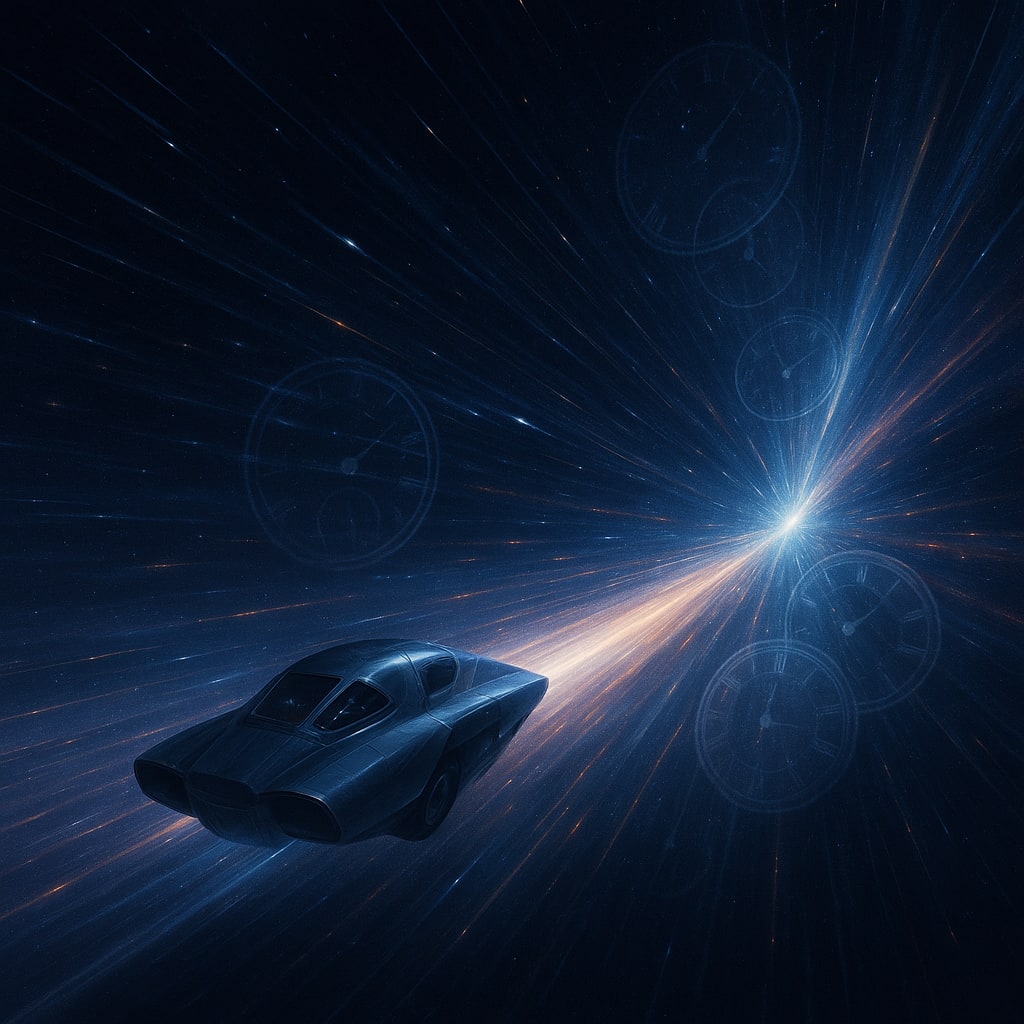
Light travels at an unimaginable pace—299,792,458 meters per second. That’s about 7.5 times around the Earth in just one second. But what makes this number truly extraordinary isn’t how fast it is—it’s the fact that it represents the ultimate speed limit of the universe. Nothing, according to Einstein’s theory of relativity, can go faster. The speed of light isn’t just a measure of velocity; it’s the foundation of how space and time themselves are built.
So what actually happens when you start moving close to that limit? And what would occur—if it were somehow possible—to exceed it, even by a single meter per second?
Time Isn’t What You Think It Is
Let’s imagine two people: one stays comfortably on Earth, while the other boards a spaceship capable of near-light-speed travel. For the astronaut, time seems to flow normally—seconds tick by, minutes pass. But for the person back home, something strange happens: the astronaut’s clock appears to slow down.
This phenomenon, called time dilation, is a key part of Einstein’s special theory of relativity. The faster you move, the slower time passes for you relative to someone who’s stationary. From Earth’s point of view, the astronaut’s biological processes, heartbeat, and even thoughts all run in slow motion. Yet for the astronaut, nothing feels unusual.
Here’s a simple example. Suppose the astronaut travels to a star 10 light-years away at 99.5% of the speed of light. For them, the journey might feel like just a few months. But when they return, decades will have passed on Earth. The astronaut would have barely aged, while everyone back home could be much older—or even gone.
This isn’t science fiction—it’s science fact. Time dilation has been confirmed through countless experiments, including observations of high-speed subatomic particles and ultra-precise comparisons between atomic clocks on Earth and those aboard fast-moving satellites.
The Closer You Get to Light, the Stranger It Gets
As speed increases, so does the distortion of time. At 90% of the speed of light, time for a traveler slows down by about half. At 99%, it’s seven times slower. At 99.9%, time stretches by a factor of 22. Each additional “9” after the decimal makes the energy requirements skyrocket, and the effects of relativity grow even more extreme.
Here’s the catch: as you accelerate, your relativistic mass (the energy-equivalent of your motion) increases. That means the faster you go, the heavier you become in terms of energy. To reach the speed of light itself, your mass would become infinite—and it would take an infinite amount of energy to push you there. That’s why nothing with mass can ever reach, let alone surpass, the speed of light.
Crossing the Line: Beyond the Speed of Light
Now, let’s step into pure speculation. What would happen if, somehow, you could exceed the speed of light—say, by just one meter per second?
Einstein’s equations predict something mind-bending: causality breaks down. In other words, the order of cause and effect could flip. From one observer’s point of view, you’d still be moving forward in time—but from another’s, you might appear to be moving backward. Events could unfold in reverse: effects happening before their causes.
In this realm, the math stops making physical sense. Time could become imaginary, and space could lose its meaning. The object wouldn’t merely be “faster”—it would have stepped outside of our universe’s logic altogether.
Physicists have speculated about theoretical particles called tachyons, which would always move faster than light. But tachyons, if they exist, would violate the basic rules of relativity and lead to paradoxes where information could be sent into the past. So far, no evidence has ever been found for such entities. For now, they remain mathematical ghosts—fascinating but likely impossible.
Light Speed Isn’t Just a Limit — It’s the Framework
It’s tempting to think of the speed of light as a wall that we just need to break through, like the sound barrier once was for aircraft. But in truth, it’s not a wall—it’s the structure of space and time itself. Everything that exists—matter, energy, even gravity—operates within that structure. Trying to move faster than light would be like trying to leave reality itself.
Still, humanity is nothing if not ambitious. Physicists and dreamers alike have imagined ways around the problem: warp drives, wormholes, and other exotic concepts that don’t technically break the speed limit but instead bend space-time itself. If you can shorten the distance between two points by curving the fabric of space, you can effectively travel faster than light—without ever actually doing so.
The Paradox of Light
Here’s the ultimate irony: the closer you get to the speed of light, the slower time becomes, until at light speed, time stops altogether. From a photon’s point of view (if it had one), no time ever passes. A beam of sunlight that left a distant star millions of years ago “arrives” instantly from its own perspective.
So, chasing the speed of light isn’t just about going faster—it’s about reaching the edge of time itself. Beyond that edge lies a realm where our concepts of before and after, here and there, simply fall apart.
Until we find a way to bend the universe itself, the only thing that can travel faster than light is the human imagination—and that, at least, has no limits.
About the Creator
Keep reading
More stories from Holianyk Ihor and writers in Education and other communities.
Building Giant Spacecraft in Earth’s Orbit: The First Step Toward Interstellar Voyages
When we imagine the spacecraft of the future, our minds often conjure images straight out of science fiction: colossal vessels bristling with solar panels, sprawling habitats large enough to house thousands of people, and mile-long engines designed to push humanity beyond the boundaries of our solar system. Yet, if you were to ask today’s aerospace engineers whether we could simply build such a spacecraft on Earth and launch it into space, the answer would be a resounding no.
By Holianyk Ihor4 months ago in Education
The $73,000 Text Message That Changed Everything
"Just realized I missed the quarterly payment deadline by one day. How bad is this?" I stared at the message, knowing I was about to deliver devastating news. My client—a successful entrepreneur who built his tech consulting firm from zero to $3.2 million in annual revenue—had just cost himself $73,000.
By Nth Degree Tax3 days ago in Education
How Audit Management Solutions Streamline ESG Compliance
Corporate credibility is increasingly defined by Environmental, Social, and Governance (ESG) compliance. Stakeholders, including shareholders, regulatory authorities, consumers, and employees, are placing greater demands on organizations to operate transparently, ethically, and sustainably.
By Matthew Luke3 days ago in Education




Comments
There are no comments for this story
Be the first to respond and start the conversation.