
Homes Beneath the Red Dust: How Subsurface Living Could Keep Mars Settlers Safe and Warm
Space

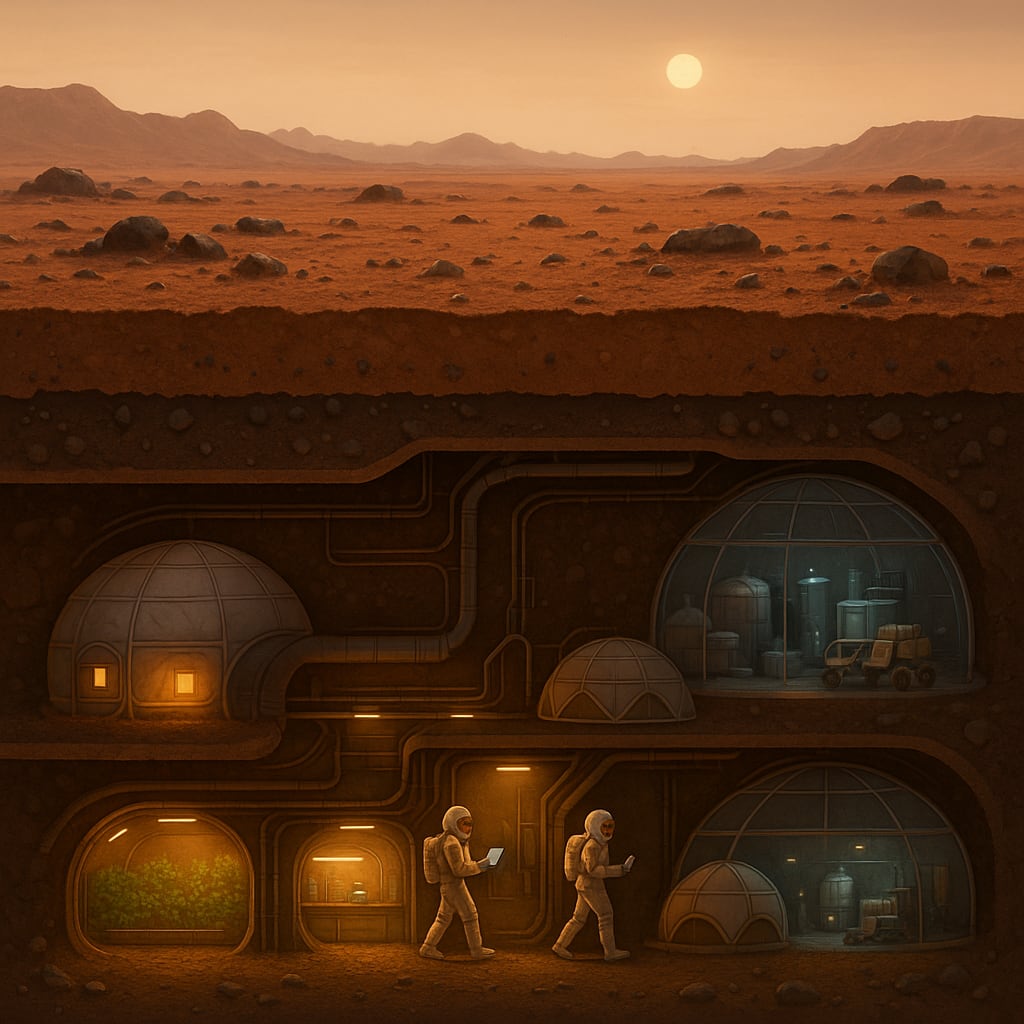
When humans finally set foot on Mars, they won’t be building glass domes under the crimson sky — at least not right away. The first Martian homes will likely be hidden beneath the planet’s surface, buried in the dusty regolith, where the hostile environment gives way to safety, stability, and warmth.
It may not sound glamorous at first — trading open Martian vistas for tunnels and caves — but underground architecture could be the key to surviving, and even thriving, on our neighboring world.
Why Going Underground Makes Sense
Mars is as beautiful as it is brutal. Its thin atmosphere is made mostly of carbon dioxide and provides almost no protection from solar radiation and cosmic rays. Without a magnetic field like Earth’s, Mars is constantly bombarded by high-energy particles that would make long-term surface living impossible.
The solution? Go underground.
Even a few meters of Martian soil — known as regolith — can block a large portion of harmful radiation. Studies from NASA’s Jet Propulsion Laboratory suggest that a 2–3 meter layer of regolith could reduce radiation exposure to levels safe for long-term human habitation.
Temperature swings are another problem. On Mars, it can be a pleasant 20°C (68°F) near the equator during the day, only to plummet to −120°C (−184°F) at night. Beneath the surface, however, the temperature remains relatively constant — hovering around −60°C (−76°F). While that’s still cold, it’s far easier to heat a stable environment than to deal with wild temperature shifts every day.
Building a Martian Underground Home
How do you build a house under an alien planet’s surface? Engineers and architects have a few ideas — and they’re as creative as they are practical.
3D Printing with Martian Regolith
Future settlers might bring massive autonomous 3D printers that use local soil as building material. By mixing regolith with sulfur or special binding polymers, the printers could create thick, durable walls without importing a single brick from Earth. This concept has already been tested on Earth using simulated Martian soil — and it works.
Lava Tubes: Nature’s Ready-Made Shelters
Mars has huge lava tubes — natural tunnels left behind by ancient volcanic activity. Some of these tunnels are so large they could fit entire city blocks. Because they’re already shielded by rock, they could serve as instant radiation shelters. Scientists have even identified several potential sites from orbit, including near the Tharsis volcanoes and the Elysium region.
Inflatable Living Modules
Inside these caves or excavated chambers, settlers could deploy inflatable habitats — pressurized living spaces made from flexible, multilayer materials. These modules, similar to NASA’s BEAM module tested on the International Space Station, can expand to create comfortable, airtight interiors and be easily transported on spacecraft.
The Art of Staying Warm
Keeping warm on Mars is a constant battle. With an atmosphere only 1% as dense as Earth’s, heat loss happens fast. That’s why insulation is everything.
The interiors of Martian homes might use multi-layer insulation, reflective coatings, and vacuum panels similar to those in modern thermos flasks. Energy will come from solar arrays and compact nuclear reactors, like NASA’s Kilopower system, which can run continuously during the long, dark Martian nights.
To avoid wasting precious energy, homes could store excess heat in phase-change materials — substances that absorb heat when melting during the day and release it again at night, maintaining a stable indoor temperature.
Breathing, Growing, and Staying Sane
A closed-loop life support system will make underground living sustainable. Plants will play a vital role: they’ll recycle carbon dioxide into oxygen, purify water, and provide fresh food — along with a splash of green in a world of red dust.
Psychological well-being, however, may be the hardest part. Living underground with no view of the sky can trigger isolation and depression. To combat this, future Martian habitats might feature artificial “windows” — high-resolution panels displaying live feeds from the surface or even serene Earth landscapes. Dynamic lighting systems could mimic sunrise, daylight, and sunset to maintain healthy circadian rhythms.
As one NASA architect put it, “A Martian base isn’t just an engineering project — it’s a psychological experiment.”
A New Kind of Home
In the early years of Martian colonization, settlers won’t be gazing out at dusty horizons from transparent domes. They’ll be living in quiet, insulated tunnels — warm, safe, and full of the hum of life-support systems. It’s not the Mars of science fiction postcards, but it’s a crucial first step.
These underground homes will be the womb of a new world — protecting humanity until we can eventually reach for the surface again. And perhaps, decades from now, when future generations stroll across Mars beneath a terraformed sky, they’ll remember that civilization on the Red Planet began not under the stars — but beneath the soil.
About the Creator
Keep reading
More stories from Holianyk Ihor and writers in Futurism and other communities.
The Titan Colony Concept — Life Beneath Methane Clouds
When humanity first gazed upon the golden, hazy images sent back by the Cassini–Huygens mission, it became clear that Saturn’s moon Titan was not just another frozen satellite. Here was a world with mountains, rivers, rain, and lakes — but everything made of something alien. Instead of water, methane flows in liquid form. Instead of white clouds, the skies are thick with orange hydrocarbon haze. The air is heavy, the light dim, and the temperature bone-chilling — a staggering minus 180°C.
By Holianyk Ihor3 months ago in Futurism
About Binding Prometheus
I want to start actively advocating on behalf of my own work, and the most valuable part of my canon is, without a doubt, Binding Prometheus, the play I have been working on since 2019 and only finished in 2023 as part of my MA. The play itself is an amalgamation of a million different inspirations. On one end, it evokes the Ancient Greek myth-play, deriving its own title from the earliest extant work of Western drama we have, Aeschylus’s Prometheus Bound. On the other end, it borrows significantly from the sci-fi bulwarks from over the years, namely Mary Shelley’s Frankenstein and Karel Capek’s Rossum’s Universal Robots. The play could be an episode of Black Mirror, I fear. I don’t know. I’ve only ever seen one episode of Black Mirror.
By Steven Christopher McKnight17 days ago in Futurism
United States Beer Market Size and Forecast 2025–2033
Market Overview The United States Beer Market continues to stand as one of the most dynamic segments of the country’s food and beverage industry. According to Renub Research, the market is estimated to expand significantly from US$ 246.72 billion in 2024 to US$ 411.89 billion by 2033, registering a strong Compound Annual Growth Rate (CAGR) of 5.86% from 2025 to 2033. This growth is driven by shifting consumer preferences toward craft and premium beers, innovative brewing techniques, and a growing emphasis on sustainability across production and packaging.
By Janine Root 8 days ago in Futurism



Comments
There are no comments for this story
Be the first to respond and start the conversation.