Ekphrastic
Healing in Verse: The Power of Psychological Poetry
Healing in Verse: The Power of Psychological Poetry For as long as she could remember, Mara had lived with a storm inside her. It wasn’t always loud or violent—sometimes it was a quiet gray that followed her into every room, like a shadow she couldn't shake. Friends called her "the deep thinker," teachers praised her essays, and her voice carried calm in conversation. But inside, she was always swimming in thoughts too big to name. At seventeen, after a long season of silence, Mara’s therapist gave her a simple suggestion: “Try writing what you feel. Don’t worry about sense—just sound.” So that night, Mara opened a notebook and wrote: > “My mind is a house where windows blink, Walls whisper, and silence sings.” It didn’t make perfect sense, but it felt true. That was the night poetry found her. Over the weeks that followed, Mara poured her quiet chaos into verse. She wrote about feeling invisible, about dreams that spoke in symbols, about the strange comfort of being alone. Her words didn't rhyme, and her lines didn’t follow rules—but something inside her began to shift. With every poem, she wasn’t just venting emotion—she was decoding it. The act of writing made the unnamed parts of her pain visible, and once visible, they became livable. --- The Psychology Behind the Pen What Mara didn’t know yet was that she had stumbled into an age-old practice now being explored by modern psychologists: poetry therapy. Psychological poetry—sometimes called therapeutic or expressive poetry—is the use of poetic language and structure to explore, understand, and even heal the mind. Research has shown that writing poetry can reduce anxiety, increase emotional resilience, and improve self-awareness. According to Dr. James Pennebaker, a leading psychologist in expressive writing, the process of putting feelings into words changes how the brain processes trauma. It's as if the act of writing allows the mind to reorganize painful memories, giving the author both distance and control. Unlike clinical talk therapy, poetry doesn’t demand clarity or explanation. Instead, it welcomes metaphor, ambiguity, and emotion. For many, that makes it safer—more intuitive. In Mara’s case, poetry became the bridge between her inner world and outer reality. It gave her a voice when she didn’t know how to speak plainly. --- A Blooming Mind One morning in early spring, Mara stood in front of her English class and read one of her poems aloud. It wasn’t about depression or trauma—it was about a tree that forgot how to bloom, and the wind that sang it back to life. > “And so the branches shook with song, Until one petal dared to wake.” When she finished, the room was silent. Not the awkward kind—the holy kind. One classmate had tears in their eyes. Another came up after class and whispered, "That poem felt like me." It was then Mara understood: poetry doesn’t just heal the writer—it heals the reader, too. --- Why Psychological Poetry Matters In a world full of fast communication and emotional noise, poetry invites depth, slowness, and reflection. It lets people: Name the unnamable (grief, fear, longing) Find meaning in pain Transform wounds into art Connect with others in silent understanding And it’s not just for “poets.” Anyone—with or without experience—can benefit from writing or reading psychologically rooted poetry. Whether it’s a journal scribbled in at midnight, a spoken word shared on stage, or a single verse taped to a mirror, poetry reminds us: You are not alone in how you feel. --- The Final Line Years later, Mara became a counselor. On the shelf behind her desk sat a stack of empty notebooks, free for any client who needed them. When one young boy asked, “What if I don’t know what to write?” She smiled and said, “Start with how it sounds inside your head.” And so the healing continued—line by line, soul by soul.
By Muhammad Saad 4 months ago in Poets
The Heart of Humanity: How Poetry Connects Us All
On a quiet Sunday morning in a city that never quite stopped moving, something unusual was happening in Central Park. Beneath the wide branches of an old oak tree, a small crowd had gathered—not for a concert, a protest, or a marathon, but for poetry. There was no stage, no microphone, no tickets. Just a circle of people—young and old, from different parts of the city and beyond—reading poems aloud, listening, and sharing. Some brought classics from Rumi, Tagore, and Maya Angelou. Others read their own verses, voices shaking slightly, hearts laid bare. At the center of the circle sat Elena, a retired schoolteacher who had started this informal gathering during the lockdowns. “I wanted to keep people connected when we were all feeling so apart,” she said. “I thought maybe a few friends would come. Now, three years later, we’re here every week—and there’s always someone new.” Poetry, often considered a quiet and solitary art, was doing something remarkable. It was reaching people. Not just in quiet parks, but online, in schools, in cafes, on social media—everywhere. Hashtags like #PoetryHeals and #VersesForChange had millions of views. Teenagers were sharing haikus on TikTok. Elders were reciting old poems on YouTube. Refugees were writing verses in camps. Prison inmates were expressing dreams through stanzas. And readers—millions of them—were listening. Why poetry? Why now? According to Dr. Amina Bell, a literature professor and social psychologist, the answer lies in poetry’s simplicity—and its depth. “In just a few lines, poetry can capture what entire books cannot,” she explains. “It gives people a way to process their emotions, to feel seen, and to connect with others. Especially in times of uncertainty, poetry feels like a lifeline.” Indeed, the world in recent years has faced profound challenges—pandemics, wars, climate change, isolation. In these moments, people turn inward. They search for meaning. They look for words that don’t just explain, but feel. And poetry is feeling, distilled. Consider the story of Rafiq, a young man who fled conflict in Syria and resettled in Sweden. At a refugee center, he began writing poems in Arabic about his journey, grief, and hope. Volunteers helped translate his work, and soon his poems were published in a small anthology. One of his verses reads: "I carried my home in my chest / like a bird keeps a sky / folded inside its wings." That one line touched thousands, reminding readers not just of Rafiq’s story, but of their own longing—for safety, belonging, and beauty. Then there’s Ava, a teenager in Brazil who struggled with anxiety during the lockdowns. She started writing short poems on her phone and posting them online. To her surprise, people responded with kindness and resonance. “It was like I wasn’t alone anymore,” she said. “And neither were they.” Poetry today isn’t just found in dusty books or academic journals. It’s on subway walls, in Instagram captions, printed on coffee cups, and spoken at open mics. It’s becoming a language of the people—accessible, personal, and healing. Governments and educators are taking note. Schools in Finland, India, and Canada have introduced daily “poetry minutes” where students read or write a short verse to begin the day. Hospitals in several countries now employ "poet therapists" who use poetry to help patients process trauma. Even corporations are exploring poetry as a tool for empathy and communication. But perhaps the most powerful impact of poetry is the human one—the simple, sacred act of sharing words. Back under the oak tree in Central Park, Elena listens as a boy of about ten reads a poem he wrote about his dog. His voice is soft, but steady. When he finishes, the group claps warmly. “That was beautiful,” Elena tells him. “Thank you for sharing your heart.” Later, she reflects: “We live in a noisy world. Poetry helps us listen—to each other, to ourselves, to the silence between the words.” As the sun dips behind the buildings, casting long shadows on the grass, the group slowly disperses. Some stay to talk. Others head home, carrying poems in their pockets or tucked into their memory. Poetry may not solve every problem. But it reminds us who we are. It brings light to the dark, gives voice to the voiceless, and reminds us that even in silence, we are not alone. And perhaps that is why more and more people are reading, writing, and living poetry—not just as art, but as a way of being.
By Muhammad Saad 4 months ago in Poets
The Harmony of Truth: Where Poetry Meets Knowledge
In a quiet village nestled between the arms of two gentle hills, there lived an old woman named Elira who was known not for her age, but for the way she spoke. Every word she uttered seemed to dance, as if the wind itself waited to carry her voice across the valley. She was a weaver — not of cloth, but of truths, carefully threaded into verses, rhymes, and stories. People called her “The Poet of Knowledge.” What made Elira unique was not just the beauty of her words, but the precision of her meaning. She believed that truth was not only something to be known — it was something to be felt. In a world filled with noise, she made knowledge sing. Children often gathered beneath the old sycamore tree where she sat, quill in hand, notebook resting on her lap like a bird’s nest. One day, a curious boy named Lior asked, “Why do you always rhyme your facts? Isn’t science just science and poetry just poetry?” Elira smiled. Her eyes sparkled like moonlight on river water. “Ah,” she said, “that is the question, isn’t it?” She closed her notebook gently and leaned forward. “Do you know how honey is made?” Lior nodded. “Bees collect nectar, bring it to the hive, pass it around to each other, and eventually it becomes honey.” Elira clapped her hands. “Very good! Now, listen to this: Golden wings in summer air, Whispers sweet beyond compare. From flower’s kiss to hive’s embrace, The nectar turns with patient grace.” The children giggled, enchanted. “But it’s the same thing!” Lior said. “Just prettier.” Elira nodded. “Yes, but you remembered both, didn’t you?” That was her secret: she wove scientific truths into poetic frames, allowing the heart to remember what the mind might forget. Her stories were more than beautiful — they were accurate, researched, and crafted with care. For her, poetry wasn’t a mask for facts; it was their lantern. Word of her gift spread beyond the village. Scholars came, skeptical at first, expecting riddles and romance. Instead, they found verses rich with information: poetic explanations of plant cycles, starlight, ecosystems, and even emotional intelligence. And in every line, the facts held strong — like roots beneath the petals. One professor asked her, “Why go through all the trouble? Isn’t prose more… efficient?” Elira replied, “Yes. But efficiency isn’t always remembrance. Poetry lives longer. A fact heard once might be forgotten, but a line that moves your heart? That stays.” She recalled how ancient civilizations passed knowledge through verse: the Vedas of India, Homer’s epics, the griots of West Africa. Before paper and pixels, poetry preserved the truths of the world — astronomy, medicine, ethics, and law — not because it was flowery, but because it was unforgettable. As the seasons turned, Elira began teaching others her method: how to root poems in research, how to respect the integrity of information while allowing emotion to breathe through metaphor. Her motto was simple: “Beauty and truth are not opposites; they are partners.” Lior, now a young man, became her apprentice. He was quick with facts, curious by nature, and slowly learned to let those facts sing. He wrote: In ocean's heart, the currents turn, A silent path the moon does learn. Gravity’s pull and winds in play, Guide every tide, both night and day. When he recited this in a classroom years later, even the quietest students lifted their heads. Something in the rhythm reached them before they even understood the physics. Elira passed peacefully one winter morning, a smile still on her lips. Her notebook — filled with verses on everything from cellular biology to the importance of kindness — was passed down, copied, and studied. Today, in schools, libraries, and even scientific journals, you can find echoes of her work. Not all facts need rhyme, of course. But in a world overwhelmed by data, the soft light of poetic information reminds us: truth isn’t just to be known — it’s to be remembered, to be shared, and, when possible, to be felt. Because when knowledge speaks in poetry, we don’t just hear — we listen.
By Muhammad Saad 4 months ago in Poets
Whispers of the Forest
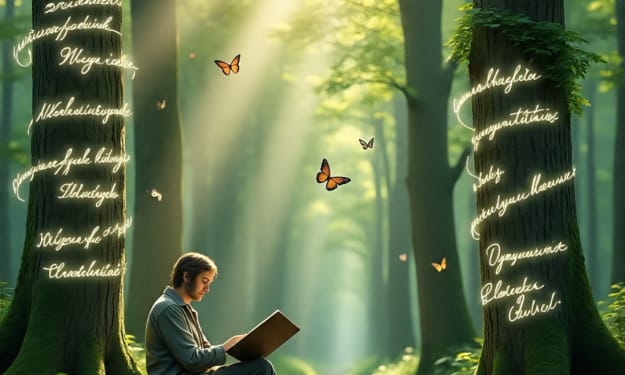
Whispers of the Forest: A Journey Through Fresh and Uplifting Poetry When Ella first stepped into the forest that summer morning, she wasn’t looking for inspiration. She had simply wanted quiet. After a long season of city noise, deadlines, and endless scrolling, the stillness of the woods called to her like an old friend. The path was soft beneath her boots, made of pine needles and time. Towering trees arched above her like cathedral pillars, filtering sunlight into golden beams. The air smelled of moss, bark, and distant rain. And somewhere, high above, a bird sang a melody so delicate it felt like a secret. She stopped, breathed deeply, and let herself simply be. It was there, in that breath of stillness, that she heard the forest speak—not in words, but in feeling. She pulled a small notebook from her bag and wrote: The trees do not ask for applause, Yet they dance for the wind, just the same. She blinked, surprised. Poetry had once been part of her life—when she was younger, when her world was smaller and somehow wider all at once. But in recent years, she’d left it behind. Jobs, bills, and grown-up responsibilities had crowded it out. Yet here it was again, as natural and unforced as the sunlight. That one verse became two, then four. Hours passed as she wandered the woods, writing about leaves that whispered old stories, rivers that hummed lullabies, and mushrooms that rose like quiet miracles from the forest floor. Her poems weren’t polished or planned, but they felt alive—fresh and full of something real. Over the next few weeks, Ella returned to the forest again and again. Each time, she wrote more. She began to see patterns: the gentle rhythm of nature echoed in her words. The forest, with all its life and stillness, had become her muse. Her poetry wasn’t just about nature—it felt like it was nature. And she wasn’t the only one. As her confidence grew, Ella started sharing her poems online under the name Forest Voice. To her surprise, they resonated. People from all over the world wrote to her: "Your poem about the falling leaf helped me through a hard day." "I read your lines about the morning dew aloud to my kids. They wanted to go outside and find poems of their own." "I forgot how much I love trees. Thank you for reminding me." Soon, a community formed—writers, readers, nature lovers, teachers, and quiet souls looking for peace. Together, they began creating and sharing fresh, forest-inspired poetry. Some were just a few lines; others were rich, lyrical meditations. All carried the same heartbeat: a deep respect for the natural world and the beauty it offers, freely and constantly. Ella also began hosting small gatherings in local woods—"Poetry Walks," she called them. People would meet among the trees, walk in silence, write, and then gather to read aloud. There were tears, laughter, even spontaneous applause. No one judged grammar or rhyme. The only rule was to listen—to the forest, and to each other. These poetry walks grew in popularity. Local schools got involved, encouraging children to write “poems of place.” Older adults shared stories of poems they’d written decades ago and hidden in drawers. What started as Ella’s personal retreat had become something bigger: a gentle movement of renewal and connection. Through it all, the poetry stayed fresh—never stale or stiff. The forest didn’t repeat itself, and neither did the poems. Each walk brought new sights: a fox’s paw print, a spider’s web sparkling with dew, a sudden bloom of wildflowers. Each moment invited new words. Ella often said, “The forest writes first. I just listen.” She published a small collection called Whispers of the Forest, filled with poems written during her walks. It wasn’t a bestseller, but it didn’t need to be. It found its way into the hands of those who needed it—people looking for calm, for truth, for beauty rooted in the earth. And somewhere, in a quiet classroom, a child wrote: The wind is soft like my mother’s hug. The trees are tall like they have stories to tell. I want to live in a forest made of poems. Ella read those lines one morning and smiled. Because that was the heart of it: the forest had always been poetry. It just needed someone to listen—and someone to share its voice.
By Muhammad Saad 4 months ago in Poets