
The Harmony of Truth: Where Poetry Meets Knowledge
Exploring How Poetic Expression Can Deliver Positive and Accurate Information with Beauty and Clarity

In a quiet village nestled between the arms of two gentle hills, there lived an old woman named Elira who was known not for her age, but for the way she spoke. Every word she uttered seemed to dance, as if the wind itself waited to carry her voice across the valley. She was a weaver — not of cloth, but of truths, carefully threaded into verses, rhymes, and stories. People called her “The Poet of Knowledge.”
What made Elira unique was not just the beauty of her words, but the precision of her meaning. She believed that truth was not only something to be known — it was something to be felt. In a world filled with noise, she made knowledge sing.
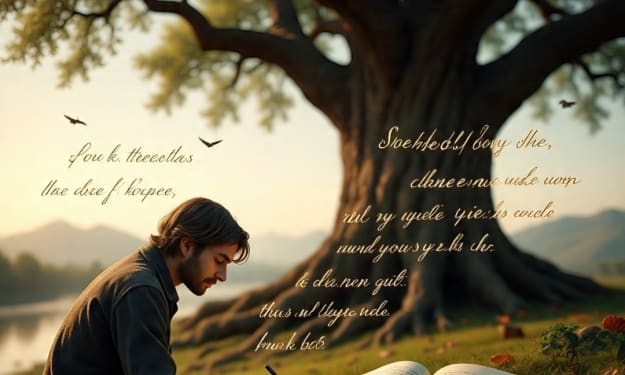
Children often gathered beneath the old sycamore tree where she sat, quill in hand, notebook resting on her lap like a bird’s nest. One day, a curious boy named Lior asked, “Why do you always rhyme your facts? Isn’t science just science and poetry just poetry?”
Elira smiled. Her eyes sparkled like moonlight on river water. “Ah,” she said, “that is the question, isn’t it?”
She closed her notebook gently and leaned forward. “Do you know how honey is made?”
Lior nodded. “Bees collect nectar, bring it to the hive, pass it around to each other, and eventually it becomes honey.”
Elira clapped her hands. “Very good! Now, listen to this:
Golden wings in summer air,
Whispers sweet beyond compare.
From flower’s kiss to hive’s embrace,
The nectar turns with patient grace.”
The children giggled, enchanted.
“But it’s the same thing!” Lior said. “Just prettier.”
Elira nodded. “Yes, but you remembered both, didn’t you?”
That was her secret: she wove scientific truths into poetic frames, allowing the heart to remember what the mind might forget. Her stories were more than beautiful — they were accurate, researched, and crafted with care. For her, poetry wasn’t a mask for facts; it was their lantern.
Word of her gift spread beyond the village. Scholars came, skeptical at first, expecting riddles and romance. Instead, they found verses rich with information: poetic explanations of plant cycles, starlight, ecosystems, and even emotional intelligence. And in every line, the facts held strong — like roots beneath the petals.
One professor asked her, “Why go through all the trouble? Isn’t prose more… efficient?”
Elira replied, “Yes. But efficiency isn’t always remembrance. Poetry lives longer. A fact heard once might be forgotten, but a line that moves your heart? That stays.”
She recalled how ancient civilizations passed knowledge through verse: the Vedas of India, Homer’s epics, the griots of West Africa. Before paper and pixels, poetry preserved the truths of the world — astronomy, medicine, ethics, and law — not because it was flowery, but because it was unforgettable.
As the seasons turned, Elira began teaching others her method: how to root poems in research, how to respect the integrity of information while allowing emotion to breathe through metaphor. Her motto was simple: “Beauty and truth are not opposites; they are partners.”
Lior, now a young man, became her apprentice. He was quick with facts, curious by nature, and slowly learned to let those facts sing. He wrote:
In ocean's heart, the currents turn,
A silent path the moon does learn.
Gravity’s pull and winds in play,
Guide every tide, both night and day.
When he recited this in a classroom years later, even the quietest students lifted their heads. Something in the rhythm reached them before they even understood the physics.
Elira passed peacefully one winter morning, a smile still on her lips. Her notebook — filled with verses on everything from cellular biology to the importance of kindness — was passed down, copied, and studied.
Today, in schools, libraries, and even scientific journals, you can find echoes of her work. Not all facts need rhyme, of course. But in a world overwhelmed by data, the soft light of poetic information reminds us: truth isn’t just to be known — it’s to be remembered, to be shared, and, when possible, to be felt.
Because when knowledge speaks in poetry, we don’t just hear — we listen.
About the Creator
Keep reading
More stories from Muhammad Saad and writers in Poets and other communities.
The Power of Long Poetry: A Journey Through Words and Wonder
In a quiet corner of a sun-drenched park, Maya unfolded a soft leather notebook that had accompanied her for years. The pages were worn at the edges, filled with looping ink and carefully measured lines. She had been writing poetry since childhood, but today, something different stirred in her spirit — a desire to write not just a poem, but a journey. Long poetry was often misunderstood. In a world that valued speed, skimming, and soundbites, the idea of a poem stretching across pages seemed, to some, like an indulgence or an outdated relic. But Maya knew better. She had felt the way a long poem unfolded like a slow sunrise — not hurried, not forced — but full of promise. She remembered the first time she read a long poem that truly moved her. It was T.S. Eliot’s The Waste Land. Though complex and at times mysterious, it invited her into a layered world of emotion, history, and thought. Each stanza revealed something new. Each shift in voice or tone was a doorway. The length didn’t make it harder to love — it made the love deeper. And that was the quiet power of long poetry. It asked for time, and in return, it gave transformation. Maya began to write, her pen gliding across the paper: > This is not a tale to fit in a breath, Nor a thought meant to end at the first sigh. It stretches like a road beneath the moon, Waiting for feet brave enough to try. As the verses grew, so did her world. The poem explored a young girl’s journey through grief, healing, and hope — themes too complex for a single stanza or neat four-line rhyme. She wove metaphors like rivers, let memories echo through repeated lines, and allowed space for silence between sections. There was room to breathe, to reflect, to feel. Long poetry, Maya realized, is an invitation — not just for the writer, but for the reader. It invites you to slow down, to dwell in meaning, to walk beside the poet through valleys and up hills. Unlike shorter forms, which sometimes offer a sharp punch or a quick moment of beauty, longer poems hold space for evolution. They can begin in sorrow and end in joy. They can shift perspectives, grow characters, or carry a conversation across continents of thought. Throughout literary history, long poems have shaped cultures and echoed across generations. Homer’s Odyssey, Dante’s Divine Comedy, Milton’s Paradise Lost — each a towering work that speaks to the power of sustained poetic thought. In more recent times, long poems have become a form of protest, reflection, and healing. Poets like Derek Walcott, Anne Carson, and Adrienne Rich have used the form to unpack identity, memory, and the truths often too tangled for brief verse. But even outside of academia and literary fame, long poetry lives in everyday writers like Maya. For her, it was a personal practice — one that helped her process life’s complexity. It didn’t need to be published or perfect. It simply needed to be written. As she reached the end of her poem, Maya smiled. > And now I close this book, but not the road, For every word I’ve sown will bloom again. A poem may end, but the truth it holds Will echo long beyond its final line. She closed her notebook with care, feeling a quiet satisfaction. Not just from finishing a piece of work, but from honoring the depth of her thoughts, the fullness of her heart. In a world rushing toward the next notification, the next distraction, the next task — long poetry is a rebellion. A beautiful, gentle rebellion that says: “Wait. Linger. Feel this fully.” It’s not about being long for the sake of length, but about allowing the soul of a poem the room it needs to speak. Sometimes, the most important truths take time to unfold. As Maya walked away from the bench, the sun casting golden shadows behind her, she felt lighter. Her story — not just the one on the page, but the one in her heart — had found its voice. And in that moment, she knew: long poetry wasn’t just something she loved. It was something the world still needed.
By Muhammad Saad 6 months ago in Poets
A More Human Vocal
When we launched Vocal nearly a decade ago, the world was a very different place. LLMs did not exist, and stories were created one at a time by people sitting down to write, revise, and share something personal. Many of our assumptions about publishing, trust, and participation were built for a world where effort and output were inseparable.
By Justin @ Vocal7 days ago in Resources


Comments
There are no comments for this story
Be the first to respond and start the conversation.