World History
"The Rise and Fall of the Ottoman Caliphate"
History of Khilafat-e-Usmania (Ottoman Caliphate) The Khilafat-e-Usmania, or the Ottoman Caliphate, was the last widely recognized Islamic Caliphate and one of the most enduring empires in world history. Established at the dawn of the 14th century, it lasted over 600 years, exerting tremendous influence across Europe, Asia, and Africa. It began as a small principality in Anatolia under Osman I, and by the 16th century, it had evolved into a global empire and the political center of the Muslim world.
By Haris khan8 months ago in History
Julie Clary, Imperial Princess
Julie looked at the mirror with horror that grew with every second. She was in a beautiful white dress, embroidered with silver and gold, with a low neckline and a high waist. Julie wore earrings that matched and to complete the ensemble, there was a gold coronet on top of her dark hair. As her maids told her, she was beautiful and looked like the princess she was.
By Rebecca Patton8 months ago in History
The Oak Island Money Pit: History, Theories, and the Flooded Trap That Changed Everything
It started with the sound of a shovel striking earth. What followed would become the longest-running treasure hunt in modern history — filled with mystery, death, obsession, and one maddening, elusive promise: that somewhere beneath Oak Island, something extraordinary lies buried.
By Rukka Nova8 months ago in History
Top 5 Ancient Inventions Still Used Today
Human civilization has been shaped by groundbreaking inventions that emerged thousands of years ago. Many of these innovations were so advanced that they continue to influence modern technology, infrastructure, and daily life. From the wheel to paper, ancient inventors laid the foundation for the world we know today.
By Himadri Niloy8 months ago in History
📚 The Library of Ashurbanipal: The World’s First Great Archive of Knowledge
📚 The Library of Ashurbanipal: The World’s First Great Archive of Knowledge 📜Part I: Discovery Amid Ruins In the mid-1800s, long before archaeology had matured into the scientific discipline we know today, the deserts of northern Iraq were largely unexplored by Europeans. One such explorer was Austen Henry Layard, a British adventurer with a deep fascination for the biblical cities of Nineveh and Babylon. In 1849, while excavating near the village of Kuyunjik, Layard uncovered massive ruins buried under mounds of earth. These ruins belonged to Nineveh, the ancient capital of the Neo-Assyrian Empire — a city that had once been one of the most powerful urban centers in the ancient world.
By Kek Viktor8 months ago in History
🏺 Göbekli Tepe: The Temple That Rewrote Human History
🏺 Göbekli Tepe: The Temple That Rewrote Human History I. Discovery and Location Göbekli Tepe, which translates from Turkish as “Potbelly Hill,” sits quietly in the dry, rolling hills of southeastern Turkey, near the modern city of Şanlıurfa. Though it had long appeared on maps as a minor mound — a common sight in the region — its true significance wasn’t understood until the mid-1990s. In fact, for decades, local farmers and researchers assumed the mound was a simple Bronze Age burial site or a ruined Byzantine outpost. But in 1994, the German archaeologist Klaus Schmidt, who had worked at nearby Neolithic sites, re-examined the mound and recognized that the flint tools and carved stones scattered across the surface pointed to something far older and more significant.
By Kek Viktor8 months ago in History
⛏️Nabta Playa: The 7,000-Year-Old Stone Circle of the Nubian Desert
⛏️Nabta Playa: The 7,000-Year-Old Stone Circle of the Nubian Desert Discovery and Location Nabta Playa lies hidden deep within the Nubian Desert, an arid and inhospitable region in southern Egypt, close to the border with Sudan. This vast desert landscape today is characterized by harsh winds, blazing sun, and seemingly endless sand dunes, but approximately 7,000 to 8,000 years ago, this area was dramatically different.
By Kek Viktor8 months ago in History
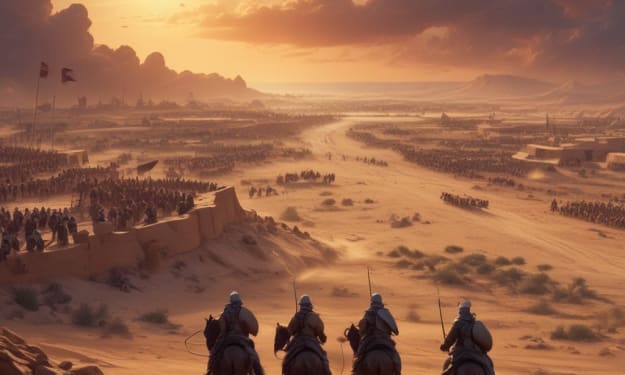
Battle of Qadsiyah. AI-Generated.
War of Qadsiyah The Decisive Battle That Marked the Fall of the Sassanian Empire The War of Qadsiyah stands as one of the most significant battles in early Islamic history. It was not just a military confrontation but a turning point that led to the collapse of the ancient Sassanian Empire and the rapid expansion of the Islamic Caliphate into Persia. The clash happened in the year 636 CE, near the banks of the Euphrates River, close to the town of Qadsiyah, in present-day Iraq. This battle symbolized the fierce determination of the early Muslim forces and the vulnerabilities of a once-mighty empire struggling with internal decay.
By Zain Ul Abedin Khan8 months ago in History
4. "The Crimson Message"
The envelope was ordinary—cream-colored, unmarked, and left on the kitchen table. But it was the ink that made Olivia’s fingers tremble. Blood-red, bold strokes scrawled her name across the front: OLIVIA. No return address. No stamp. Someone had left it there.
By Usman Khan8 months ago in History
Andalusia: The Forgotten Beacon of Civilization
The Forgotten Glory of Andalusia: A Legacy of Civilization, Now Overshadowed It is a historical fact that when the streets of Europe were overflowing with filth and plagued by disease—when people in many European cities were compelled to wear high wooden clogs just to avoid stepping in their own waste—Andalusia stood as a beacon of cleanliness, culture, and unparalleled development. In that golden era of Islamic Spain, not only did every Muslim household boast a private bath, but a well-structured sewage and drainage system also existed—an advanced infrastructure that was centuries ahead of its time and of anything found in Europe.
By Ikram Ullah8 months ago in History