
"The Rise and Fall of the Ottoman Caliphate"
A Historical Overview of Khilafat-e-Usmania and Its Impact on the Muslim World.
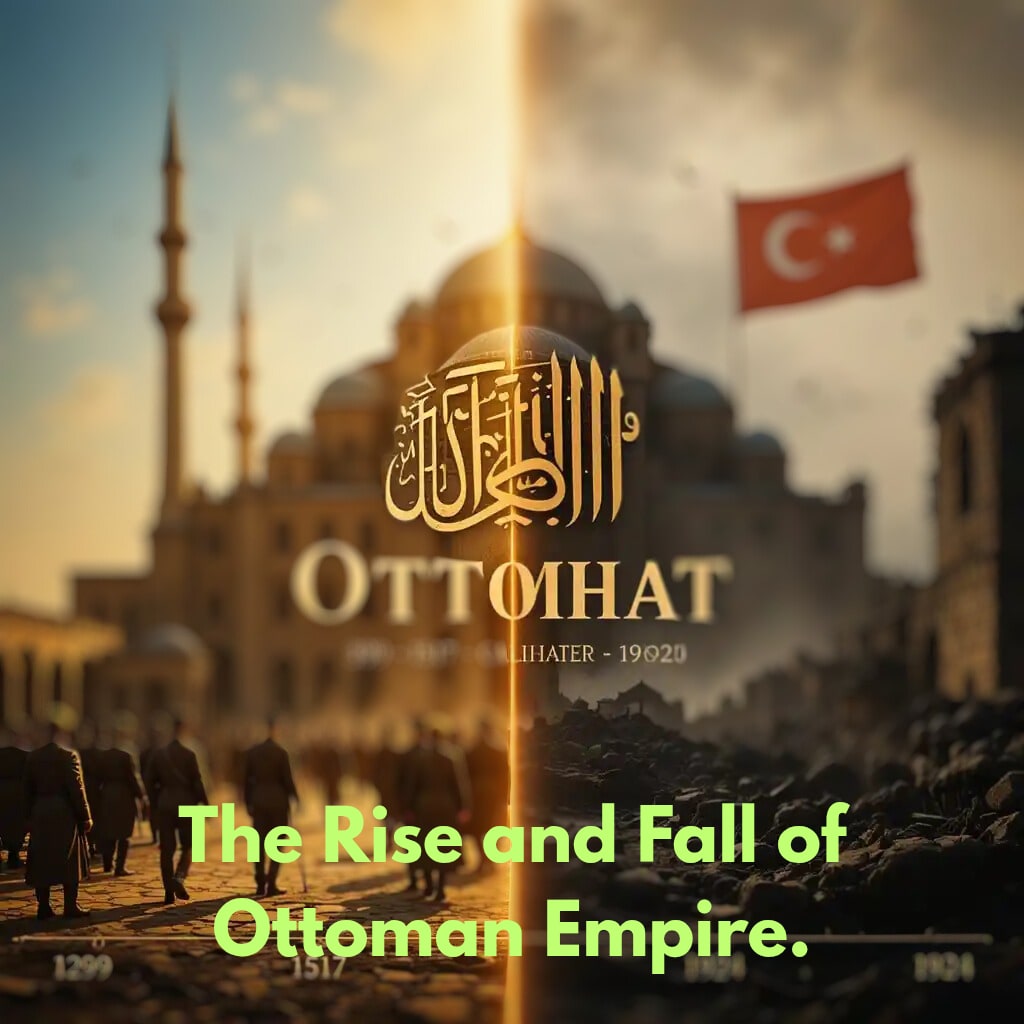
History of Khilafat-e-Usmania (Ottoman Caliphate)
The Khilafat-e-Usmania, or the Ottoman Caliphate, was the last widely recognized Islamic Caliphate and one of the most enduring empires in world history. Established at the dawn of the 14th century, it lasted over 600 years, exerting tremendous influence across Europe, Asia, and Africa. It began as a small principality in Anatolia under Osman I, and by the 16th century, it had evolved into a global empire and the political center of the Muslim world.
Origins and Rise (1299–1453)
The Ottoman Empire was founded in 1299 by Osman I, a leader of the Turkic Kayi tribe in northwestern Anatolia. Osman’s principality grew in power as the Byzantine Empire weakened. The early Ottomans were known for their military prowess and strategic alliances, and their expansion was marked by continuous victories against both Christian and Muslim rivals.
One of the most significant milestones in the early Ottoman expansion was the conquest of Constantinople in 1453 by Sultan Mehmed II, also known as Mehmed the Conqueror. This victory marked the end of the Byzantine Empire and the transformation of Constantinople into Istanbul, the new capital of the Ottoman Empire. It also cemented the Ottomans' role as a major Islamic power.
Emergence as the Islamic Caliphate (1517)
While the Ottomans were recognized as powerful Muslim rulers, they did not initially claim the title of Caliph. This changed under Sultan Selim I, who defeated the Mamluk Sultanate of Egypt in 1517, gaining control of the Islamic holy cities Mecca, Medina, and Jerusalem. After this victory, Selim I formally adopted the title of Caliph, thus incorporating the spiritual leadership of the Muslim world into the Ottoman political structure.
This moment is widely regarded as the beginning of the Ottoman Caliphate, also called Khilafat-e-Usmania, which was seen as the legitimate continuation of the earlier Rashidun, Umayyad, and Abbasid caliphates.
The Golden Age (16th–17th Century)
The Ottoman Empire reached its zenith during the reign of Sultan Suleiman the Magnificent (1520–1566), under whom the empire became a dominant global power. The empire stretched from Central Europe to North Africa, and from the Persian Gulf to Algeria, encompassing a vast and diverse population.
Suleiman not only expanded the empire's borders but also reformed its legal and administrative systems. Islamic jurisprudence (Sharia) was codified alongside customary law, and the empire became a center for Islamic learning, arts, architecture, and science. The Ottomans also maintained a sophisticated bureaucratic system, supported by an elite military force known as the Janissaries.
The Ottoman Caliphate during this era was both a religious and political authority. The sultans were seen as protectors of Islam, defenders of the Haramayn (holy sanctuaries), and leaders of the global Muslim community (Ummah).
Decline and Challenges (18th–19th Century)
By the 18th century, the Ottoman Empire began to face significant internal and external challenges. Corruption, succession disputes, and administrative inefficiency weakened the central authority. Meanwhile, European powers such as Britain, France, and Russia were growing in strength, encroaching on Ottoman territories and influence.
The empire was dubbed the "Sick Man of Europe" as it struggled to modernize and maintain its territories. During the 19th century, nationalist movements emerged within the empire’s diverse population, leading to uprisings and the gradual loss of provinces such as Greece, Egypt, and the Balkans.
At the same time, Islamic reform movements emerged in response to Western imperialism and internal decay. These movements, such as Pan-Islamism, sought to revive the idea of a unified Islamic Caliphate, with the Ottoman Sultan-Caliph at its head.
World War I and the Fall of the Caliphate (1914–1924)
The final blow to the Ottoman Caliphate came with World War I. The Ottomans joined the Central Powers (Germany and Austria-Hungary) and suffered a crushing defeat. After the war, the empire was dismantled under the terms of the Treaty of Sèvres (1920), with much of its territory partitioned by the Allied powers.
In response to the occupation of Istanbul and the dismemberment of the empire, a Turkish nationalist movement led by Mustafa Kemal Atatürk emerged. This movement rejected the authority of the Sultan and established the Republic of Turkey in 1923. In a bold move to secularize and modernize the country, Atatürk abolished the Ottoman Sultanate in 1922 and then the Caliphate itself on March 3, 1924.
Legacy
The abolition of the Khilafat-e-Usmania marked the end of the Islamic Caliphate, a political and religious institution that had existed in various forms since the death of Prophet Muhammad (PBUH) in 632 CE. The loss of the Caliphate deeply affected Muslims around the world, particularly in British India, where the Khilafat Movement was launched in an attempt to pressure the British to preserve the Caliphate.
Although the Ottoman Caliphate no longer exists, its legacy continues to influence Muslim thought, politics, and identity. Calls for the restoration of a Caliphate persist among some Muslim groups, while historians and scholars continue to study the Ottoman model of governance, its cultural contributions, and its role in Islamic civilization.
About the Creator
Keep reading
More stories from Haris khan and writers in History and other communities.
"Saddam Hussein: Rise, Reign, and Ruin of Iraq’s Strongman"
: Saddam Hussein: The Rise and Fall of Iraq’s Iron Ruler. Saddam Hussein, born on April 28, 1937, in the village of Al-Awja near Tikrit, Iraq, rose fromPoverty to become one of the most powerful—and feared—leaders in the Arab world. His reign over Iraq, from 1979 to 2003, was marked by brutal repression, ambitious wars, and an unwavering grip on power.
By Haris khan8 months ago in History
A Story of the World
The history of the world is the longest story ever told—a vast journey that began long before written words, long before cities, and even before humans themselves. It is a story shaped by nature, driven by curiosity, and transformed by ideas, power, faith, and struggle. The Dawn of Life and Early Humanity Billions of years ago, the Earth was a violent and restless place. Volcanoes erupted, oceans formed, and the first simple life appeared in the seas. Over immense stretches of time, life evolved from single-celled organisms into complex plants and animals. Eventually, a branch of primates learned to walk upright, use tools, and think beyond survival. These were the early humans. For tens of thousands of years, humans lived as hunters and gatherers. They followed animals, gathered plants, and learned to cooperate in small groups. Fire changed everything—it provided warmth, protection, and a way to cook food. Language allowed ideas to pass from one generation to the next. Slowly, humans spread across continents, adapting to deserts, forests, mountains, and ice. The Agricultural Revolution and the First Civilizations Around 10,000 years ago, a turning point arrived: agriculture. Humans learned to grow crops and domesticate animals. This allowed them to settle in one place, build villages, and increase their population. Farming began independently in regions such as Mesopotamia, the Indus Valley, China, Egypt, and Mesoamerica. With settled life came civilization. Cities rose near rivers that provided water and fertile soil. Governments formed to organize labor and protect land. Writing was invented to record trade, laws, and stories. The first legal codes appeared, such as the Code of Hammurabi, which tried to define justice. Religion became organized, explaining the mysteries of life and death and giving meaning to human existence. Empires, Power, and Belief As civilizations grew, so did conflict. Powerful kingdoms expanded into empires through conquest and control. The Egyptian, Persian, Greek, Roman, Mauryan, and Han empires shaped large parts of the ancient world. Roads, armies, taxes, and laws connected millions of people under a single rule. Ideas traveled along with armies and traders. Greek thinkers explored philosophy, science, and democracy. In India and China, deep philosophies like Hinduism, Buddhism, Confucianism, and Taoism offered guidance on morality and harmony. In the Middle East, monotheistic faiths emerged, teaching belief in one God and emphasizing justice and compassion. The Roman Empire became a bridge between ancient and modern worlds. It spread law, engineering, and language across Europe and the Mediterranean. Yet no empire lasts forever. Over time, internal weakness, economic strain, and outside pressures caused great empires to fall. The Middle Ages and the Flow of Knowledge After the fall of Rome in the West, Europe entered a period often called the Middle Ages. Power was divided among kings, nobles, and the Church. Life was difficult for many, but this era was not without progress. Universities formed, architecture flourished, and faith shaped daily life. Meanwhile, the Islamic world experienced a golden age. Scholars preserved and expanded knowledge in mathematics, medicine, astronomy, and philosophy. Cities like Baghdad and Cordoba became centers of learning, where ideas from Greece, India, and Persia were studied and improved. Trade routes connected Asia, Africa, and Europe, allowing goods and cultures to mix. In Asia, powerful dynasties ruled China, advancing technology such as paper, printing, gunpowder, and the compass. These inventions would later transform the world. The Renaissance and the Age of Exploration Around the 14th century, a rebirth of learning began in Europe: the Renaissance. Artists, scientists, and thinkers looked back to classical knowledge while pushing forward with new ideas. Figures like Leonardo da Vinci and Galileo challenged old beliefs and celebrated human potential. At the same time, explorers set sail across unknown oceans. The Age of Exploration connected the world as never before. Europeans reached the Americas, Africa, and Asia, creating global trade networks. This brought wealth and knowledge—but also suffering. Indigenous civilizations were destroyed, millions were enslaved, and colonial empires rose through exploitation. Revolutions and the Modern World The 18th and 19th centuries were ages of revolution. Political revolutions in America and France challenged absolute monarchy and promoted ideas of liberty, equality, and rights. The Industrial Revolution transformed economies, as machines replaced manual labor and cities grew rapidly. Life improved for some, but workers often faced harsh conditions. New ideologies emerged—capitalism, socialism, nationalism—each offering different visions of society. Nations formed and competed, leading to global conflicts. The 20th century witnessed two devastating world wars that reshaped borders and shattered illusions of progress. Yet from the ruins came international cooperation, technological leaps, and movements for independence and civil rights. The World Today and Beyond In recent decades, technology has accelerated history. Computers, the internet, and artificial intelligence have changed how humans communicate, learn, and work. Globalization has connected economies and cultures, while also creating new challenges. Climate change, inequality, and conflict remind humanity that progress is fragile. The history of the world is not just a record of kings and wars—it is the story of ordinary people: farmers, thinkers, builders, dreamers. It is a story of mistakes and lessons, destruction and hope. Each generation inherits this long journey and adds its own chapter. The future remains unwritten. Like those who came before, humanity stands at a crossroads—guided by the past, tested in the present, and responsible for what comes next.
By The best writer about 24 hours ago in History
Martin Luther King Jr.: The Voice of Peace and Justice
Martin Luther King Jr. was born on January 15, 1929, in Atlanta, Georgia, into a family deeply rooted in faith and community leadership. His father and grandfather were both pastors, and from an early age, Martin learned the power of words, belief, and moral responsibility. Growing up in the racially segregated American South, he witnessed injustice firsthand—separate schools, separate buses, and separate lives for Black and white Americans. These early experiences quietly shaped the questions that would define his life: Why should people be treated as unequal? And how could such injustice be peacefully undone?
By The best writer 6 days ago in History



Comments
There are no comments for this story
Be the first to respond and start the conversation.