
⛏️Nabta Playa: The 7,000-Year-Old Stone Circle of the Nubian Desert
📜Amazing Archeological Discovery🏺

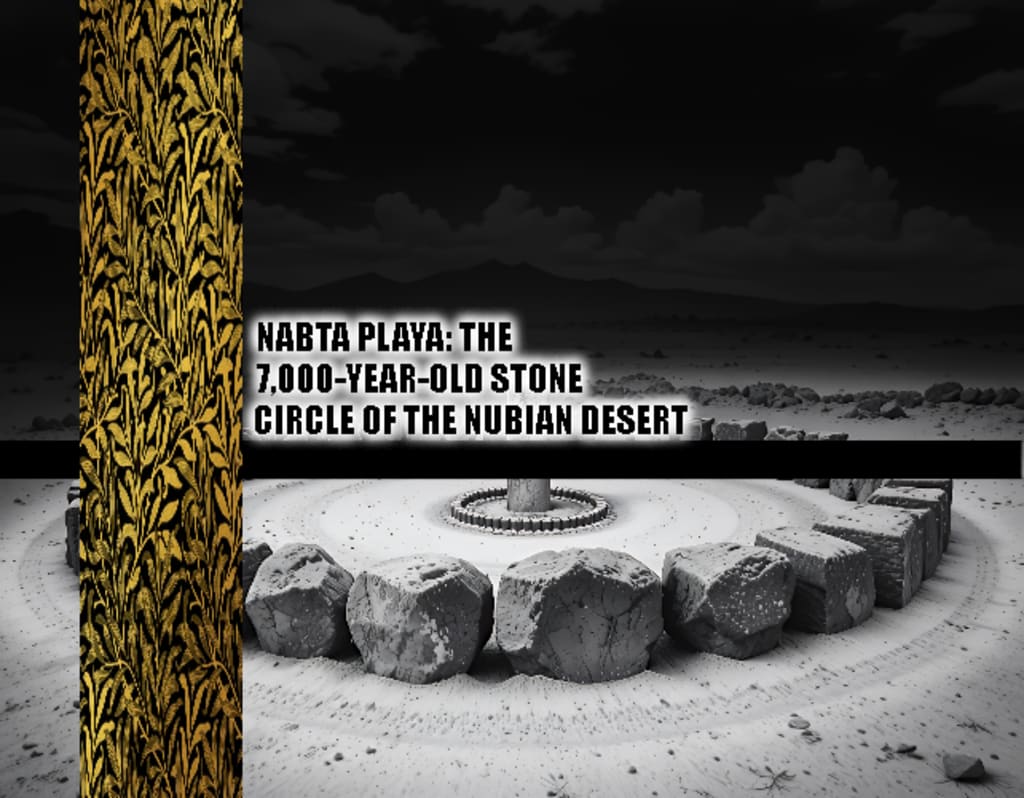
⛏️Nabta Playa: The 7,000-Year-Old Stone Circle of the Nubian Desert
Discovery and Location
Nabta Playa lies hidden deep within the Nubian Desert, an arid and inhospitable region in southern Egypt, close to the border with Sudan. This vast desert landscape today is characterized by harsh winds, blazing sun, and seemingly endless sand dunes, but approximately 7,000 to 8,000 years ago, this area was dramatically different.
During the early Holocene, a wetter climate turned Nabta Playa into a fertile basin punctuated by seasonal lakes, lush grasslands, and rich wildlife. These conditions attracted small groups of hunter-gatherers and early pastoralists who relied on the natural abundance of water and grazing for their herds. It was in this transformed landscape that the ancient people began to gather, build, and ritualize. The site was rediscovered in the 1970s by a team of archaeologists led by Fred Wendorf and Romuald Schild, whose systematic excavations uncovered a trove of ancient stone structures and artifacts. The basin’s seasonal lakes, now dried, had preserved the remains of these early societies, providing a unique window into a time before the great civilizations of the Nile Valley emerged. The location itself is remote and difficult to access, which contributed to the site’s preservation but also means it remains relatively unknown outside specialist circles.
The discovery of Nabta Playa revolutionized ideas about prehistoric human activity in the Sahara. Previously, it was thought that the harsh desert environment was unsuitable for sustained human settlement until much later periods. However, this site demonstrated that human groups were not only surviving but thriving here thousands of years ago, with social and ritual complexity that rivaled better-known ancient cultures. The placement of the site in a natural basin also suggests a sophisticated understanding of the environment, as these seasonal lakes would have been vital for herding cattle and other livestock during dry periods. This early connection between humans and their environment set the stage for the development of complex social systems and monumental architecture.

🪨The Stone Circle
At the heart of Nabta Playa lies its most enigmatic and compelling feature: the stone circle. This megalithic monument consists of roughly a dozen large sandstone blocks, some standing erect while others have fallen, arranged in a circular formation approximately seven meters across. The stones are not randomly placed but positioned with apparent care, some aligned with key solar events such as the summer solstice sunrise. This alignment indicates that the circle was likely constructed to serve as a kind of solar calendar, allowing its creators to track the changing seasons with remarkable precision.
The significance of this stone circle extends far beyond its physical presence. For hunter-gatherer and pastoral communities reliant on seasonal cycles, knowing when the summer solstice occurred would have been crucial for timing migrations, breeding livestock, and conducting religious or communal ceremonies. The precision with which these stones were placed suggests that the people who built them had an advanced understanding of the sun’s movements and its impact on their environment. This challenges earlier notions that such knowledge was exclusive to later agricultural societies.
The construction of the stone circle required considerable effort, coordination, and skill. The sandstone blocks, quarried locally, were shaped and transported using rudimentary tools, demonstrating early engineering capabilities. The choice of sandstone, which is relatively soft and workable compared to granite, allowed for carving and shaping, though evidence of detailed decoration on the stones is limited. Still, the arrangement itself, its scale, and its apparent purpose reveal a society deeply invested in marking time and celestial phenomena.

🔭Significance for Early Astronomy
Nabta Playa holds a special place in the history of astronomy because it is one of the earliest known archaeological sites with clear evidence of astronomical alignment. The standing stones’ orientation towards the solstice sunrises means that the site functioned not merely as a ritual center but as an observational tool. This discovery pushed back the timeline for human interest in celestial phenomena and the creation of structures designed to measure and mark the passage of time according to the movement of celestial bodies.
The implications of this are profound. For many years, it was assumed that formal astronomy began with the ancient civilizations of Mesopotamia or Egypt, whose detailed star charts and calendars are well documented in written form. Nabta Playa’s stone circle, dating back over 7,000 years, predates these civilizations by several millennia and proves that prehistoric societies were capable of sophisticated environmental and astronomical observations without writing or complex technology.
In a desert environment, the stars and the sun were essential guides for survival. The knowledge encoded in the stone circle likely helped these early peoples anticipate seasonal changes, such as the flooding or drying of lakes and the growth cycles of natural vegetation. This knowledge would have informed decisions about when to move herds, hunt, or gather, thus directly affecting the community’s survival and prosperity. Nabta Playa represents a critical step in humanity’s long relationship with the sky — a relationship that would eventually lead to the development of calendars, navigation, and science.

🏺Cultural and Social Context
While Nabta Playa’s stone circle is often highlighted for its astronomical importance, it was just one part of a broader ceremonial landscape. The site includes burial mounds, hearths, and remains of huts, revealing that it served as a communal gathering place with social and spiritual significance. Excavations have uncovered graves containing human skeletons, stone tools, animal bones, and pottery fragments, indicating complex ritual behaviors and the possible veneration of ancestors.
The burials often contained offerings, which suggest beliefs about life after death and the importance of honoring those who came before. This indicates that the people of Nabta Playa had developed social structures capable of organizing and sustaining communal ceremonies — a sign of increasing social complexity in these early Neolithic societies.
The presence of cattle remains is particularly notable, as it highlights the importance of pastoralism in this culture. Domesticated cattle were central not only to the economy but also to social identity and religious practice. Some scholars propose that the stone circle and other monuments may have been part of rituals related to cattle worship or fertility rites. This intersection of astronomy, ritual, and pastoralism offers a rich glimpse into how early societies integrated their environment, spirituality, and survival strategies.

🧭Environmental Changes and Decline
The story of Nabta Playa is also a story of environmental transformation. During the early Holocene, the Sahara was a much wetter place, with lakes, rivers, and grasslands that supported a wide variety of flora and fauna. This favorable climate allowed human groups to thrive and develop complex societies such as those who built Nabta Playa.
However, around 5,000 to 6,000 years ago, the climate began to shift dramatically. The once fertile basin dried up as the African Humid Period ended, and the Sahara gradually transformed into the desert we recognize today. This desertification forced the inhabitants of Nabta Playa and the surrounding region to abandon their settlements and migrate toward more hospitable areas, such as the Nile Valley.
This climatic change had a profound impact on human history in the region. As people moved, they carried with them cultural practices, technologies, and knowledge that contributed to the rise of early Egyptian civilization. Some scholars argue that sites like Nabta Playa played a role in shaping the cultural and religious foundations of later societies in the Nile Valley, linking prehistoric pastoralist traditions to the great dynastic cultures that followed.
Today, Nabta Playa remains a vital site for understanding the deep roots of human civilization. It challenges long-held assumptions about prehistoric societies by showing that early nomadic peoples were capable of remarkable feats of architecture, astronomy, and social organization. Its stone circle stands as one of humanity’s earliest monuments dedicated to tracking celestial events, bridging the gap between prehistoric and historic cultures.
Archaeologists continue to study Nabta Playa with modern technologies such as satellite imagery, 3D mapping, and advanced dating methods to uncover more about its layout, construction, and meaning. The site serves as a powerful reminder that humanity’s desire to understand the cosmos and mark time transcends geography, culture, and technology. Nabta Playa is not just an archaeological curiosity — it is a testament to the enduring human spirit and its quest for knowledge, connection, and meaning.
About the Creator
Kek Viktor
I like the metal music I like the good food and the history...
Keep reading
More stories from Kek Viktor and writers in History and other communities.
🤢The Great Stink of London, Summer 1858: How the Thames River's Filth Nearly Shut Down Parliament and Sparked Sewer Reforms
The Summer That Stank to High Heaven In the sweltering summer of 1858, London became the setting for one of the foulest crises in urban history. For several weeks, an unbearable stench rose from the River Thames, the city's main waterway and open sewer, engulfing the metropolis in a nauseating miasma that no one - not even the powerful lawmakers in the Palace of Westminster - could escape. The event, which became known as "The Great Stink," was more than just a sensory nightmare; it was a pivotal moment in the evolution of public health and urban infrastructure.
By Kek Viktor8 months ago in History
Stanislav Kondrashov Oligarch Series: The Roots of Oligarchy in the Mediterranean
When people hear the word “oligarchy,” they often think of modern contexts. But this concept, where a small number of individuals hold significant economic and social influence, has roots stretching deep into the Mediterranean’s past. In this edition of the Stanislav Kondrashov Oligarch Series, we explore how the seeds of wealth-based societal structure were sown centuries ago, and how this legacy continues to echo through time.
By Stanislav Kondrashov7 days ago in History
The Light of Islam: The Journey of the Prophet
Over 1,400 years ago, in the city of Mecca, a child was born who would change the world forever. His name was Muhammad ﷺ, and he belonged to the noble tribe of Quraysh. From the beginning, his life was marked by trials and simplicity. Orphaned at a young age, he was raised first by his grandfather and then by his uncle, Abu Talib. Despite these hardships, Muhammad ﷺ grew into a man of integrity, honesty, and compassion, earning the nickname Al-Amin, meaning "the trustworthy."
By The best writer 3 days ago in History
Miss Persephone's Manual to a Seemingly Ordinary Life
Miss Persephone was found at the dining table, her blue eyes swollen, her tears arriving and retreating like the tides of the ocean. Earlier that day, her family had visited her in the retirement home where she had lived for eight years. It was her eightieth birthday.
By Imola Tóth5 days ago in Fiction




Comments
There are no comments for this story
Be the first to respond and start the conversation.