
Tipu Sultan: The Last Roar of the Tiger of Mysore
A Warrior King’s Final Battle for Freedom Against British Imperialism

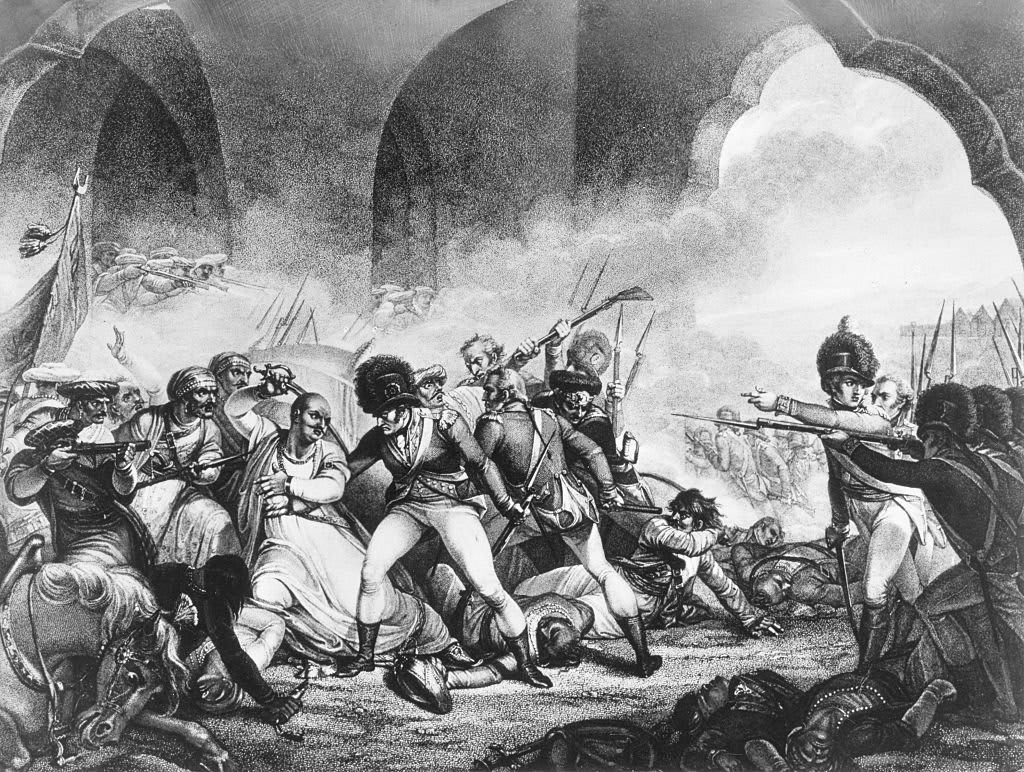
In the annals of Indian history, few names shine as brightly—and as tragically—as that of Tipu Sultan. Known as the Tiger of Mysore, Tipu was a visionary ruler, a fearless warrior, and an uncompromising enemy of British colonialism. His story is not just of battles and politics, but of pride, resistance, betrayal, and ultimately, heroic martyrdom.
This is the story of his final stand—the Siege of Srirangapatna in 1799—and how one man's roar echoed through history.
A Prince Born for War
Tipu Sultan was born on November 10, 1750, in Devanahalli near present-day Bangalore. He was the eldest son of Sultan Hyder Ali, the ruler of Mysore. From an early age, Tipu was immersed in the disciplines of statecraft, languages, military science, and Islamic scholarship. He studied Persian, Arabic, and philosophy, while also training in swordsmanship and cavalry warfare.
Tipu was only 15 when he first tasted war. He accompanied his father in battles against the British and quickly displayed extraordinary courage and military prowess.
Vision for a Strong, Free Mysore
Unlike many Indian rulers who bowed to British diplomacy and deceit, Tipu envisioned a unified and sovereign India, free from foreign rule. He implemented radical reforms in administration, taxation, military organization, and technology.
Tipu introduced rocket artillery, a technology far ahead of its time. He modernized the Mysorean army and invited experts from France, Turkey, and Persia to strengthen his arsenal and economy. He even sent embassies to Napoleon Bonaparte and the Ottoman Sultan, forming alliances against the British East India Company.
His refusal to submit made him a symbol of resistance—and the British saw him as a dangerous threat that had to be eliminated.
The Betrayal and the Build-Up to the Final War
By the late 1790s, Tipu had already fought the British in three major Anglo-Mysore Wars. Though he had suffered setbacks, he remained unbeaten.
But in 1799, his worst fear came true—not because the British were stronger, but because his allies betrayed him.
The Nizam of Hyderabad and the Marathas, who once fought alongside Tipu, allied with the British. The final assault was led by Lord Wellesley, who marshaled over 50,000 troops against Tipu’s forces of barely 20,000.
The British surrounded Srirangapatna, Tipu Sultan’s capital. The city was fortified and defended fiercely, but the British were determined—and patient.
The Siege of Srirangapatna
In April 1799, the British forces began their siege. The city came under constant bombardment. Day and night, cannonballs smashed into the city walls, shaking the ground and the spirits of the people.
Inside the fort, Tipu moved from bastion to bastion, motivating his soldiers. He rejected all offers of escape or surrender. One of his generals, seeing the hopeless odds, pleaded:
“My Lord, your life is too precious. Please escape while you still can.”
Tipu replied with the words that would etch into history:
“Better to live one day as a tiger than a hundred years as a jackal.”
These were not mere words—they were a declaration of his fate.
The Final Assault – May 4, 1799
On the morning of May 4, British forces launched their final attack. Through a secret breach discovered by traitors inside the fort, British soldiers stormed into the city.
Tipu Sultan, dressed in his regal armor and mounted on his horse, took his sword and led the defense. He fought alongside his men in the narrow streets of the fort. Blood flowed, cannon smoke filled the air, and cries of resistance echoed through the walls.
At one point, Tipu dismounted to fight hand-to-hand. In the chaos, a bullet struck his left side. Wounded, he continued to fight. A second bullet hit his temple.
He fell—not as a defeated king, but as a martyr.
The British found his body hours later beneath a pile of soldiers—his sword still clenched in hand, eyes wide open.
Aftermath: A Silence That Spoke Volumes
With Tipu’s death, Mysore fell. The British looted his palace, plundered the treasury, and destroyed what they feared—his legacy. But they could never erase the memory of his courage.
The people of Mysore mourned him not just as a ruler but as a national hero. Even his enemies—British officers—respected his valor.
Legacy of the Tiger
Tipu Sultan remains a towering figure in South Asian history. He was among the first Indian kings to sacrifice his life fighting British imperialism. His resistance inspired future freedom fighters, including Mangal Pandey, Rani Lakshmi Bai, and Bhagat Singh.
His military innovations, especially rocket warfare, later inspired British military engineers, who used similar rockets in the Napoleonic Wars.
To this day, his fort in Srirangapatna, his tomb, and his legacy continue to draw visitors and admirers from around the world.
Conclusion: The Tiger Still Roars
Tipu Sultan was not just a king—he was a symbol of resistance, a martyr for freedom, and a visionary leader who dared to challenge the might of empire. He died fighting for his land, his people, and his belief in justice.
In the words of a historian:
"His body may have fallen, but his spirit never surrendered. And that spirit still roars in the heart of every soul who dreams of freedom."
About the Creator
jalalkhan
Motivational and emotional storyteller | Health & wellness explorer | I write to heal, inspire, and lift spirits. Every story I share is rooted in real-life challenges,
Olive Borden
Olive Borden’s (1907–1947) obituary in The New York Times is short and sober. It notes in the opening paragraph that though Borden made an estimated $1500 a week during her Hollywood heyday in the 1920s, she died “penniless in the Sunshine Mission after a brief siege of pneumonia,” aged 40.
By A. L. Fletcher 5 days ago in History
Abandoned: The All American Ruins Podcast
There are some podcasts that define genre classification and would never be considered by large podcast networks, worried about recouping their investment in the show. Abandoned: All-American Ruins is one of those podcasts.
By Frank Racioppi4 days ago in History
Not Just For Clean Up: A History Of The MCU's Department of Damage Control
Initially an organisation that seemed to exist to help the heroes of the Marvel Cinematic Universe, from Phase Four onwards, the Department of Damage Control has shifted into a more antagonistic role. Most recently seen in the Wonder Man series, the current incarnation of Damage Control seems to target superpowered individuals, regardless of whether that person poses an active or intentional threat.
By Kristy Andersonabout 9 hours ago in Geeks


Comments
There are no comments for this story
Be the first to respond and start the conversation.