
🏺 Göbekli Tepe: The Temple That Rewrote Human History
📜An Ancient Temple

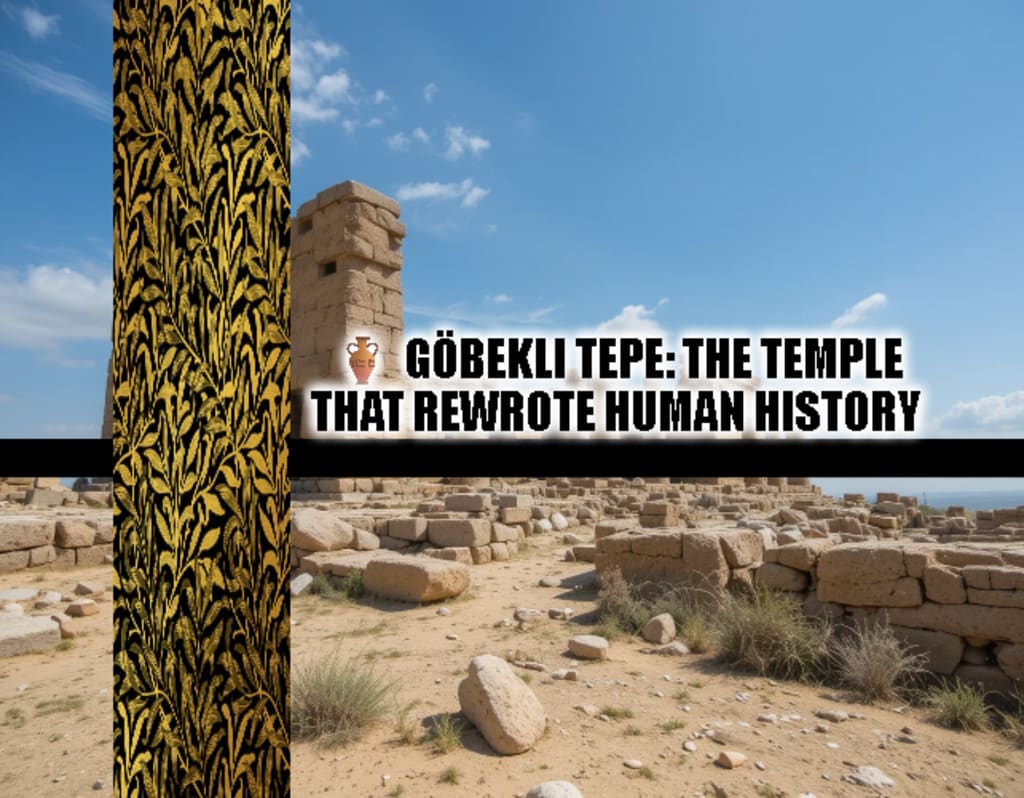
🏺 Göbekli Tepe: The Temple That Rewrote Human History
I. Discovery and Location
Göbekli Tepe, which translates from Turkish as “Potbelly Hill,” sits quietly in the dry, rolling hills of southeastern Turkey, near the modern city of Şanlıurfa. Though it had long appeared on maps as a minor mound — a common sight in the region — its true significance wasn’t understood until the mid-1990s. In fact, for decades, local farmers and researchers assumed the mound was a simple Bronze Age burial site or a ruined Byzantine outpost. But in 1994, the German archaeologist Klaus Schmidt, who had worked at nearby Neolithic sites, re-examined the mound and recognized that the flint tools and carved stones scattered across the surface pointed to something far older and more significant.
Schmidt began a formal excavation under the German Archaeological Institute and the Şanlıurfa Museum in 1995. What he unearthed over the next two decades would shake the foundations of our understanding of prehistory. Beneath the mound, buried by thousands of years of sediment and human activity, lay a vast, complex arrangement of monumental stone pillars — intricately carved, carefully placed, and deliberately buried after centuries of use.
Göbekli Tepe, it turned out, was not a burial mound at all. It was something far more ancient and extraordinary: a ritual or ceremonial site that predates agriculture, writing, metal tools, and even pottery. Its earliest layers have been radiocarbon dated to as early as 9600 BCE, making it over 11,000 years old — more than 6,000 years older than Stonehenge and 7,000 years older than the Egyptian pyramids.

⛏️ II. The Enigmatic Pillars and Architecture
The central structures uncovered at Göbekli Tepe are a series of massive circular enclosures, each formed by a ring of T-shaped limestone pillars, some weighing as much as 20 tons and reaching heights of over 5.5 meters (18 feet). In the center of many enclosures stand two larger T-pillars, which are thought to have held special ritual or symbolic significance. These megaliths were carved from local bedrock using stone tools, dragged into position, and arranged in perfectly circular or oval shapes — an extraordinary feat for a society without the wheel, metal, or domesticated animals.
What astonished archaeologists wasn’t just the scale, but the detail. Many of the pillars are richly decorated with carvings of animals, such as foxes, snakes, wild boar, cranes, scorpions, lions, and vultures. These creatures are rendered with remarkable skill, realism, and symbolism. Some pillars even feature abstract symbols, including hands, belts, and H-shaped motifs, whose meaning remains the subject of intense debate.
None of the animals depicted are domesticated — they are all wild, reflecting the hunter-gatherer lifestyle of the builders. The images do not tell a clear narrative but seem to be symbolic or sacred in nature. No human remains have been found in association with the circles, ruling out the idea that these were tombs. Instead, Göbekli Tepe appears to be a spiritual or religious center — possibly the world’s earliest known temple complex.
Even more puzzling, the structures were not just abandoned — they were deliberately buried by the people who built them. Over time, layers of backfill, stone debris, and refuse were used to cover the enclosures. Whether this was for preservation, ritual closure, or cultural transition remains unknown, but the act ensured the site's preservation across the millennia.

🧭 III. A Site That Predates Civilization
What makes Göbekli Tepe so revolutionary is not just its age or artistic sophistication, but what it represents in the grand arc of human history. For decades, archaeologists believed that large-scale religious structures, organized labor, and social stratification only emerged after the development of agriculture — in other words, that farming came first, temples second.
Göbekli Tepe reverses this timeline.
The builders of Göbekli Tepe were hunter-gatherers — they lived in small, mobile groups, relied on wild plants and animals, and had no permanent settlements. Yet they organized the construction of massive stone structures requiring long-term planning, specialized labor, and sustained communal effort. There is no evidence of permanent dwellings or agricultural fields at Göbekli Tepe. The site predates domesticated wheat, pottery, or the wheel.
This suggests that religion or ritual gathering may have preceded — and perhaps even motivated — agriculture, not the other way around. Some archaeologists propose that in order to support the building and maintenance of such a large religious site, people began to settle nearby, cultivate grain, and gradually transition into farming — flipping the standard model of Neolithic development on its head.
In this view, the desire to gather, worship, or carry out communal rituals could have led to the birth of civilization itself.

📜 IV. Interpretation and Ongoing Mystery
Despite decades of excavation and research, Göbekli Tepe continues to baffle and provoke debate among archaeologists. What exactly was the site used for? Why did early hunter-gatherers invest so much effort in constructing something so monumental? What do the carvings mean? And why was it ultimately buried?
Some scholars see the animal carvings as mythological, possibly representing spiritual beliefs, totemic symbols, or cosmological concepts. Others believe they may encode astronomical knowledge or mark important seasonal events, though such claims are still under scrutiny. Still others argue that the site may have served as a neutral meeting ground, a sacred gathering place for multiple clans or groups, where feasts, rituals, and even early forms of trade or social negotiation took place.
Intriguingly, the T-shape of the pillars may represent stylized human figures, with hands and arms carved into some of the central megaliths. This has led to the theory that these pillars may have represented gods, ancestors, or spiritual beings central to the community’s belief system.
Because Göbekli Tepe was buried and not reused in later periods, its original meaning has been lost to history. There are no written records from this era. Every interpretation must come from physical evidence, careful excavation, and comparative analysis with other prehistoric sites.
Today, only 5% to 10% of the total site has been fully excavated. Ground-penetrating radar surveys have revealed dozens more enclosures still underground. As excavations continue, new discoveries may further reshape our understanding of the people who built this extraordinary place.
The implications of Göbekli Tepe’s discovery have been far-reaching. It has forced scholars to reevaluate the origins of religion, architecture, and social complexity. The notion that sophisticated symbolic thinking and monumental construction could occur before settled farming societies has required a dramatic shift in how we define the birth of civilization.
The site also underscores how much of human history remains buried, literally and figuratively. For generations, archaeologists assumed that civilizations only began with cities, writing, and state institutions. Göbekli Tepe proved that the seeds of civilization were planted much earlier, by people whose names, languages, and stories are forever lost, but whose vision and effort echo through 11,000 years of stone.
Since its inclusion as a UNESCO World Heritage Site in 2018, Göbekli Tepe has drawn global attention and increasing numbers of visitors. A protective shelter now covers many of the excavated enclosures, and research teams continue their work year-round. Meanwhile, debates rage on in academic circles over what this place means for our understanding of humanity’s first great cultural leap.

Göbekli Tepe remains an enigma — older than the written word, older than the wheel, and older than farming itself. Yet it tells us something deeply human: even at the dawn of our species’ long journey toward civilization, we sought meaning in the world around us, and we came together to build something lasting, beautiful, and sacred.
About the Creator
Kek Viktor
I like the metal music I like the good food and the history...
Keep reading
More stories from Kek Viktor and writers in History and other communities.
⛏️Nabta Playa: The 7,000-Year-Old Stone Circle of the Nubian Desert
⛏️Nabta Playa: The 7,000-Year-Old Stone Circle of the Nubian Desert Discovery and Location Nabta Playa lies hidden deep within the Nubian Desert, an arid and inhospitable region in southern Egypt, close to the border with Sudan. This vast desert landscape today is characterized by harsh winds, blazing sun, and seemingly endless sand dunes, but approximately 7,000 to 8,000 years ago, this area was dramatically different.
By Kek Viktor10 months ago in History
Hidden Fortune: 100 Kilograms of Gold Discovered in Inherited House
A surprising discovery inside an inherited home has captured widespread attention after authorities confirmed that approximately 100 kilograms of gold were found hidden within the property. The unexpected find, which is worth millions of dollars at current market prices, has sparked intrigue, legal debates, and speculation about how such a large treasure remained concealed for so long.
By Irshad Abbasi 3 days ago in History
Pandora’s Burden
“My brother warned me to not accept gifts from the one who commissioned you,” said Epimetheus to the woman clad in silvery raiments standing at the entrance to the temple. Her silver tiara and the silver rings on her fingers and toes glinted in the firelight cast by torches set on either side of the doorway. Lingering in the shadows, beyond the reach of the flames as she was, he could not tell what she held in her hands. At first what appeared to be a box was perhaps a funerary urn, or maybe merely an apple.
By J. Otis Haasabout 10 hours ago in Fiction


Comments
There are no comments for this story
Be the first to respond and start the conversation.