
The Untold Stories of 5 Historical Scientists Who Changed the World
Exploring the Lives, Struggles, and Breakthroughs of the Scientific Minds Who Shaped Our Future

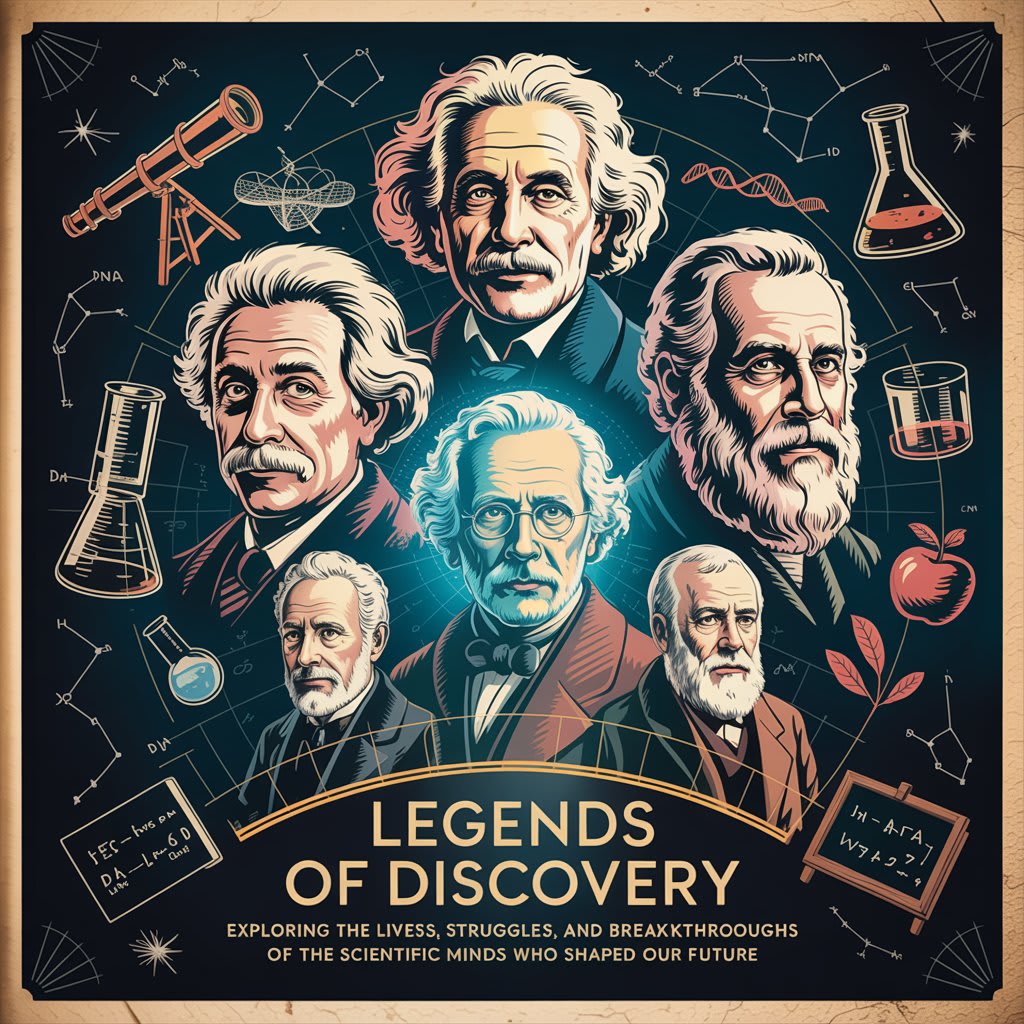
In every age, there are those rare individuals who refuse to accept the world as it is. They ask questions others are afraid to ask. They seek truth, not for fame or wealth, but to understand the nature of the universe and our place in it. These are the legends of discovery — scientists whose courage and curiosity changed the course of history.
1. Galileo Galilei – The Rebel with a Telescope
Born in Pisa, Italy in 1564, Galileo was expected to become a doctor. But his heart beat for the stars. He built his own telescope and pointed it toward the night sky, discovering moons orbiting Jupiter and proving that the Earth was not the center of the universe — a direct challenge to the Church’s teachings.
For this, Galileo was put on trial by the Inquisition. Under threat of death, he was forced to deny his findings. Though silenced, his work laid the foundation for modern astronomy. In the quiet of his house arrest, Galileo whispered, "And yet it moves." His courage inspired generations to look up and keep asking questions.
2. Isaac Newton – The Silent Genius
Orphaned as a child and bullied in school, Isaac Newton grew up in solitude. During the plague years of 1665–1666, he returned to his family farm and, in isolation, laid the groundwork for physics as we know it today. It was during this time he developed calculus, studied light and optics, and formulated the laws of motion and gravity.
The falling apple — more symbol than fact — became the icon of inspiration. Newton’s brilliance was not just in observation but in the ability to turn nature’s chaos into universal laws. He once said, "If I have seen further, it is by standing on the shoulders of giants." Yet many would say Newton himself became the greatest of those giants.
3. Marie Curie – The Woman Who Glowed with Purpose
In an era when women weren’t welcome in science, Marie Curie dared to dream differently. Born in Poland in 1867, she had to move to Paris to study science, as universities in her homeland wouldn’t accept women. With determination and little money, she worked day and night in a makeshift lab.
Alongside her husband Pierre, she discovered two new elements — polonium and radium. Her research on radioactivity, a term she coined, earned her two Nobel Prizes — a feat still unmatched by any other scientist in two different fields. Despite health problems caused by radiation exposure, she never stopped working.
Marie Curie proved that passion and persistence could break the strongest barriers, even those built by centuries of inequality.
4. Charles Darwin – The Reluctant Revolutionary
Charles Darwin never intended to stir controversy. He was a quiet naturalist with a love for beetles and birds. But after a five-year journey aboard the HMS Beagle, Darwin began to see patterns in nature that others had overlooked.
His theory of evolution by natural selection was revolutionary — and terrifying to many in the 19th-century world. Afraid of backlash, Darwin delayed publishing his ideas for over two decades. When he finally published On the Origin of Species, it shook the scientific and religious world to its core.
Darwin wasn’t trying to attack faith. He was simply following evidence. His story reminds us that sometimes the hardest truths are the most important ones to tell.
5. Albert Einstein – The Dreamer Who Redefined Reality
As a child, Albert Einstein was slow to speak. Some thought he wasn’t very bright. But inside his mind, ideas were forming — strange, beautiful ideas about time, space, and energy. Working in a Swiss patent office, Einstein published four groundbreaking papers in 1905, including his theory of special relativity.
His equation, E = mc², revealed that energy and matter were two sides of the same coin. Later, his general theory of relativity would change how we understand gravity and the fabric of the universe itself.
Einstein’s success didn’t shield him from pain. He fled Nazi Germany, struggled with personal loss, and later advocated for peace in a world threatened by nuclear war. Yet through it all, he never lost his childlike wonder. “Imagination,” he said, “is more important than knowledge.”
The Legacy of Curiosity
These five scientists lived in different times, spoke different languages, and faced different battles. Yet one thing united them: the courage to think differently. They faced ridicule, exile, discrimination, and danger — but never gave up on seeking truth.
Their discoveries are now part of our everyday lives, from the GPS in our phones (thanks to Einstein) to the vaccines we develop using evolutionary science (thanks to Darwin), and even the stars we study through telescopes (thanks to Galileo). We owe much of our modern understanding of the universe to their sacrifices and brilliance.
Their stories remind us that the path of discovery is never easy — but always worth it. As we look to the future, may we carry their torch forward, lighting the way for the next generation of dreamers, rebels, and seekers of truth.
About the Creator
Farhan
Storyteller blending history and motivation. Sharing powerful tales of the past that inspire the present. Join me on Vocal Media for stories that spark change.
Three Pakistani Women Explore Egypt in Wheelchairs, Challenging Stereotypes
Traveling across a foreign country can be challenging for anyone, but for three Pakistani women who use wheelchairs, it became a powerful statement of courage, independence, and resilience. Their journey to Egypt was not just a vacation—it was a mission to challenge social perceptions and inspire others living with disabilities.
By Irshad Abbasi 7 days ago in History




Comments
There are no comments for this story
Be the first to respond and start the conversation.