Trivia
The Forgotten Empire
Throughout history, certain empires stand out, their legacies immortalized in the shared consciousness of humanity. The Egyptians, Greeks, Chinese, and Indians are among those whose contributions have withstood the test of time. However, not every significant kingdom has enjoyed such enduring recognition. The Kingdom of Mitanni, once a formidable power in the ancient world, has largely slipped into obscurity, its narrative obscured by the passage of time. This is the story of Mitanni, a realm that achieved remarkable heights, only to be lost to the annals of history.
By A História11 months ago in History
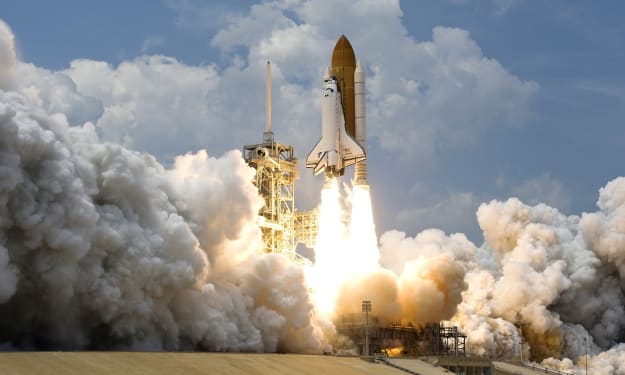
SpaceX Starship Mega Rocket Faces Another Setback, But Booster Catch Marks a Historic Success. AI-Generated.
SpaceX’s latest Starship test flight, its eighth overall, ended in a bittersweet outcome as the massive rocket’s upper stage was lost once again. However, the test was not without its triumphs, as SpaceX managed to successfully catch the Super Heavy booster for the first time—an achievement that brings Elon Musk’s vision for fully reusable rockets one step closer to reality.
By Refayat Amin11 months ago in History
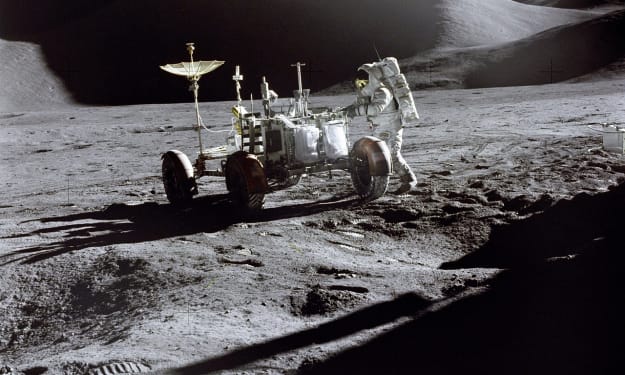
A Giant Leap for Robotics: 1st American Robotic Lunar Rover Set to Land on the Moon Today. AI-Generated.
In a historic moment for space exploration, the United States is set to land its first robotic lunar rover on the Moon today. Named Voyager-1, this mission represents a monumental step forward in NASA’s Artemis program, which aims to return humans to the lunar surface by the mid-2020s and establish a sustainable presence there. The rover’s landing is not just a technological triumph but also a critical milestone in understanding the Moon’s resources, geology, and potential to support future human missions. As the world watches, Voyager-1 is poised to unlock new scientific discoveries and inspire a new era of lunar exploration.
By Refayat Amin11 months ago in History
Remember the Alamo!. Content Warning.
Haunting History: February 23rd-March 6th 1836 Remember the Alamo! A cry shouted to American soldiers inspiring them toward vengeance through the Mexican-American War. What were they remembering, exactly? A siege led by General Antonio Lopez de Santa Anna against a small force of Texans holed up in a fortress compound originally founded by Roman Catholic missionaries and called the Misión San Antonio de Valero.
By Tales from a Madman11 months ago in History
Echoes of the Peninsula
The Korean Peninsula, renowned for its stunning scenery and deep cultural roots, currently represents both harmony and discord. Globally recognized for its innovations in technology, vibrant pop culture, and critical geopolitical role, Korea's narrative is marked by endurance, strife, and change. To fully grasp the contemporary essence of Korea, it is essential to trace back thousands of years to an era when the peninsula was home to ancient civilizations, well before the contemporary separation of North and South.
By A História11 months ago in History
Echoes of the Past
As soon as we acquire the skills of speaking, reading, and writing, we become intricately connected to the cultural tapestry of our homeland. The myths, traditions, and values of our forebears become integral to our identity, influencing our perspectives and understanding of the world. In contemporary times, what is often referred to as Western culture is a rich amalgamation of diverse traditions, yet its roots can be traced back to one ancient civilization: Rome. The narrative of Rome's ascent is not merely one of military triumph and authority; it is a profound story of mythology, aspiration, and the lasting impact of a city that would ultimately shape the known world.
By A História11 months ago in History
The Power of Self-Editing: A Writer's Epiphany
What is Self-Editing? At its core, self-editing is the process of revising your own work to improve clarity, coherence, style, and accuracy. Unlike initial drafts that are often raw and filled with imperfections, self-editing is about refining and polishing those ideas. It involves analyzing everything from sentence structure to word choice, pacing, and overall flow.
By Malik Kashif11 months ago in History
New language discovered to be developing in the United States.
New language discovered to be developing in the United States. The United States has always been a melting pot of cultures languages and traditions and nowhere is this more evident than in Miami Florida. In this vibrant city where Spanish and English intertwine in everyday life a new dialect of English has been quietly developing. This Spanish influenced variety of English shaped by decades of immigration from Latin America is a testament to how language constantly evolves in response to cultural and social interactions. Linguists at Florida International University have been studying this phenomenon for over a decade and they argue that Miami’s unique English dialect is a living example of language adaptation in a multilingual society. Miami is one of the most bilingual cities in the United States. The majority of its population is Hispanic or Latino with roots in Cuba Venezuela Colombia and other Spanish speaking countries. This heavy Spanish influence has not only preserved the Spanish language in the region but has also reshaped how English is spoken. Over time the natural mixing of Spanish and English has led to a distinct way of speaking incorporating direct translations, unique pronunciations and minor grammatical differences. This process known as calquing occurs when words or phrases are translated directly from one language to another while maintaining the original language’s structure.
By Adnan Rasheed11 months ago in History
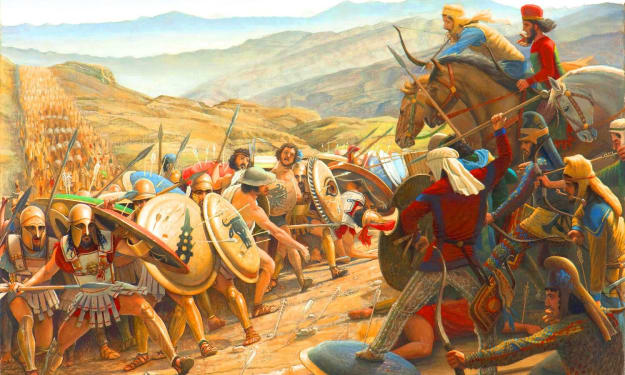
The Fall of Giants
History has a unique way of demonstrating that no empire, regardless of its size or strength, is truly invulnerable. Time after time, those who seem all-powerful have succumbed, often to adversaries who initially appeared weak and inconsequential. This recurring narrative is prominently showcased in the ascension and decline of empires such as the Akkadian, Assyrian, and the Qin Dynasty in China. However, one of the most remarkable illustrations of this concept is the saga of the Persian Empire, a giant of the ancient world, ultimately defeated by a coalition of small, resolute Greek city-states. This narrative encompasses the Greco-Persian Wars, a series of battles that not only influenced the ancient world but also established the groundwork for Western civilization as we recognize it today.
By A História11 months ago in History
The Nomadic Empire
For millennia, the vast expanse of the Asian steppes has been a crucible of human history. Its strategic location and abundant resources made it a prize fiercely contested by numerous ancient peoples. Among these, the Scythians stand out as one of the most influential civilizations, leaving an indelible mark on both Asia and Europe. Their nomadic lifestyle, warrior culture, and intricate artistry not only defined their own era but also shaped the civilizations that followed. This is the story of how the Scythians, a people of the open plains, became a force to be reckoned with, defying empires and leaving a legacy that endures to this day.
By A História11 months ago in History
The last days of the Neanderthals.
The last days of the Neanderthals. The story of the Neanderthals is one of survival adaptation and ultimately extinction. For thousands of years they thrived across Europe and parts of Asia coexisting with early Homo sapiens before vanishing from the fossil record around 40,000 years ago. Their disappearance has long puzzled scientists sparking debates over the causes and consequences of their extinction. However recent research has painted a more nuanced picture of their fate revealing that Neanderthals were not a primitive dead end in human evolution but rather a sophisticated and resilient species that left an enduring legacy in modern human DNA. Neanderthals evolved from a common ancestor shared with Homo sapiens roughly 500,000 years ago. While some researchers suggest Homo antecessor as this ancestor the exact lineage remains debated. What is certain is that Neanderthals adapted to the harsh climates of Ice Age Europe and Asia developing robust physiques suited for cold environments. Their short stocky bodies helped retain heat and their large nasal cavities warmed the air they breathed. These adaptations allowed them to hunt large Ice Age mammals like mammoths and woolly rhinoceroses proving their ability to survive in extreme conditions.
By Adnan Rasheed11 months ago in History