
Echoes of the Peninsula
A Journey Through Korea’s Ancient Past and Modern Divide


The Korean Peninsula, renowned for its stunning scenery and deep cultural roots, currently represents both harmony and discord. Globally recognized for its innovations in technology, vibrant pop culture, and critical geopolitical role, Korea's narrative is marked by endurance, strife, and change. To fully grasp the contemporary essence of Korea, it is essential to trace back thousands of years to an era when the peninsula was home to ancient civilizations, well before the contemporary separation of North and South.
The history of Korea traces back to the depths of prehistory, approximately 10,000 BCE, when the first human communities began to form. These early settlers, existing during the Neolithic era, depended on hunting, fishing, and foraging for their sustenance. By around 6,000 BCE, more established settlements emerged, characterized by the creation of megalithic structures known as dolmens. These grand stone tombs, some of which date to the second millennium BCE, provide insight into the customs and beliefs of Korea’s ancient inhabitants. The dolmens, frequently containing valuable items such as jewelry and personal effects, indicate a culture that held its ancestors and the concept of an afterlife in high regard.
With the onset of the Bronze Age around 1,000 BCE, Korea experienced the development of more sophisticated societies. The landscape was adorned with menhirs, or standing stones, which may have served as markers or symbols of authority. Coastal villages were often fortified with wooden barriers, and residences were typically constructed partially underground, featuring central hearths. Artifacts from this period—including stone tools, pottery, and obsidian arrowheads—illustrate a society that was closely attuned to its surroundings and engaged in early trade with neighboring regions such as China and Japan.
The earliest known state in Korean history, Gojoseon, is said to have been established around 2333 BCE, according to legend. It was founded by Dangun, who was believed to be the offspring of a deity and a bear that transformed into a woman. Gojoseon functioned as a confederation of fortified cities, primarily located along the river basins of the Liao and Taedong. Although historians continue to debate the specifics of Gojoseon, its impact on the region is clear. The kingdom flourished through agriculture, especially rice farming, which was facilitated by trade with China, and its social structure was characterized by a hierarchy with an elite ruling class.
The decline of Gojoseon began around 300 BCE, as it faced invasions from the Chinese state of Yan. By 108 BCE, the Han Dynasty of China had successfully conquered the area, subsequently dividing it into administrative commanderies. This event initiated a prolonged era of Chinese influence on the Korean peninsula, significantly affecting its culture, governance, and religious practices for many centuries.
The decline of Gojoseon ushered in the Three Kingdoms period, a chaotic time characterized by ongoing conflicts and fluctuating alliances. The kingdoms of Goguryeo, Baekje, and Silla, along with the Gaya confederation, competed for supremacy on the Korean peninsula. Goguryeo emerged as the most formidable kingdom, extending its influence into Manchuria and Mongolia, while Baekje thrived as a hub of culture and commerce. Initially the least powerful, Silla ultimately triumphed with the assistance of the Tang Dynasty from China.
The unification of the peninsula under Silla in 668 CE signified the conclusion of the Three Kingdoms period and the onset of the Unified Silla era. This epoch witnessed the rise of Buddhism as the predominant faith, accompanied by the establishment of magnificent temples and monasteries. Nevertheless, the centralized authority of the Silla state gradually diminished, paving the way for the emergence of the Goryeo Dynasty in 918 CE.
The narrative of Korea illustrates the strength and perseverance of its people. From the ancient dolmens of the Neolithic era to the magnificent temples of the Unified Silla period, the peninsula has served as a hub of culture, religion, and authority. However, the division of Korea into North and South during the mid-20th century serves as a poignant reminder of the lasting effects of conflict.
In contemporary times, Korea occupies a pivotal role in global geopolitics, representing a split nation with a common heritage. The tales of its historical kingdoms, the resistance against foreign invasions, and its cultural milestones continue to resonate, providing insights for a world still facing the complexities of unity and division.
As we contemplate Korea’s history, it becomes clear that history is more than a mere account of events; it is a dynamic narrative that influences our present and future. The legacies of the peninsula’s ancient civilizations continue to echo, urging us to remember, to learn, and to aspire for a future where the rifts of the past can be bridged.
About the Creator
A História
"Hi. My name is Wellington and I'm a passion for general history. Here, I publish articles on different periods and themes in history, from prehistory to the present day.
Keep reading
More stories from A História and writers in History and other communities.
Echoes of the Past
As soon as we acquire the skills of speaking, reading, and writing, we become intricately connected to the cultural tapestry of our homeland. The myths, traditions, and values of our forebears become integral to our identity, influencing our perspectives and understanding of the world. In contemporary times, what is often referred to as Western culture is a rich amalgamation of diverse traditions, yet its roots can be traced back to one ancient civilization: Rome. The narrative of Rome's ascent is not merely one of military triumph and authority; it is a profound story of mythology, aspiration, and the lasting impact of a city that would ultimately shape the known world.
By A Históriaabout a year ago in History
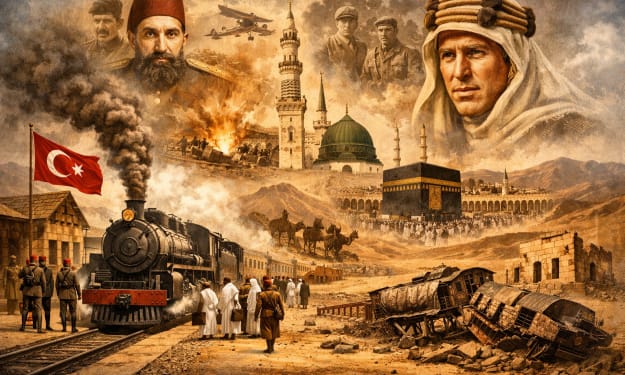
The Hijaz Railway: Why the Ottoman Empire’s Grand Vision to Unite Muslims Was Left Abandoned
In the early twentieth century, the Ottoman Empire launched one of the most ambitious infrastructure projects in the Muslim world: the Hijaz Railway. Conceived as both a symbol of Islamic unity and a practical solution to improve travel for pilgrims heading to Mecca, the railway represented the Ottoman Sultan’s vision of connecting distant Muslim lands. Yet, despite its promise and initial success, the project was ultimately left abandoned due to war, rebellion, and the collapse of the empire itself.
By Irshad Abbasi 5 days ago in History
Top tipple tricks
Been thinking a lot about drinking, lately. Not least because of a recent episode of over-indulgence and the inevitable after effects. Some readers may recall the earlier articles I wrote about beating the booze. Here I set out an experiment in techniques for cutting down on my alcohol intake. The experiment was successful, the techniques worked, and I have armed myself with an arsenal of weapons in the war against the demon drink. I have yet to fire the first round however. It's all a question of timing (perhaps procrastination).
By Raymond G. Taylora day ago in Psyche



Comments
There are no comments for this story
Be the first to respond and start the conversation.