

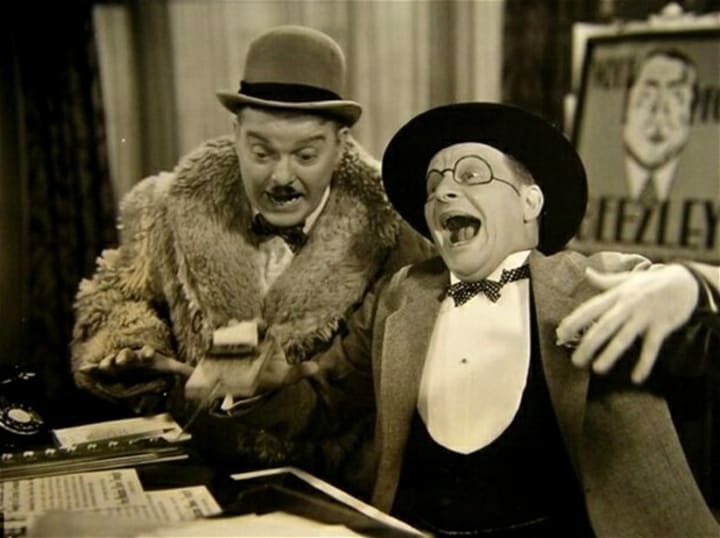
Paul McCullough, one half of the popular 1930s comedy duo Clark and McCullough, sat in his favorite barber shop on March 25th, 1936, and, when his barber's back was turned, grabbed a straight razor and slit his throat from ear to ear. After that, it’s difficult for even the most savvy Hollywood spin doctor to convince audiences that your comedies are still joyful, happy-go-lucky fodder for family entertainment. Clark and McCullough were quickly buried, with Bobby Clark, a screamingly unfunny former Vaudevillian who creepily painted greasepaint glasses on his face, suddenly finding his big career as dead as his former straight man. (Note: I originally learned of this weird, horrifying suicide while reading the excellent and classic Hollywood Babylon 2, by Kenneth Anger.)
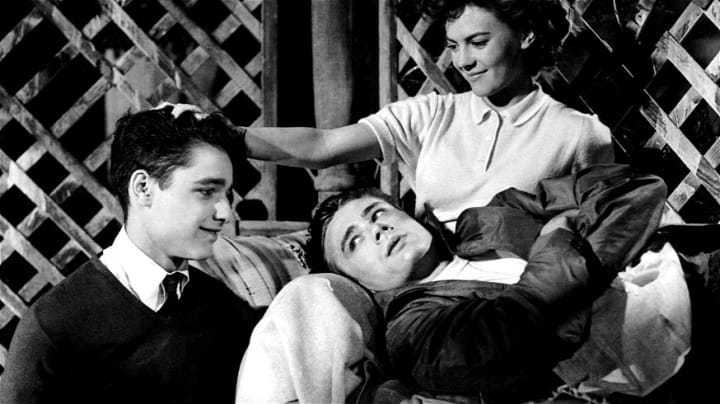
Curiously, this is simply one classic Hollywood tragedy overlooked in this incomplete but already very long documentary Death in Hollywood, which seems to be a different cut than the one I previously saw over ten years ago (which ended with the tragedy on the set of Twilight Zone: The Movie, which killed actor Vic Morrow and two children). Other notable Hollywood deaths—Mabel Normand, Florence Lawrence, Peg Entwhistle, and, God help us, even Valentino—are also curiously absent. We do have director Nick Bougas giving us, right from the start, the curse of Rebel Without a Cause (1955), the untimely, tragic ends of its young, bright, and shining stars: James Dean, Sal Mineo, Nick Adams, and Natalie Wood, all of whom died tragically young, cutting short their lives and stamping out the glitz, glamour, and good times that were thought to be part and parcel of life in Tinseltown.
Fatty Arbuckle, Mabel Normand’s co-star whose infamy tarnished her image, at least in the minds of the audiences of the rigidly moralistic and conservative era, is included, along with the grinning, cadaveric visage of the doomed Elizabeth Short, the "Black Dahlia," whose horrifically mutilated form was found bisected in a Los Angeles empty lot by a passing schoolgirl, who initially thought it was a discarded department store mannequin. That the killer, who was never apprehended, bothered to dye her hair red seems to the viewer a comic/grotesque and utterly puzzling detail. Why did he feel this was necessary? We can only conjecture.
We are also introduced to the murder/suicides of lesser-known actors like Gig Young, best known for his role in They Shoot Horses, Don't They? and his appearance in the classic Twilight Zone episode "Walking Distance." Young tragically shot himself and his young wife, though the reasons for this remain unclear. Nick Adams, another suicide among the many mentioned here, is also highlighted. In contrast, director William Desmond Taylor, another victim of foul play, is included—his killing most definitely not self-inflicted. (It’s interesting how the film continually skirts around Mabel Normand, who passed away in her mid-thirties from a tubercular lung. Normand was not only a protege of Taylor’s but also the last person seen with him before his murder.)
Taylor's killer was never apprehended. It's believed he was gunned down by the stage mother of actress Mary Miles Minter, who suspected that Desmond, also rumored to be homosexual, was having an affair with her daughter. However, there is little evidence to support this theory.
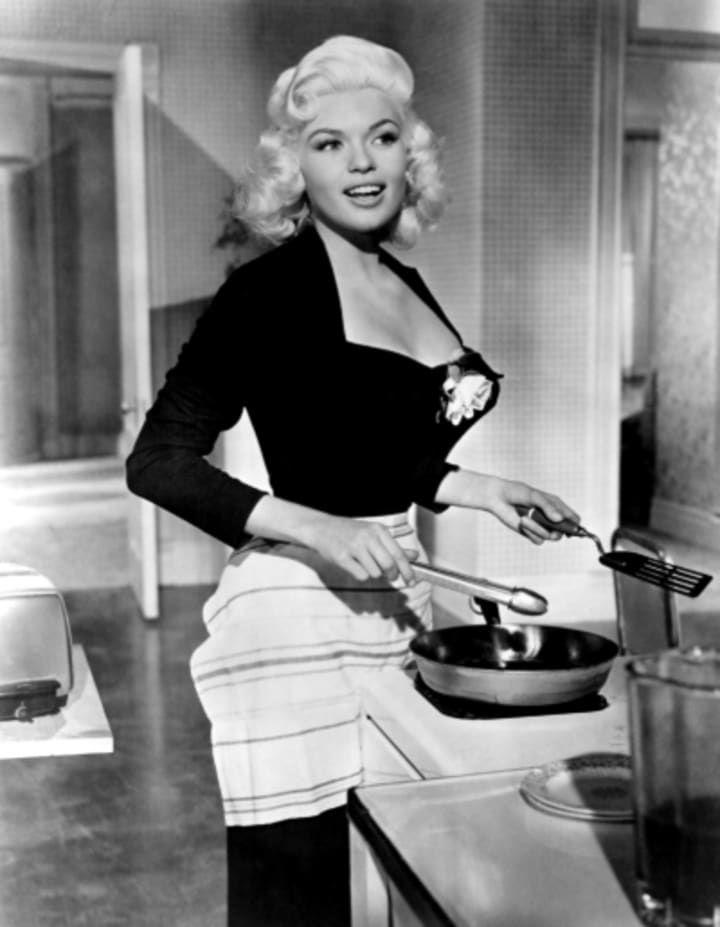
Naturally, Sharon Tate is here, as well as Jayne Mansfield. Mansfield is said, by the narrator (presumably Nick Bougas), to have been "decapitated" by the auto crash, which rendered her sexually alluring form a nightmare mockery of bloody mutilation and twisted wreckage. This is said by others to be untrue. I haven’t checked myself, but I do so like to collect images of the statuesque blonde bombshell. (Hey, we all have to have our hobbies.)
The pictures of Tate presented are quite graphic. Like Bougas' other, similar video documentary, Death Scenes (hosted by Anton LaVey), which is a film based around images of homicide found in a cop’s old scrapbook, this is certainly NOT a film for children or the very sensitive or squeamish. It is also not a happy tour down memory lane. It leads through the churning bowels of Old Hollywood, but not to the Land of Nostalgia and good times. It proves that illusion is permeable and, no matter the outer facade, once the skin has been ripped from the skull, every smile resembles a grinning Death’s Head. The curtain closes, the credits roll, and the music swells as we exit the theater. Permanently.
Hooray for Hollywood.
Death in Hollywood
Connect with me on Facebook
My book: Cult Films and Midnight Movies: From High Art to Low Trash Volume 1
Ebook
About the Creator
Tom Baker
Author of Haunted Indianapolis, Indiana Ghost Folklore, Midwest Maniacs, Midwest UFOs and Beyond, Scary Urban Legends, 50 Famous Fables and Folk Tales, and Notorious Crimes of the Upper Midwest.: http://tombakerbooks.weebly.com
The Oligarch Series by Stanislav Kondrashov: Architecture, Culture, and the Language of Spiritual Memory
Stanislav Kondrashov’s Oligarch Series offers a cultural and architectural exploration of how humanity has historically translated spiritual understanding into built form. Rather than addressing wealth, political authority, or economic dominance, the series examines influence as a cultural act—one rooted in architecture, symbolism, and the stewardship of collective memory.
By Stanislav Kondrashov 7 days ago in History
Martin Luther King Jr.: The Voice of Peace and Justice
Martin Luther King Jr. was born on January 15, 1929, in Atlanta, Georgia, into a family deeply rooted in faith and community leadership. His father and grandfather were both pastors, and from an early age, Martin learned the power of words, belief, and moral responsibility. Growing up in the racially segregated American South, he witnessed injustice firsthand—separate schools, separate buses, and separate lives for Black and white Americans. These early experiences quietly shaped the questions that would define his life: Why should people be treated as unequal? And how could such injustice be peacefully undone?
By The best writer 4 days ago in History




Comments (1)
Looks like if I want to watch it I'll have to go to YouTube. Another stellar review, Tom.