
The Nomadic Empire
How the Scythians Shaped Eurasia and Defied the Greatest Powers of Antiquity

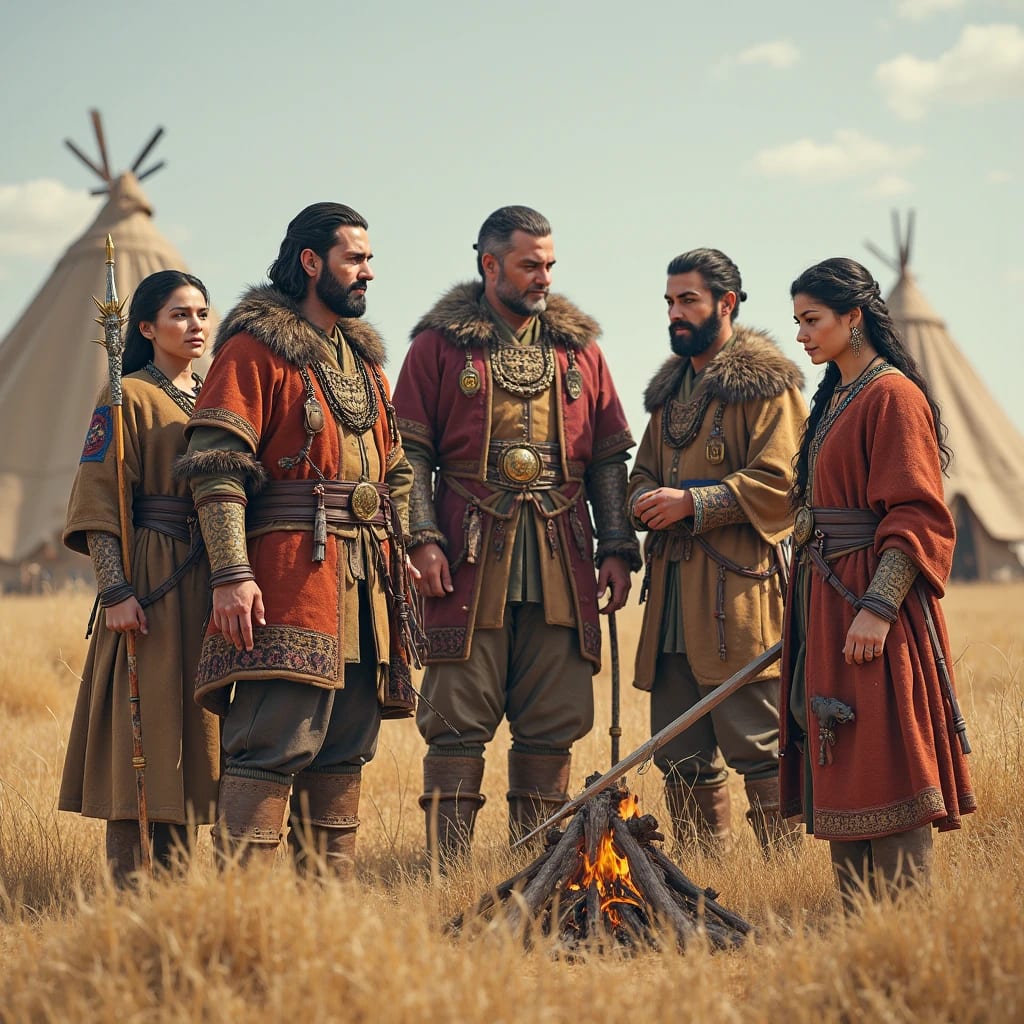
For millennia, the vast expanse of the Asian steppes has been a crucible of human history. Its strategic location and abundant resources made it a prize fiercely contested by numerous ancient peoples. Among these, the Scythians stand out as one of the most influential civilizations, leaving an indelible mark on both Asia and Europe. Their nomadic lifestyle, warrior culture, and intricate artistry not only defined their own era but also shaped the civilizations that followed. This is the story of how the Scythians, a people of the open plains, became a force to be reckoned with, defying empires and leaving a legacy that endures to this day.
The Scythians emerged as a distinct culture around the 6th century BCE, though their origins remain shrouded in mystery. Historians like Herodotus and Diodorus Siculus documented their movements, tracing their presence from the Thracian region in the west to the Altai Mountains in Mongolia, spanning an astonishing 4,000 kilometers. This vast territory, characterized by open plains, deserts, and sparse forests, fostered a pastoral way of life. The Scythians were nomads, with few urban centers, relying instead on their herds and their unparalleled skill as mounted archers.
Recent archaeological discoveries in Tuva and the Altai Mountains suggest that the Scythians may have originated further east than previously thought. Chinese chronicles from the 1st century CE even describe a people with red hair and blue eyes, hinting at their Caucasian features. Adrienne Mayor, a historian at Stanford University, posits that the Scythian culture was a fusion of Siberian, East Asian, and Eurasian steppe groups, a testament to the fluidity and interconnectedness of the ancient world.
The Scythians were not a monolithic entity but a confederation of tribes, each with its own identity yet united by common cultural traits. The four main groups—the Pontic Scythians near the Black Sea, the Sarmatians in the Caspian region, the Massagetae in the Central Asian deserts, and the Sacae in the eastern steppes—shared a nomadic warrior ethos, a distinctive art style, and an Indo-European language. Their tribal structure was both a strength and a defining feature, allowing them to adapt to the challenges of the steppe while maintaining a cohesive identity.
Herodotus provides a vivid account of Scythian life, describing them as a people without cities or fixed settlements, living in wagons and relying on their herds. This mobility made them nearly invincible, as they could evade enemies and strike with precision. Their refusal to engage in conventional warfare, as demonstrated in their famous confrontation with the Persian king Darius the Great, showcased their tactical brilliance. When Darius demanded submission, the Scythian king Idanthyrsus replied with defiance, stating, “We have neither cities nor cultivated lands that might induce us to fight for them. If you wish to fight, find our graves—there you will find us.”
The Scythians were masterful warriors, their success rooted in their unparalleled horsemanship and archery skills. They employed a variety of weapons, from composite bows and spears to battle axes and swords, and their armor included scaled mail and helmets. Their tactics of hit-and-run and ambush, combined with their ability to stretch enemy supply lines, made them formidable opponents. They were often sought as mercenaries, fighting alongside the Persians at Marathon and Platea and even against Alexander the Great at the Battle of Gaugamela.
Yet, their most celebrated victory came against the Persian Empire itself. When Darius invaded Scythian territory, the Scythians employed a strategy of attrition, drawing the Persians deep into their lands and harassing them with guerrilla tactics. This not only forced Darius to retreat but also cemented the Scythians’ reputation as invincible warriors.
One of the most striking aspects of Scythian society was the prominent role of women. Unlike many contemporary cultures, Scythian women fought alongside men, earning equal status in both military and political spheres. Some scholars believe that the legendary Amazons of Greek mythology were inspired by these warrior women. Archaeological evidence, including burial mounds, reveals that women were buried with the same honors as men, often accompanied by weapons, jewelry, and other symbols of power.
The Scythians were not just warriors; they were also artists and spiritual beings. Their art, characterized by intricate goldwork and animal motifs, reflects a deep connection to their environment. The famous Scythian “animal style” art, found in burial mounds or kurgans, depicts everything from stags to mythical creatures, blending realism with abstraction. These artifacts, along with tattoos, clothing, and musical instruments, offer a glimpse into their daily lives and beliefs.
Their spirituality was deeply tied to the natural world. They worshipped deities representing the sky, earth, sun, and fire, with the horse holding a sacred place in their pantheon. Herodotus lists eight Scythian gods, including Tabiti (Hestia), Papaios (Zeus), and Argimpasa (Aphrodite), though they lacked temples or idols, preferring to honor their gods in the open steppe.
Despite their prowess, the Scythians eventually faced decline. Their defeat at the hands of Alexander the Great at the Battle of the Jaxartes River marked a turning point. Later, conflicts with the Greeks and Romans further weakened their hold on the Black Sea region. By the 1st century BCE, their influence had waned, though their legacy endured in the cultures they had touched.
The Scythians were more than just nomadic warriors; they were a complex society that thrived in the harsh environment of the steppes. Their art, religion, and military tactics influenced countless civilizations, from the Greeks to the Persians. They were a people defined by their love of freedom, their adaptability, and their unyielding spirit. Though their empire faded, their story remains a testament to the enduring power of human ingenuity and resilience.
About the Creator
A História
"Hi. My name is Wellington and I'm a passion for general history. Here, I publish articles on different periods and themes in history, from prehistory to the present day.
Keep reading
More stories from A História and writers in History and other communities.
The Enigmatic Tale of Polycrates’ Ring
In the chronicles of ancient history, few narratives are as engaging and reflective as the story of Polycrates’ Ring. This account, rich in intrigue and moral implications, centers on Polycrates, the tyrant of Samos, whose ascent to power and eventual decline were both dramatic and symbolic. Chronicled by the Greek historian Herodotus, this tale serves as a perennial reminder of the fragile equilibrium between human ambition and the enigmatic will of the divine.
By A Históriaabout a year ago in History
Stanislav Kondrashov Oligarch Series: How Oligarchy Shaped Small Industries Through History
When people hear the word “oligarchy”, they often picture vast fortunes, towering headquarters, and influence that stretches across continents. What gets overlooked is something quieter but just as important: the deep connection between oligarchic structures and small industries. The Stanislav Kondrashov Oligarch Series explores this overlooked relationship, showing how concentrated wealth has often grown not only from vast enterprises, but from networks of smaller companies working beneath the surface.
By Stanislav Kondrashov5 days ago in History
Review of 'Man on the Run'
My wife and I saw Man on the Run, a nearly 2-hour documentary on Amazon Prime, about Wings, Paul McCartney's group that flew around the world from shortly after The Beatles broke up in early 1970 to shortly after John Lennon was murdered at the end of 1980, making a Beatles reunion forever impossible.
By Paul Levinson6 days ago in Beat



Comments
There are no comments for this story
Be the first to respond and start the conversation.