Fiction
Alexander's Indian Campaign: Triumph, Tactics, and the Edge of the World
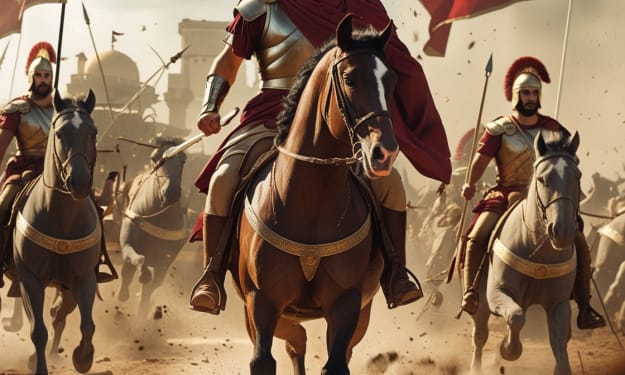
Alexander in the East: The Campaign into India and the Limits of Conquest Following the defeat of the Persian Empire, Alexander the Great advanced his forces eastward into the enigmatic regions of India. What ensued was an audacious and ruthless campaign across challenging landscapes and against unfamiliar adversaries. From the Battle of the Hydaspes to his resolution to retreat at the Hyphasis River, this article examines the strategic ingenuity, cultural interactions, and eventual obstacles that characterized Alexander’s final military frontier.
By Say the truth 9 months ago in History
Alexander’s Conquest of Persia: Strategy, Sieges, and Supreme Victory. AI-Generated.
Alexander in Asia: Conquest of the Persian Empire Following the consolidation of Greece and his passage into Asia Minor, Alexander the Great commenced one of the most audacious campaigns in military historythe subjugation of the Persian Empire. Through exceptional strategy, astute diplomacy, and ceaseless ambition, he dismantled the preeminent empire of his era. This article examines how Alexander leveraged intellect and creativity to bring Persia to submission.
By Say the truth 9 months ago in History
The War Genius of Alexander the Great: Strategy, Speed, and Supremacy
The Military Strategy of Alexander the Great: Brilliance on the Battlefield Alexander the Great, one of history's most exceptional military intellects, established an empire that extended from Greece to India. His war strategies integrated audacious tactics, psychological operations, expert logistics, and an extraordinary capacity to adjust to shifting battlefield circumstances. This article examines the fundamental elements of Alexander's military genius that enabled him to dominate much of the known world before reaching the age of 33.
By Say the truth 9 months ago in History
A True Story of the May 2025 India–Pakistan Conflict
In the spring of 2025, South Asia once again stood on the edge of a dangerous conflict. Tensions between India and Pakistan had been simmering quietly, as they often do, but the peace shattered like glass on April 22, when a devastating terrorist attack in Pahalgam, Kashmir, killed 26 civilians, including women and children. India blamed the attack on Pakistan-based militant groups, primarily Jaish-e-Mohammed and Lashkar-e-Taiba—names that had echoed many times before in similar tragedies. This time, however, something felt different. The Indian public was furious, social media was ablaze, and calls for retaliation rang louder than ever. With elections looming and national sentiment boiling, the Indian government moved quickly. On May 7, the Indian military launched Operation Sindoor—a coordinated campaign of precision missile strikes across the Line of Control (LoC) and deep into Pakistan. The targets included known militant training hubs in Muridke, Bahawalpur, Kotli, and Muzaffarabad. The message was loud and clear: this time, India would not just respond—it would punish. According to Indian defense sources, over 100 militants were neutralized, including top commanders. Satellite images and intercepted communications suggested that several facilities were completely destroyed. The attacks were carried out with high-altitude drones, air-launched missiles, and supersonic cruise weapons, avoiding direct combat to minimize casualties on both sides. But the quiet didn’t last. Retaliation from the West On May 10, as the world held its breath, Pakistan retaliated with what it called “Operation Bunyan al-Marsus”. The Pakistan Air Force launched strikes on several Indian forward military bases, attempting to hit fuel depots and radar systems. Cities like Pathankot, Barmer, and Srinagar were put on high alert as air raid sirens wailed. India responded with a second wave of attacks, this time striking deeper into Punjab and Sindh, including a devastating raid on the Rahim Yar Khan airbase, allegedly destroying runways and grounded aircraft. India’s advanced Rafale jets played a key role, with electronic warfare support and night-capable targeting systems. Pakistan claimed to have shot down five Indian jets, but India denied the loss. As missiles flew and fighter jets roared over contested skies, millions across both nations sat glued to news broadcasts, praying for peace and fearing the worst. Schools were closed. Hospitals were placed on emergency footing. Both countries moved ballistic missile units into readiness. The world began to whisper a word no one wanted to say aloud: nuclear. A Call from the World As the conflict escalated, international diplomacy kicked into high gear. The United States, along with China, Saudi Arabia, and the United Nations, urged both sides to step back before the situation became uncontrollable. On the night of May 10, after more than 72 hours of conflict, a US-brokered ceasefire agreement was reached. India and Pakistan both agreed to halt offensive operations immediately and pull back air forces from border zones. But the cost had already been felt. Aftermath and Reflection Though the war officially lasted less than four days, it left behind a trail of destruction and diplomatic scars. India claimed a strategic and moral victory, stating that the world had witnessed its resolve against terrorism. In Uttar Pradesh, 17 newborn girls were named “Sindoor”, in honor of the military operation. In Pakistan, however, emotions were mixed. Some viewed the response as necessary defense; others criticized the leadership for not being adequately prepared. There were internal debates about military coordination and the increasing reliance on foreign-supplied aircraft and weapons. On social media, citizens from both countries shared photos of destroyed schools, bomb shelters, and injured civilians. Hashtags like #NoMoreWar, #PrayForPeace, and #Sindoor2025 trended across platforms. While politicians made speeches and generals gave press briefings, ordinary people on both sides mourned the lives lost and futures broken. A Fragile Peace The ceasefire held, but not without tension. Sporadic drone sightings and minor cross-border shelling were reported even after the agreement. Diplomatic channels remained hot, and a new wave of negotiations began—this time with more pressure from global superpowers. In the end, this short but sharp war served as a brutal reminder of how fragile peace can be in South Asia. In less than 100 hours, two nuclear-armed neighbors had stood just a breath away from a catastrophic escalation. And once again, it was diplomacy—backed by fear and history—that saved the day. Final Note To some, this war was about vengeance. To others, it was a show of strength. But for the mothers who lost children, for the pilots who never came home, and for the border villagers who still can’t sleep at night—it was nothing but another chapter in a long, painful story that both nations are still writing.
By saqiab khan9 months ago in History
LIFE WITHOUT FUEL
[Isaac Asimov is a noted scientist and science fiction writer. He has a remarkable gift for being able to explain complex science phenomena in ways that the ordinary person can easily understand. Asimov was recently asked to imagine and describe what would happen to everyday life in 1997 if fuel energy began running out. Asimov explains that "this is a picture of the worst, of waste continuing of oil running out, of nothing in its place, of world population continuing to rise."]
By its_ishfaq_ahmad9 months ago in History
The Beautiful Land of Elowen
Long ago, nestled between two glistening seas and surrounded by violet-crowned mountains, there lay a land so breathtakingly beautiful that even the stars above paused in their orbits to gaze down in wonder. This was Elowen—a place where rivers shimmered with the colors of moonlight, trees whispered secrets to the wind, and the air always smelled of wild honeysuckle and rain-kissed earth.
By Haris Khan9 months ago in History
"Israel in the Quran: The Legacy of the Children of Israel"
The Role of Bani Isra'il in Islamic Scripture and Beliefs Bani Isra'il, or the Children of Israel, hold a significant place in Islamic history and theology. The Quran, the holy book of Islam, references the Children of Israel extensively, presenting their story as an important part of the broader narrative of divine guidance and prophetic missions. From the time of Prophet Musa (Moses) to the eventual emergence of Prophet Isa (Jesus), the Children of Israel are depicted as a community chosen by God, tasked with upholding His commandments and serving as a model for righteousness. The Quranic portrayal of Bani Isra'il emphasizes not only their religious and spiritual journey but also the lessons to be learned from their successes and failures.
By World politics 9 months ago in History
The Fragmented Kingdom of Axum: Ethiopia’s Overlooked Empire of Wealth and Prestige . AI-Generated.
The Fragmented Kingdom of Axum: Ethiopia’s Overlooked Empire of Wealth and Prestige Concealed in the highlands of contemporary Ethiopia lies the heritage of a once-formidable empire the Kingdom of Axum. Renowned for its monumental obelisks, architectural excellence, and robust trading networks, Axum served as a symbol of African influence and affluence for over 800 years. From the 1st to the 10th centuries CE, it matched the Roman, Persian, and Indian empires in cultural significance and commercial strength.
By Say the truth 9 months ago in History
The Silver City of the Andes: The Rise and Fall of Potosí’s Forgotten Fortune
The Silver City of the Andes: The Ascendancy and Decline of Potosí’s Overlooked Wealth Nestled high in the Bolivian Andes, Potosí was once the most affluent city on the planet during the Spanish colonial period. Driven by the extraordinary silver riches of Cerro Rico (the "Rich Mountain"), Potosí supported the Spanish Empire and transformed global commerce, yet its affluence exacted a lethal toll. This article examines the narrative of how the silver from a single mountain sparked an economic upheaval, wreaked havoc on indigenous labor, and ultimately faded into insignificance as the veins ran dryleaving behind remnants, myths, and the specters of imperial avarice.
By Say the truth 9 months ago in History
The Final Enigma: The Mysterious Death of Alexander the Great
The Ultimate Puzzle: Deciphering the Enigmatic Demise of Alexander the Great The passing of Alexander the Great in 323 BCE persists as one of the most captivating historical conundrums. Was it due to poison, illness, or a more sinister cause? This article investigates the final days of the iconic conqueror, scrutinizing ancient narratives and contemporary hypotheses to reveal the reality behind one of history's most profound puzzles.
By Say the truth 9 months ago in History