habitat
The natural home and environment for all things sci fi, including future homes and territories.
First Real-Time Evidence of Volcanic Activity on Venus
For decades, Venus has stood as one of the greatest enigmas of our Solar System. Shrouded in a thick, toxic veil of sulfuric acid clouds, it has often been described as Earth’s “evil twin.” With surface temperatures hot enough to melt lead, crushing atmospheric pressure 90 times greater than Earth’s, and skies forever hidden behind stormy clouds, Venus feels more like a furnace than a planet. Yet despite its hellish reputation, one scientific question has lingered longer than most: is Venus still geologically alive?
By Holianyk Ihor4 months ago in Futurism
Phosphorus Molecules Found in a Stellar Nursery: A Clue to the Origins of Life
When astronomers talk about the building blocks of life, we often hear about carbon, hydrogen, oxygen, and nitrogen. These elements dominate both living organisms and the cosmos. But there is another, less talked-about ingredient that is just as crucial: phosphorus. Without it, our DNA would collapse, our cells would lose their energy currency, and life as we know it would not exist.
By Holianyk Ihor4 months ago in Futurism
Oxygen in the Atmosphere of Exoplanet K2-18b: A Possible Glimpse of Alien Life
Astronomy never ceases to surprise us. Recently, researchers confirmed the presence of molecular oxygen in the atmosphere of a distant world: the exoplanet K2-18b. This discovery is more than just a scientific milestone—it raises profound questions about whether life, in some form, could exist far beyond our solar system.
By Holianyk Ihor4 months ago in Futurism
The Star That Spins Almost at the Speed of Light
Astronomy never ceases to amaze us. Just when we think we’ve reached the limits of what the universe can throw at us, a new discovery bends our imagination. This time, scientists have detected a neutron star — specifically, a pulsar — spinning so fast that its surface is moving at a speed brushing against the ultimate cosmic speed limit: the speed of light itself.
By Holianyk Ihor4 months ago in Futurism
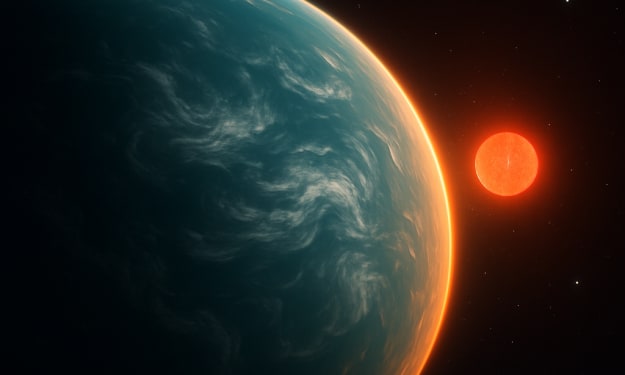
A Potentially Habitable Exoplanet Around the Red Dwarf LHS 475c
The search for life beyond Earth has taken an exciting leap forward. For decades, astronomers have scanned the skies for rocky planets orbiting distant stars, hoping to find one with the right conditions to host life. Now, the James Webb Space Telescope (JWST) has delivered a groundbreaking discovery: a rocky exoplanet orbiting the red dwarf LHS 475, known as LHS 475c, shows signs of an atmosphere containing carbon dioxide and clouds. This finding not only reshapes our expectations of red dwarf planets but also adds a compelling candidate to the list of potentially habitable worlds.
By Holianyk Ihor4 months ago in Futurism
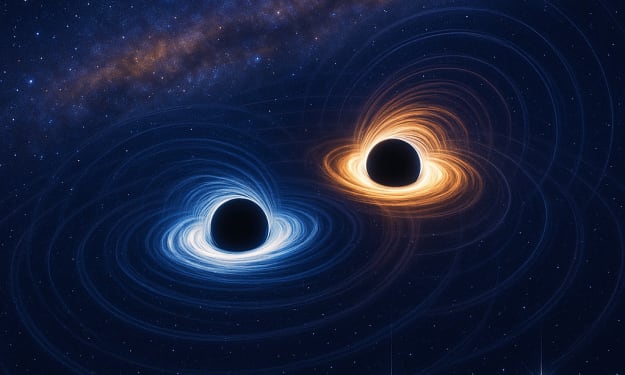
The First Map of Low-Frequency Gravitational Waves: Listening to the Universe’s Deepest Echoes
Astronomy has always been about looking deeper into space, but today, scientists are learning to listen as well. The cosmos does not only shine; it hums, vibrates, and resonates with invisible waves. And in 2025, for the first time, astronomers have created a map of low-frequency gravitational waves—a faint but persistent background signal produced by the slow, titanic mergers of supermassive black holes across the Universe.
By Holianyk Ihor4 months ago in Futurism
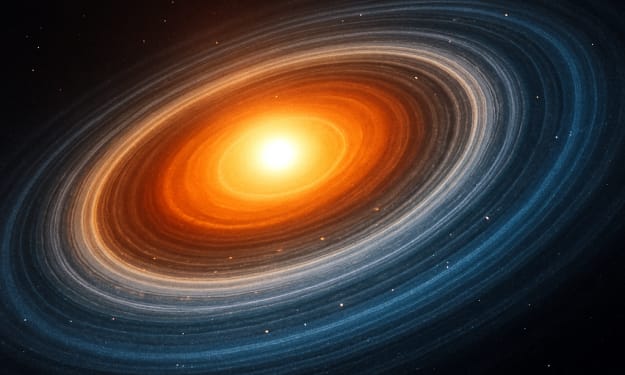
Cold Water Molecules Found for the First Time in a Protoplanetary Disk
When astronomers search for water in space, they usually expect to find it close to stars, where it exists as hot vapor, or locked away as ice on distant comets and asteroids. But a groundbreaking discovery has changed that view: for the first time, scientists have detected “cold” water molecules in the outer regions of a protoplanetary disk — exactly where icy worlds may be forming.
By Holianyk Ihor4 months ago in Futurism
The Tasmanian Tiger’s DNA Reveals a Hidden Extinction Story
The thylacine, often called the Tasmanian tiger because of its striped back, was a unique carnivorous marsupial. It looked like a dog with a pouch and once roamed across Australia, Tasmania, and New Guinea. Sadly, the species was declared extinct in 1936, when the last known thylacine died in Hobart Zoo.
By Muzamil khan5 months ago in Futurism
Future-Proof Yourself in 2025: 10 Powerful Skills You Must Master to Stay Ahead
Introduction: Why 2025 Demands New Skills The world is changing faster than ever. Automation, artificial intelligence, global remote work, and digital entrepreneurship are redefining how people succeed. In 2025, it’s not just about working hard — it’s about working smart with future-proof skills. This guide reveals the 10 most powerful skills you must master to stay ahead of the curve, increase your earning potential, and thrive in any career path.
By KAMRAN AHMAD5 months ago in Futurism
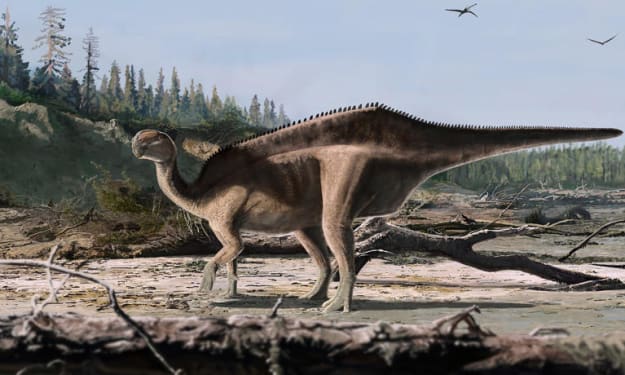
A Dinosaur with Sail Discovered on Isle of wight
A Striking New Find Imagine walking along the Isle of Wight’s beaches in southern England and stumbling upon fossils from a creature that lived 125 million years ago. That’s exactly what happened with the discovery of Istiorachis macarthurae, a new species of dinosaur. What makes this herbivore special is a sail-like structure running along its back and tail a feature that has sparked excitement and debate among paleontologists. This dinosaur belongs to the iguanodontians, a group of plant-eating dinosaurs closely related to the well-known Iguanodon. Unlike most of its relatives, however, Istiorachis stands out with its exaggerated neural spines that formed the “sail.”
By Muzamil khan5 months ago in Futurism
"The AI-Powered Workday: How Artificial Intelligence Is Redefining Productivity in 2025"
Introduction: The Quiet Takeover of AI in Everyday Work In 2025, artificial intelligence isn’t a distant concept discussed in tech conferences — it’s part of your morning routine before you even finish your coffee. From drafting emails to managing schedules, AI has quietly become the backbone of modern productivity. For professionals across industries, the question isn’t if AI will change the way they work — it’s how fast and how far the transformation will go.
By Tousif Arafat5 months ago in Futurism
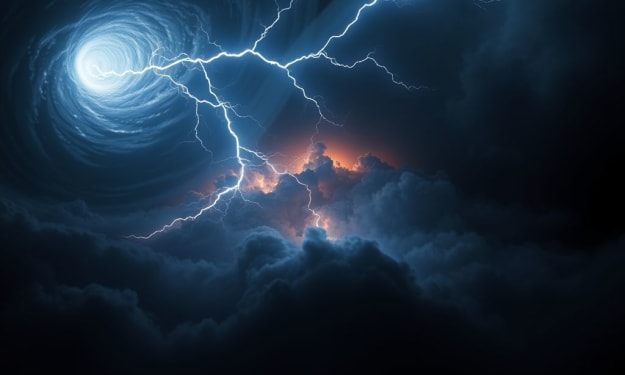
How Electric Discharges Form in the Atmospheres of Other Planets
When we hear the word lightning, we usually picture a blinding flash slicing through a stormy sky, followed by a deafening roll of thunder. On Earth, lightning is a familiar natural spectacle. But beyond our planet, electric discharges can be far stranger, far more powerful, and, in some cases, even dangerous.
By Holianyk Ihor5 months ago in Futurism