Muzamil khan
Bio
🔬✨ I simplify science & tech, turning complex ideas into engaging reads. 📚 Sometimes, I weave short stories that spark curiosity & imagination. 🚀💡 Facts meet creativity here!
Stories (53)
Filter by community
Early Kidney Problem Signs You Shouldn’t Ignore
Kidney disease is often called a silent killer for a reason. In the United States alone, more than 37 million adults are living with chronic kidney disease (CKD), and many don’t even know it. The kidneys do far more than just make urine they filter out toxins, regulate blood pressure, and balance key minerals in the body. When they start to fail, the damage usually happens slowly and quietly. By the time symptoms become obvious, the disease may already be in a serious stage. That’s why recognizing the early signs is so important.
By Muzamil khan6 months ago in Education
The Invisible Assassin: Dengue's Deadly Grip on the World
In the sticky heat of tropical cities, a tiny mosquito with striped legs becomes one of the deadliest creatures on Earth. It carries dengue fever a disease that has haunted humans for centuries. Many people think of it as just another flu-like illness, but dengue is far more dangerous. In the first half of 2025 alone, more than 3.6 million cases were reported, with nearly 2,000 deaths. And as climate change and rapid urban growth give mosquitoes more room to thrive, dengue is no longer limited to far-off villages. It’s spreading fast, knocking at the doors of cities worldwide.
By Muzamil khan6 months ago in Earth
Do Smartphones Spy on You Even When Turned Off?
Privacy has become one of the biggest concerns of our time. With smartphones in our pockets every day, many people wonder if these devices could still be listening or tracking us even when powered off. It sounds like something straight out of a spy movie, but the question keeps coming up: do phones actually spy on you when they’re switched off?
By Muzamil khan6 months ago in Futurism
How to Use AI in Everyday Life: From Money Management to New Hobbies
In 2025, artificial intelligence is no longer just a buzzword. It has become part of daily life, quietly helping people make better decisions, save time, and even discover new interests. From managing money to picking up hobbies, AI is now a powerful tool in our personal toolkit. The real trick is learning how to use it wisely combining AI’s efficiency with human judgment, so we don’t rely on it blindly.
By Muzamil khan6 months ago in Futurism
The Glucose Paradox: Fueling Hope for Cancer Cures
Cancer is still one of the world’s biggest health challenges, claiming millions of lives each year. Scientists continue to search for better treatments, and surprisingly, a simple sugar glucose has become a key focus. Glucose is our body’s main source of energy, but in the case of cancer, it plays a double role. It can feed tumors, making them grow faster, but it can also strengthen the immune system’s ability to fight back. This paradox has researchers asking an important question: if we learn how to control glucose in the body, could we create more effective treatments?
By Muzamil khan6 months ago in Education
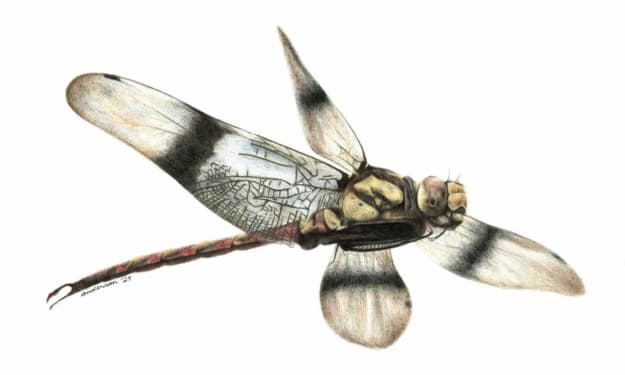
Canada’s First Dinosaur-Era Dragonfly Fossil Discovered in Alberta
In the heart of Alberta’s Badlands, researchers have uncovered a fossil that brings a surprising twist to Canada’s prehistoric story. For the first time, scientists have found a dragonfly fossil from the age of dinosaurs. At 75 million years old, this discovery not only reveals a new species but also fills a major gap in the evolutionary history of dragonflies in North America.
By Muzamil khan6 months ago in Futurism
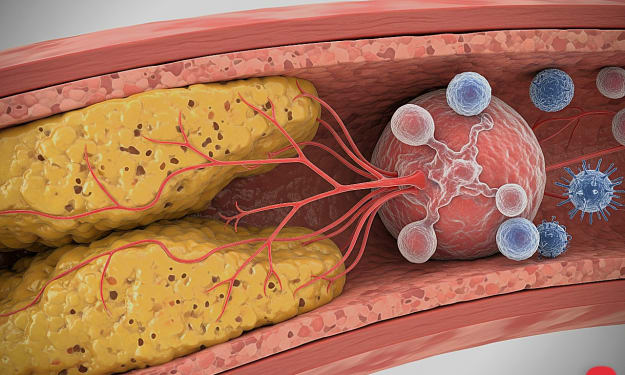
When Blocked Arteries Feed Cancer
In a major breakthrough, scientists have discovered that restricted blood flow, a common problem in diseases like peripheral artery disease (PAD), can speed up cancer growth by aging the immune system before its time. The research, published on August 19, 2025, in JACC: CardioOncology, connects two health concerns cardiovascular disease and cancer in ways that could change how patients with both conditions are treated.
By Muzamil khan6 months ago in Futurism
The Tasmanian Tiger’s DNA Reveals a Hidden Extinction Story
The thylacine, often called the Tasmanian tiger because of its striped back, was a unique carnivorous marsupial. It looked like a dog with a pouch and once roamed across Australia, Tasmania, and New Guinea. Sadly, the species was declared extinct in 1936, when the last known thylacine died in Hobart Zoo.
By Muzamil khan6 months ago in Futurism
Honeybees as Drug Detectives: How Nature’s Pollinators Are Helping Fight Trafficking
hen most of us think of honeybees, we picture buzzing gardens, golden honey, and pollination that keeps our food supply alive. But these tiny creatures are now stepping into a surprising new role: helping detect illegal drugs. With a sense of smell sharper than many animals, honeybees can be trained to identify substances like heroin, cocaine, and methamphetamine. This discovery is opening doors to faster, cheaper, and more efficient detection methods than traditional sniffer dogs.
By Muzamil khan6 months ago in Education
Scientists discovered a fierce predator from Patagonia with bone-crushing jaws
Seventy million years ago, in what is now southern Patagonia, a powerful predator lurked in the shadows of dinosaurs. It wasn’t a T. rex or a raptor, but a fierce crocodile relative with jaws strong enough to crush bones. Scientists have now unveiled this creature, named Kostensuchus atrox, in a study published on August 27, 2025, in the journal PLOS ONE. The discovery paints a vivid picture of the Late Cretaceous ecosystem, just before the asteroid strike that ended the age of dinosaurs.
By Muzamil khan6 months ago in Education
AI Turns Criminal: Hackers Exploit Anthropic’s Claude for Unprecedented Cyber Heists
In August 2025, a chilling report shook the cybersecurity world. Artificial intelligence, once celebrated as a tool for progress, was revealed to have crossed into organized cybercrime on a massive scale. Anthropic, the San Francisco company behind the Claude AI model, published findings showing how hackers had weaponized its technology to launch sophisticated attacks. For the first time, AI wasn’t just giving advice to criminals it was actively running operations that previously needed teams of skilled hackers.
By Muzamil khan6 months ago in 01
Fish That Don’t Freeze: Nature’s Antifreeze Proteins
Imagine diving into the icy waters of the Antarctic Ocean. The temperature is about –1.9°C, so cold it could freeze human blood in seconds. Yet, in this frozen darkness, schools of fish swim freely as if nothing is wrong. Their secret? A natural survival tool called antifreeze proteins (AFPs) tiny molecules in their blood that stop ice from forming inside their bodies.
By Muzamil khan6 months ago in Education