
The Tasmanian Tiger’s DNA Reveals a Hidden Extinction Story
What ancient genetic weaknesses and human pressures combined to wipe out one of nature’s most mysterious predators

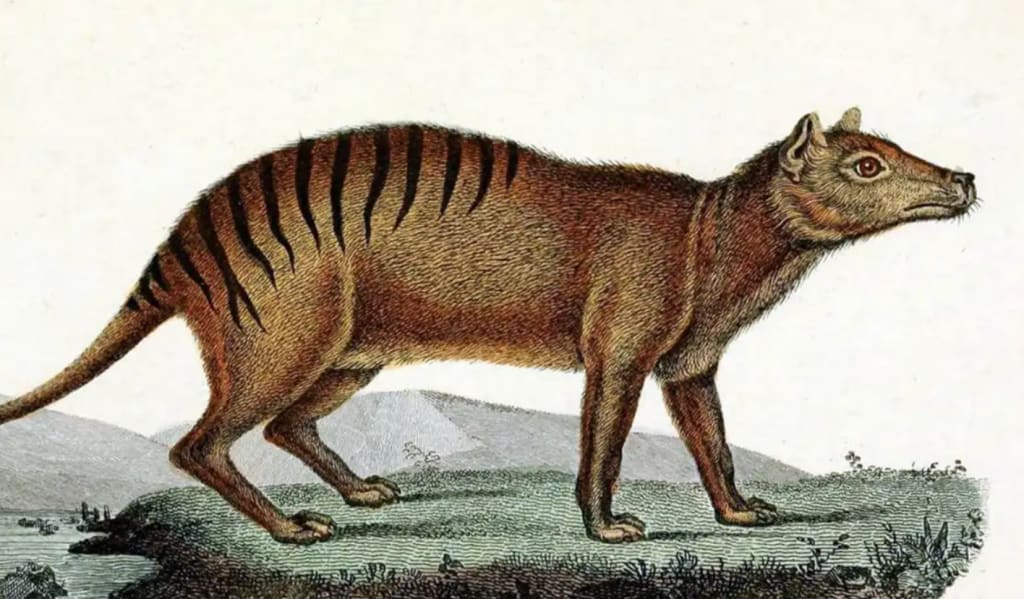
The thylacine, often called the Tasmanian tiger because of its striped back, was a unique carnivorous marsupial. It looked like a dog with a pouch and once roamed across Australia, Tasmania, and New Guinea. Sadly, the species was declared extinct in 1936, when the last known thylacine died in Hobart Zoo.
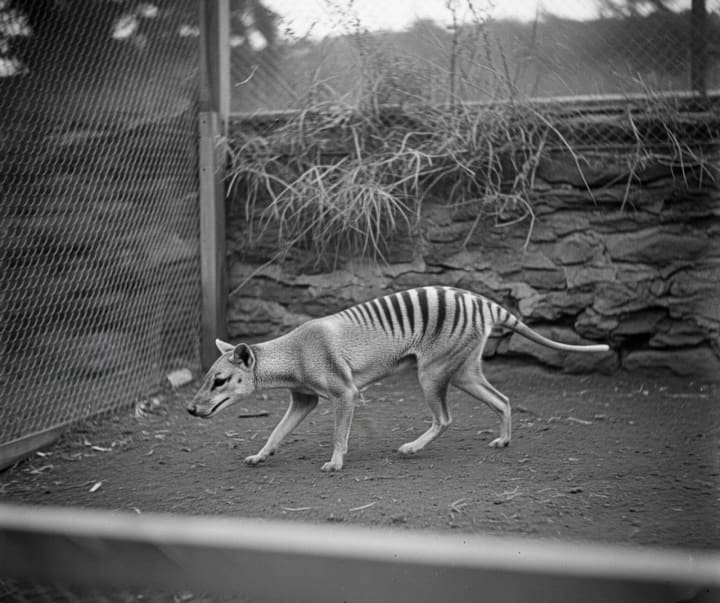
For a long time, people blamed its disappearance almost entirely on human actions. Bounty hunting in the 1800s and early 1900s wiped out large numbers, while habitat destruction and competition with dingoes made survival even harder. But new research shows the story is more complicated. The thylacine may have been struggling long before people arrived, due to genetic weaknesses that made it especially vulnerable.
Ancient Weaknesses in the DNA
In recent years, scientists have turned to the thylacine’s DNA for answers. In 2017, researchers managed to sequence its genome using a preserved pouch young specimen. What they found was striking: the species had very low genetic diversity, meaning individuals were too genetically similar to one another. This problem likely began 70,000 to 120,000 years ago, during the Ice Age. Such low diversity made the species less adaptable, more prone to disease, and less able to cope with sudden environmental shifts. This discovery suggested the thylacine was already fragile long before humans entered the picture. The seeds of its extinction had been planted thousands of years earlier.
A Deeper Look into Lost Genes
A new 2025 study dug even deeper into the thylacine’s genetic history. Using machine learning and comparisons with other marsupials like the Tasmanian devil, researchers discovered that the thylacine had lost four important genes sometime between 13 million and 1 million years ago. These genes SAMD9L, HSD17B13, CUZD1, and VWA7 played roles in immunity, metabolism, lactation, and overall health.
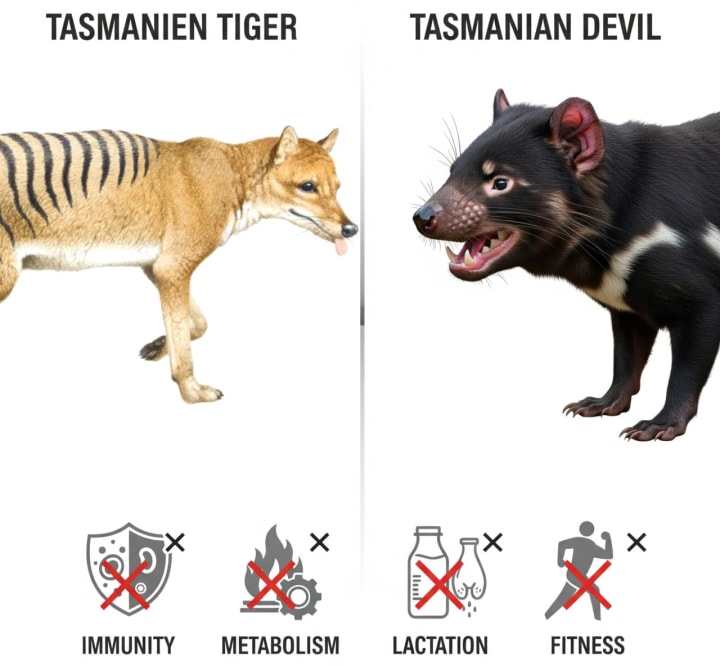
The absence of these genes may have been linked to the thylacine’s evolution into a hypercarnivore, meaning it relied almost entirely on meat for survival. While this shift made sense in its ancient environment, it also left the species less resilient. Interestingly, the Tasmanian devil, which survived despite facing similar pressures, still carries these genes perhaps giving it an edge.
Senses, Hunting, and Survival
The study also revealed that the thylacine had fewer olfactory receptor genes and a smaller olfactory lobe in its brain. In simple terms, it didn’t depend much on smell for hunting. Instead, it probably relied more on sharp eyesight and hearing. While this might have been fine in earlier times, it may have become a disadvantage later when prey grew scarce and habitats fragmented.
Disease and Human Pressure
Historical reports suggest that thylacines may have also suffered from disease. In the early 1900s, observers described a “distemper-like” illness sweeping through populations. Without strong immune genes like SAMD9L, the animals might have been especially vulnerable. Still, disease alone wasn’t enough to cause extinction. Combined with hunting, competition from dingoes, and shrinking habitats, it was the final blow.
Lessons for Today
The story of the thylacine is not just about what happened in the past. It also provides lessons for the future. By showing how long-term genetic weaknesses contributed to its downfall, scientists emphasize the importance of monitoring genetic health in endangered animals. For example, the Tasmanian devil today suffers from a contagious cancer known as facial tumor disease, and understanding its genetic resilience is vital to saving it.
The thylacine’s DNA has also sparked debate around de-extinction. Some companies, like Colossal Biosciences, are working on reconstructing its genome to explore the possibility of bringing it back. But whether we should do that is another question, as ethical and ecological concerns remain.
A Complex Extinction Story
The extinction of the thylacine is often seen as a simple case of humans driving a species to disappearance. But its genome tells a deeper story. Ancient genetic bottlenecks, lost genes, disease vulnerability, and ecological changes all combined with human pressure to seal its fate. This reminds us that extinction is rarely caused by one factor alone. It is often the result of multiple stresses building up over time. And it highlights why protecting biodiversity today means not just saving animals from hunting or habitat loss, but also paying close attention to their genetic health.
About the Creator
Muzamil khan
🔬✨ I simplify science & tech, turning complex ideas into engaging reads. 📚 Sometimes, I weave short stories that spark curiosity & imagination. 🚀💡 Facts meet creativity here!
Keep reading
More stories from Muzamil khan and writers in Futurism and other communities.
NASA’s Psyche Spacecraft Captures Earth and Moon from Deep Space
in July 2025, NASA’s Psyche spacecraft turned its cameras back toward Earth and captured something breathtaking a picture of our planet and the Moon from 180 million miles away. From this incredible distance, Earth and its companion appear only as two tiny specks of light, sparkling against the stars. While this may look simple, it’s a remarkable achievement that serves both as a scientific test and a humbling reminder of our place in the universe. This moment instantly recalls the famous “Pale Blue Dot” image taken by Voyager 1 decades ago, showing Earth as a fragile dot in the vastness of space.
By Muzamil khan5 months ago in Futurism
About Binding Prometheus
I want to start actively advocating on behalf of my own work, and the most valuable part of my canon is, without a doubt, Binding Prometheus, the play I have been working on since 2019 and only finished in 2023 as part of my MA. The play itself is an amalgamation of a million different inspirations. On one end, it evokes the Ancient Greek myth-play, deriving its own title from the earliest extant work of Western drama we have, Aeschylus’s Prometheus Bound. On the other end, it borrows significantly from the sci-fi bulwarks from over the years, namely Mary Shelley’s Frankenstein and Karel Capek’s Rossum’s Universal Robots. The play could be an episode of Black Mirror, I fear. I don’t know. I’ve only ever seen one episode of Black Mirror.
By Steven Christopher McKnight18 days ago in Futurism
Japan LED Modular Display Market Size & Forecast 2025–2033
Japan LED Modular Display Market at a Glance The Japan LED Modular Display market is anticipated to grow to US$ 1,009.54 million by 2033, rising from US$ 380.54 million in 2024, registering a robust CAGR of 11.45% during 2025–2033. This growth is driven by the increasing demand for high-resolution digital signage across retail, transportation, entertainment, and public infrastructure, combined with the adoption of energy-efficient, customizable display systems for Japan’s expanding smart city initiatives.
By Aaina Oberoi3 days ago in Futurism
Miss Persephone's Manual to a Seemingly Ordinary Life
Miss Persephone was found at the dining table, her blue eyes swollen, her tears arriving and retreating like the tides of the ocean. Earlier that day, her family had visited her in the retirement home where she had lived for eight years. It was her eightieth birthday.
By Imola Tóth4 days ago in Fiction



Comments
There are no comments for this story
Be the first to respond and start the conversation.